Nightmare Revisited
From what I’ve heard, Cambodians old enough to remember the "Pol Pot time" (1975 to 1979) are pretty much just trying to forget about it and get on with their lives.
However, since my first visit to Cambodia in 2004 I’ve continued to be haunted by thoughts of what happened during the rule of the Khmer Rouge. Last year I went to the infamous S-21 Tuol Sleng Interrogation Center and the killing fields at Choeng Oek, and can't forget what I saw. How could such atrocities have happened? How could Cambodians treat each other this way? It's especially troubling considering that Cambodia today is such an enjoyable place to visit; and Cambodians seem so hospitable.
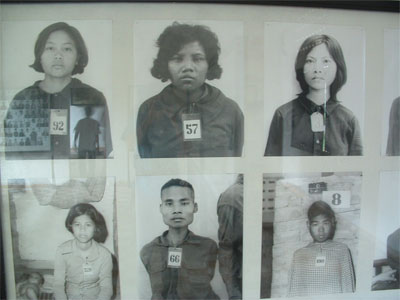
Portraits of murdered victims at S-21 Interrogation Center, Phnom Penh.
I’ve avoided re-visiting either of those locations on this trip, but I have done some reading. Two books have been excellent:
The Pol Pot Regime: Race, Power, and Genocide in Cambodia Under the Khmer Rouge, 1975-79 by Ben Kiernan.
Published in 1996, the back cover of this book calls it "the first comprehensive study of the Pol Pot regime." Through the use of five hundred interviews with survivors, the author provides a detailed chronology of the Khmer Rouge rise to power, the 1975 evacuation of Phnom Penh and other cities, and the attempt during the ensuing four years to build a totalitarian agrarian utopia. He concludes with a chronicle of the internal resistance movement, and the Vietnamese invasion of late 1978 that ended the regime.
Mr. Kiernan believes that the most important themes in the history of the Pol Pot regime are the race question (esp. their xenophobic hatred of the Vietnamese) and the struggle for central control of the revolution. He makes the argument that these issues are what brought down the Khmer Rouge revolution. He considers the Khmer Rouge as guilty of genocide for the number of Cambodians who died during the period, which he estimates at 1.5 million (about 20% of the estimated 1975 population of 7.9 million.)
The author implicates the "secret" United States bombing and invasion of Cambodia during 1970-1975 as significant factors in the coming to power of the Khmer Rouge.
Cambodia 1975-1982 by Michael Vickery.
First published in 1984 and then updated in 1999, this book provides a different interpretation. Also relying on hundreds of first-hand interviews, the author focuses on clarifying what he considers gross inaccuracies by other authors about the Khmer Rouge reign.
First of all, he offers what he calls the "Standard Total View" (STV): This view, promoted by the western press, is based on incomplete and selective evidence, and holds that the Democratic Kampuchea (DK) leadership (the so-called "Pol Pot regime"):
Tried to exterminate all those who had held military or civilian government posts during the previous administrations (Sihanouk and Lon Nol periods);
Abolished schooling, medical care and religion;
Sought to destroy the Cambodian family;
Deliberately deprived the population of a decent diet in order to cause large numbers of deaths;Targeted ethnic minorities for extermination (genocide.)
While acknolwledging widespread brutality by the DK leadership, Mr. Vickery makes the case that rather than being driven by blind fanaticism, the DK leadership at least had rational bases for most of their actions; but they were carried out badly resulting in disastrous consequences for the population. For example, during the evacuation of Phnom Penh during April 1975, the refugee-swollen population of two million was forcibly dispersed to the countryside. The STV claims that this evacuation was carried out in a brutal manner characterized by countless summary executions and atrocities. The author points out that when the Khmer Rouge entered Phnom Penh following a prolonged siege, there was virtually no food, medicine or doctors in the city; so in hindsight it seems at least reasonable that the forced evacuation of the city was prudent to prevent mass starvation and the spread of disease. He also provides testimony by a number of evacuees who experienced the evacuation as a fairly orderly process, and who witnessed no accompanying brutality or executions.
Thus, he makes the case that the STV is not an accurate reflection of what really happened during the Pol Pol time.
The author makes these additional points:
The Cambodian revolution was first of all a victorious peasant revolution, perhaps the first one in modern times, and exhibited none of the qualities which would characterize a Marxist revolution. Thus the revolution was populist, peasant-based rather than proletarian, and fiercely anti-intellectual.
The peasant-populist nature of the revolution explains why the DK leadership initially received broad support among the peasants who comprised the bulk of Cambodian society. The historic exploitation of the peasants by the wealthy explains their acquiescence to the relatively harsh treatment meted out to former urban dwellers. Thus, according to Vickery, "The excesses of DK, then, did not spring from the brains of Pol Pot or Khieu Samphan and are certainly not because they 'learned their revolutionary theory in Paris.' Nor were these excesses the result of reading, or misreading, Marx, or due to Stalinist or Maoist influences. They lay in the very nature of a peasant revolution, which was the only kind of revolution possible in Cambodia."
Cambodian culture has a tradition of violent social mores, with a documented history of gratuitous violence as a means of dealing with enemies; this explains in part the brutal history of the revolution;
Mr. Vickery estimates the number of excess deaths from starvation or executions during the DK period at 740,000 (about 10% of the population.)
Finally, he harshly criticizes the United States not only for bringing the Indochina War to Cambodia, thus helping to create the conditions for the Khmer Rouge ascent to power in 1975; but also for abruptly switching from criticism of Pol Pot and the DK while they ruled Cambodia, to giving them critical support following their overthrow by the Vietnamese (the latter was the result of residual bitterness towards the Vietnamese for having beaten America in Vietnam.)
There just don't seem to be any easy explanations for the horrors of history.
See also my 2004 webpage about S-21 and Choeng Ek
Return to Chris in Cambodia 2