Our visit to the battlefields of the Peninsular Campaign
At the battle of Seven Pines (May 31-June 1), the Confederates were dealt another of several marginal defeats, and yet they were curiously lucky: their commander, Johnston, was wounded, and General Robert E. Lee was given command of the army.
On July 26th, a minor battle (Mechanicsville) finally turned McClellan's nerve, and he began to retreat from Richmond after being within a mile of the city. Lee had lost more than 4 times the men McClellan had at Mechanicsville, but the Federal commander remained convinced of the strength of the adversary.
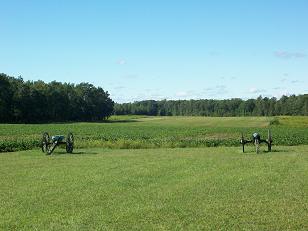
July 27th, the 3rd day of "The Seven Day's Battles," the battle of Gaines Mill was fought. This photo shows the swamp which a combined 100,000 men of both sides faced each other across. This situation was the result of over 4 hours of hard yet indecisive fighting. When Lee finally had all 56,000 of his men at hand, he ordered an all-out assault, the largest charge of the war, across the swamp you see here.
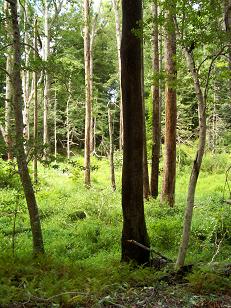
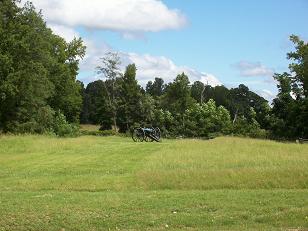
These photos were taken from above the swamp (or, boatswain as it is called). In the picture looking West, you can see the terrain slopes down into the trees, which is where the boatswain is. The same is true of the picture looking, East, only from an opposite angle of course. The guns you see represent the position of those which would have fired upon Confederate positions across the boatswain.
The charge of almost 60,000 Confederates broke the Federal line, and these guns were soon overrun. The Federals lost close to 7,000 men, the Confederates 9,000. But the successful charge ordered by Lee would be the event that give him confidence in his men to the point of a rash decisions, which was manifested at Gettysburg.
Over the course of the next several days, Lee attacked again and again. Inexplicably, Lee's generals displayed a incompetence which continually robbed Lee of the major victory he sought. He was tactically victorious again and again, leaving McClellan completely unwilling to go on the offensive.
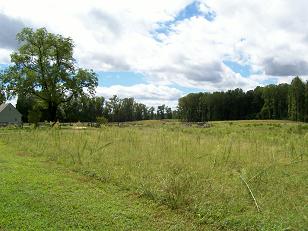
At Malvern Hill, July 1st, the last of the 7 Days Battle's commenced. Lee foolishly sent his men against a very strong Federal position atop Malvern hill, and at the apex of the Federal position, (the photo shown here), the Confederates, marched accross a lengthly field of fire, and yet never came close to breaking the line. Said Confederate commander D.H. Hill, "It was not war, it was murder."