
1st Manassas
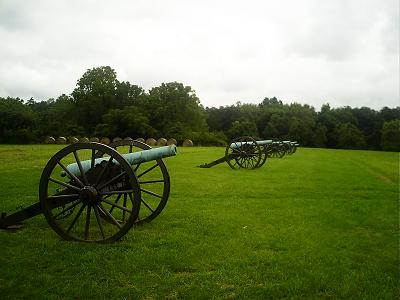
General McDowell was able to mobilize his army much early than Beauregard (the Confederate) commander. Feinting to the center, the main attack fell instead on the Confederate left flank, from the North.
These guns represent the position of Federal rifles when the battle began. They fired upon the Confederate flank.
These guns are not rifles, but Napoleons (smoothbores) which were used mostly for short range, messy work.
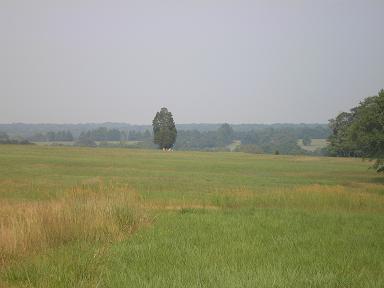
Matthews Hill, where the Federal attack began, can be seen in the backround. The Confederates retreated from the Federal advance. In this photo, imagine canon firing from the ridge in the background, and a rabble of Grey followed by disjointed lines of blue, slowly climbing towards you.
The Federals soon took the pinnacle of the hill, placing guns there in support.
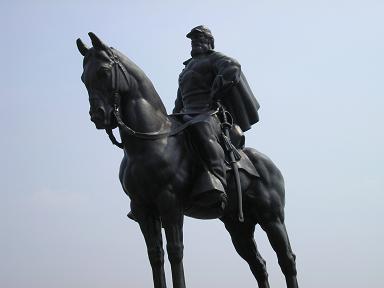
General Jackson earned his nickname "Stonewall" at this spot. While other brigades retreated, his would not, and he thereby managed to rally the retreating troops behind his brigade.
The blue uniforms of Jackson's brigade confused the Federal gunners, and so they weren't fired on until it was too late. The Confederates captured the guns and took the hill. With the aid of timely reinforcements, the Confederates turned a disastrous retreat into a rout of the Union army.
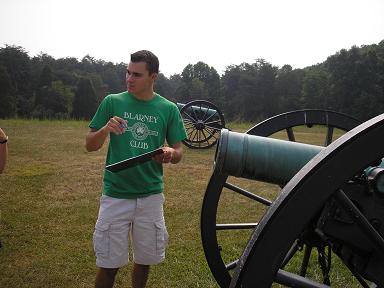
Here I am standing by the guns which supported Jackson's advance upon the hill.
These guns are also Napoleons, but they're probably accurate to what was used in this situation: They're targets would have been about 100-300 yards away, not the 1/2 mile which rifles guns specialized in.
The Peninsular Campaign was both the enagagement aforementioned, as well as the next visit in our tour of the Eastern Civil War battlefields.
