By Jason Pratt
The national debt is a constant source of anguish for concerned Americans and economists, and rightly so. It�s persistently higher � both in real terms and as a percentage of GDP � than it ever has been, save the few years we were fighting World War II. Year after year, Federal deficits mean that Congress spends more than it takes in, and borrows the rest, ratcheting the debt even higher. On top of that, the interest payments continue to grow as the debt grows, and they take a bigger and bigger chunk from the Federal budget each year. There seems to be no way to ever pay the off. Looming over us at nearly $7 trillion, the debt threatens our standard of living, our way of life, and the wealth and prosperity we hope to bequeath to our grandchildren.
But is it really that big of a deal? After all, life seems normal to the average American, who goes about his daily routine as if there was no debt burden. If it�s such a problem, why hasn�t the world ended? Aren�t we just going to pay this big debt off one day, making the whole concern irrelevant? And what if we don�t?
This chapter addresses those questions. In summary, the national debt is a giant and growing problem facing Americans who live today, and those who have not yet been born. It is a true debt in every sense of the word. It must be repaid � and not just �to ourselves� as many argue. It�s possibly the biggest legacy of the 20th century United States, and the largest financial mess this nation will ever have to clean up. In short, the debt is a measure of how we�re doing as a country at living within our means, ensuring freedom and limited government, and protecting our future posterity. And the score doesn�t look so good.
THE DEBT: AN OVERVIEW
The day before President Bush signed the tax cut of 2003, he quietly and without ceremony signed another piece of legislation that raised the legal debt ceiling for the United States by $984 billion. He did this because his Administration knew that the tax cuts were going to pass, and if they did, the country would need to borrow money. Tax cuts are generally a good thing for the economy, but unless spending is reduced along with them, they mean only more debt. When presented with the bill for his tax cut, Bush essentially whipped out the credit card.
According to the Bureau of the Public Debt, the current debt
(including what the government calls �intragovernmental
 holdings�)
is around $6.54 trillion in June of 2003, and is expected to rise to well over
$7 trillion in the next few years. Each time we get close to the legal ceiling,
Congress and the President just raise the ceiling and keep on borrowing. The
debt has been steadily increasing since the early 1970s, not coincidentally the
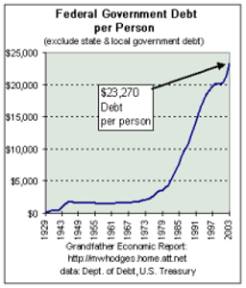
era in which Nixon repudiated the gold standard. Figure 1 demonstrates that the
federal debt equates to $21,777 per man, woman and child in the U.S at the end
of 2002. My 5-year old daughter already owes $21,777 to those who hold the
Federal debt. So does my 1-year old son, who doesn�t even have any money yet.
My wife and I each do, too. Actually, we all owe more than that, since we�re
now almost through 2003. And what about that alarming uptick
at the end of the chart?
holdings�)
is around $6.54 trillion in June of 2003, and is expected to rise to well over
$7 trillion in the next few years. Each time we get close to the legal ceiling,
Congress and the President just raise the ceiling and keep on borrowing. The
debt has been steadily increasing since the early 1970s, not coincidentally the
era in which Nixon repudiated the gold standard. Figure 1 demonstrates that the
federal debt equates to $21,777 per man, woman and child in the U.S at the end
of 2002. My 5-year old daughter already owes $21,777 to those who hold the
Federal debt. So does my 1-year old son, who doesn�t even have any money yet.
My wife and I each do, too. Actually, we all owe more than that, since we�re
now almost through 2003. And what about that alarming uptick
at the end of the chart?
All this doesn�t count state, local, and private debt � which adds another $30 trillion or so on top of the $6 trillion in current Federal debt and an additional, unbelievable $40 trillion in Federal unfunded liabilities (made up of future Medicare and Social Security benefits yet to be paid), per a recent report from the U.S. Treasury Department., for a total of $76 trillion in debt � over ten years of production for the entire U.S. economy! �It would take us ten years of exporting everything we produce, eating nothing and buying nothing (obviously impossible even for ten days, much less ten years) to pay that debt.
What are the potential consequences of a huge and growing national debt? First, whether we pay off the debt or not, interest rates will trend higher as the amount of public debt �crowds out� private credit markets and reduces the amount of capital available for private loans. While we thought 18% prime rates were bad in the 1970s, we really haven�t seen anything yet, if the debt trend continues.
Second, taxes will have to increase to keep paying the interest and principal on the debt. There�s no way to keep borrowing money, lower taxes, and simultaneously reduce the debt. Most people feel like their Federal income taxes are high enough, and the prospect of raising them by the amount needed to pay off the debt in any reasonable timeframe is enough to cause a revolt.
As taxes and interest rates increase, the cost of living for the average working family goes through the roof. Therefore, the standard of living that the average American enjoys drops as the debt crisis escalates. Fewer vacations, smaller houses, older cars, and fewer educational opportunities for the kids � this is not the stuff of the American dream.
There are only a few choices we have for getting out of this
pickle, and most of them aren�t easy to face. The most important task is to
drastically reduce Federal spending. If you don�t turn off the water, it makes
no sense to start draining the bathtub. Congress must reign in its amount of
spending if we�re ever to get back on track to fiscal responsibility.
Unfortunately, if you�ve been watching
Lowering spending is the common sense, logical part of the solution. The remainder of it is more politically charged, controversial, and unproven. There are several options: we could inflate the currency so much that the debt payments are easier to pay, but in doing so we incur even more debt for the future and we wreck the livelihood for many Americans, especially savers and the elderly. Social Security and Medicare have a hard time keeping up with high inflation. Most observers think the Fed has learned that this isn�t the right way to handle the debt problem.
We could repudiate the debt � tell our debtors that we�re
not going to pay. This would shake the very foundations of the world economy
and would quite likely spell the end of the
Many say we can just grow ourselves out of the debt by
producing and exporting goods and services to people in other countries, who
will pay us for them in dollars, which we can then use to pay down the debt.
That�s theoretically possible. But in reality, we�re importing much more than
we are exporting, measured by the
The only real option is to pay it off �fair and square� � keeping inflation low but paying the debtors the money we owe them. The sooner we get this behind us � and swear off persistent debt in the future � the better our future will be. It makes no sense to do this if Federal spending is still so high that we have to borrow more to pay today�s bills.
Some intrepid economists and politicians argue that debt is a good thing and has valuable properties, for example smoothing out the economy. It�s true that debt has a useful purpose in the economy, but like the old saying, too much of a good thing is not good. How much is too much? Nobody knows for sure, but if the only way to find out is to keep borrowing until we break the bank, then the average American is in for a financial shock unlike anything he�s ever experienced. It would be an encouraging sign if the debt went down, even a little bit, even for a little while. A debt that only goes up should worry even the biggest spendthrift.
THE DEBT AND MONEY
Now here�s some irony: it�s a good thing that we have all this debt, because without it we�d have no money. Our Federal Reserve money supply is entirely debt-based, meaning that if the debt were all repaid, the money would disappear. [1]This is an unbelievable and fascinating by-product of the money system we use in this country, indeed worldwide. It practically requires a large and growing national debt in order to function. The Federal Reserve finds that if it doesn�t keep growing the money supply, the economy falters. So Congress obligingly raises the debt ceiling year after year (like they did just recently), and economists concoct all sorts of reasons why the market is �demanding more liquidity� or �pricing in inflationary expectations.� What�s actually happening is that the debt machine needs to be fed with more debt, or else interest payments dry up, for the simple reason that when money is created as debt, the money to pay the interest payments is not created! Without a steady stream of increasing debt, the whole monetary system will collapse. At some point, maybe those who hold the debt might see this, get nervous and ask for repayment. We can hope that they don�t.
Many ask what our money is. Is it backed by debt, based on
debt, or is it debt? The best answer is that a Federal Reserve Note (FRN) is evidence of debt. It isn�t backed by
anything, because to be backed, an instrument must promise payment in something
� the backing. With the FRN, the holder of it owns no identifiable piece of the
national debt, and so there is no debt backing. Likewise, it is not actually debt in the sense that the bearer owes
or is owed something; because the debt is owed to investors and central banks by
the Federal government. The bearer of a dollar bill might be a French citizen,
and therefore isn�t obligated by the
The FRN is a piece of evidence that there exists on the
books of the Federal Reserve one dollar in debt owed by the
So who do we owe all this debt to? We owe the debt to those who buy Treasury securities; 40% of it is owned to foreign investors and foreign banks. The remainder is held by a mixture of domestic investors and the Federal Reserve System, which is the �guaranteed buyer� of Treasuries for the government. Congress can always count on the Fed to buy its debt, no matter how bad things look. That�s part of what the Fed was created for.
The debt that the FRN refers to is created when Congress authorizes the Treasury to sell debt (bonds) on the open market. The usual buyer of this debt is the Federal Reserve, who literally purchases it with money it prints out of thin air. For no cost other than the cost of printing the FRNs, the Federal Reserve becomes the owner of a valuable security � a government bond � that it can do with what it wishes. This is an amazing power granted to an institution whose members are not elected and whose operations are highly secretive. Any American, whether Democrat, Republican, Green, Libertarian, or independent, should be suspect of such an arrangement.
On top of the debt created directly by the Federal Reserve when it buys government bonds, the commercial banks in the Federal Reserve banking system also create debt-based money called �checkbook money.� When a customer goes to a neighborhood bank for a loan, the money given to the customer is created there, on the spot, from thin air. The only limit to the amount of such �checkbook money� that the bank can create, is the reserve requirement, or the amount of FRN currency the neighborhood bank has deposited at the Federal Reserve. Currently commercial banks need less than ten cents on deposit for every dollar in loans they create.
Many people have a hard time believing that loans from their local bank branch are money created from nothing, but in fact that is exactly what they are. The bank collects interest and principal back on something that cost nothing to produce. This is the awesome money power bestowed by the 1913 Congress on the Federal Reserve system, and because of the inherent tendencies of such a power, the debt load at all levels of the U.S. economy has continually grown over the 20th century, with few exceptions.
Looking today at the private debt programs available to average Americans, ranging from �low-interest� credit cards, high-interest payday loans, 6-months-same-as-cash purchasing arrangements at the local electronics retailer, Visa checks, cash advances, mortgages (adjustable, fixed, 30-year, 15-year, 10-year, 3/1, 5/1, 7/1, and balloon varieties), zero-down car loans, and the myriad other credit arrangements available from financial services outfits popping up around the country, it�s clear that Americans are swimming in debt. We�re up to our eyes in it and we�re financing our high lifestyle today with our children�s future consumption. Our politicians are no different, and are happily spending our future to pay for programs today.
What can be done? Can we avoid traveling further down the
�Road to Serfdom� as Hayek so memorably named this situation? Will our children
live in a socialist tyranny brought on by massive debt collapse? There have
been other societies in history who became dependent on inflation and debt
(most recently
[1] In October 2002, I spoke with Mr. Harvey Rosenblum, Senior Vice President of Research at his office
in the Federal Reserve Bank of