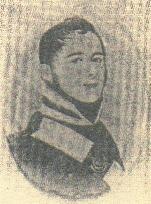
Thomas Laycock, soldier and explorer, was the son of Thomas Laycock and his wife Hannah, and came to Sydney with his mother in 1791.
He entered the New South Wales Corps, and was its tallest officer when he was commissioned ensign in December 1795 and promoted lieutenant in 1802. After serving in turn at Sydney and Norfolk Island, he was sent to Port Dalrymple in 1806 under Captain A.F.Kemp. He was entrusted with dispatches for Lieut-Governor Collins in Hobart Town, and made the first journey across the island, with the object of obtaining relief for the famine stricken northern settlement. With a party of four men and three weeks provisions, Laycock went by way of the Lake River on 3 February 1807 and reached Hobart on 11 February, after penetrating the mountains past Wood�s Lake (first known as Laycock�s Lake) and descending the valley of the Clyde to the Derwent. After four days rest they made the return journey in less than a week but without help for the northern famine, as Hobart was equally short of food. For this service Laycock was rewarded with a cow, then greatly prized because of the shortages of food and livestock.
He returned to Sydney and in January 1808 was a member of the Criminal Court assembled to try John Macarthur whose behavior led to the arrest and deposition of Governor Bligh. Laycock was the only casualty in the Rum Rebellion; while searching Government House he fell through a manhole on to his �principal joint�. Partly because of his support for the new administration and partly as a reward for his exploration, he was granted 500 acres of land at Cabramatta by Lieut-Governor Foveaux, but like all the rebels� grants it had to be surrended when Governor Macquarie assumed office.
Laycock, newly married to Isabella, daughter of Eber Bunker, returned to England with the corps in1810, was promoted Captain in the 98th Regiment in September 1811 and served in the American War. When his regiment returned to Britain Laycock sold his commission and in March 1817 reached Sydney in the Fame with his wife and two children. His wife died in May, and in July at St Phillips Church he married Margaret, daughter of John Connell, merchant, who bore him two more children. He set up a store, opened a hotel and was soon a large supplier of meat to the commissariat. In 1819 he was one of the leading citizens applying for trial by jury in the colony. He died on his estate at Bringelly on 7 November 1823, aged 37.
TAKEN FROM THE AUSTRALIAN DICTIONARY OF BIOGRAPHY. |