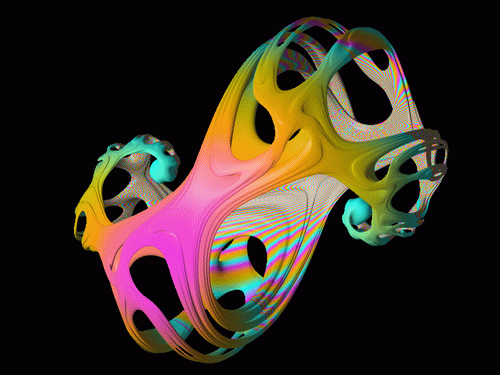
| Some typical questions about fractals are: Just what the hell are they? They're everywhere, those bright, weird, beautiful shapes called fractals. But what are they, really? Fractals are geometric figures, just like rectangles, circles and squares, but fractals have special properties that those figures do not have. What's so hot about fractals, anyway? There are three basic answers to that question: They're New! Most math you study in school is old knowledge. For example, the geometry you study about circles, squares, and triangles was organized around 300 B.C. by a man named Euclid. Much of fractal geometry, however, is much newer. Research on fractals is being carried out right now by mathematicians. You can understand them. Much research in mathematics is currently being done all over the world. Although we need to study and learn more before we can understand most modern mathematics, there's a lot about fractals that we can understand. Fractals often look like objects in nature. Many objects in nature aren't formed of squares or triangles, but of more complicated geometric figures. Many natural objects - ferns, coastlines, etc. - are shaped like fractals. Here you can read about fractals in nature. Imagine the coastline of Africa.You measure it with kilometer-long rulers and get a certain measurement. What if on the next day you measure it with meter-long rulers? Which measurement would give you a larger measurement. Since the coastline is jagged, you could get into the nooks and crannies better with the meter-long ruler, so it would yield a greater measurement. Now what if you measured it with a centimeter-long ruler? You could really get into the teeniest and tiniest of crannies there. So the measurement would be even bigger, that is if the coastline is jagged smaller than an inch. What if it were jagged at every point on the coastline? You could measure it with shorter and shorter rulers, and the measurement would get longer and longer. You could even measure it with infinitesimally short rulers, and the coastline would be infinitely long. That's fractal. Now, the most important person in the fractals field is a man named Benoit Mandelbrot. Click here if you want to read his biography. Here to visit his homepage. What is the Mandelbrot set? A mathematician might say it was the locus of points, C, for which the series Zn+1 = Zn * Zn + C, Z0 = (0,0) is bounded by a circle of radius two, centered on the origin. But most of us aren't mathematicians, so.... a) It's a pretty picture. b) It's a mathematical wonder that we can appreciate, and to some extent understand, even if we don't understand the first paragraph. c) It's just one example of an amazing new science with applications as far ranging as weather forecasting, population biology, and computerized plant creation. d) It's a floor wax and a dessert topping! e) It's all of these and more. One of the fascinating things about the Mandelbrot set is the seeming contradiction in it. It is said to be the most complex object in mathematics, perhaps the most complex object ever seen. But at the same time, it is generated by an almost absurdly simple formula. Multiply Z by itself. Add C. The answer is the new value for Z. Repeat until the absolute value of Z is greater than two, or until our counter expires. If abs(Z) ever exceeds two, then it will very quickly head off towards infinity which means that the point is not in the Mandelbrot set (that's the definition of the Mandelbrot set). These points are typically assigned a colour based on how many iterations were done before abs(Z) exceeded two. If abs(Z) doesn't exceed two after a large number of iterations, then we give up and assume that the initial point is in the Mandelbrot set. These points are typically coloured black. The black, barnacle covered pear is the Mandelbrot set proper - all the bands of colour outside of it are simply curious artifacts that help to expose the detail of the Mandelbrot set itself. |
| "Clouds are not spheres, coastlines are not circles, bark is not smooth, nor does lightning travel in straight lines". Benoit B. Mandelbrot |

|
 |
[ + ] A gallery of (other people's) fractal art [ + ] A gallery of my own art [ + ] Interesting facts about fractals [ + ] Download a program to create your fractals! [ + ] Join a group to share and talk about fractal art |
   |