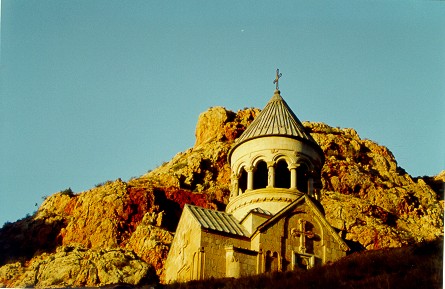
Armenian Religious Sites
Armenia has a very rich religious history. It was the first nation to adopt Christianity as a state religion in 301AD thanks to St. Gregor. This year has been a year long celebration here as it is the 1700th anniversary of said adoption. It has been the cause of many festivals, new buildings/renovations and a recent papal visit. The country is close to 100% Christian which has caused many problems over the years since they are bordered by Turkey, Iran and Azerbaijan, all primarily Muslim countries. Because of it's history, there are many old monasteries and churches scattered throughout the country. The one above is called Noravank, and, if my memory is right, it is from the 13th century and has been recently restored. Another famous site is Mt. Ararat (seen in some of my other pages) where Noah's ark is said to have come to a rest after the great flood.
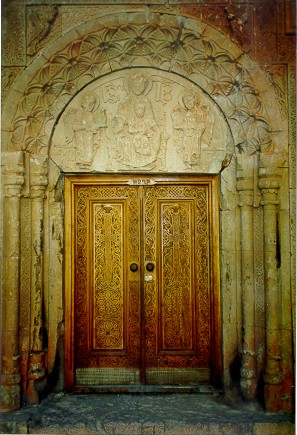
This is the main entrance to the Noravank church. The door is much newer than the surrounding stones, and is very intricately carved. When I was visiting, a little boy of about 12 or so was there giving tours. I expected to be asked to pay at the end, but I found out afterwards that he is there as part of his training. He is studying to become a monk or priest and so is there to practice and to teach visitors about the stories, carvings and buildings.
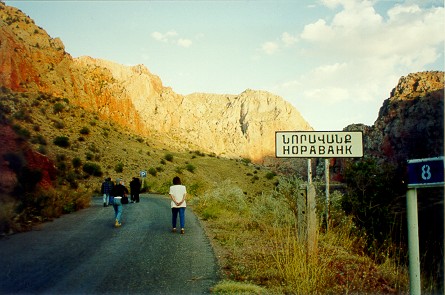
Noravank (Armenian on top, Russian on the bottom) is my favorite monastery that I have visited to date. It is in a valley and is surrounded by red cliffs that were just gorgeous with the setting sun shining on them.
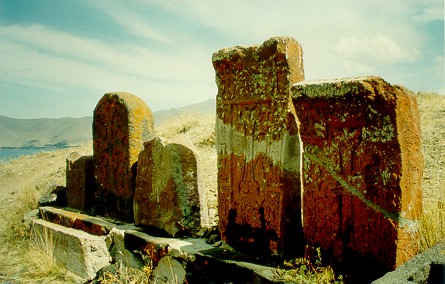
These are found outside two 9th century churches bordering lake Sevan, the only sizable body of water in Armenia. Where they are located used to be an island, but so much water has been drained from the lake for irrigation and other reasons, it is now connected to land. The picture shows some stone crosses, or khachkars, that are from a church that was destroyed in an earthquake. Hatchkars, which can be carved in stone or wood, are found all over Armenia.
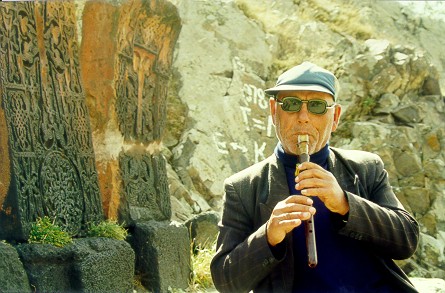
This gentleman is playing an Armenian doduc, a very traditional instrument. It sounds something like a cross between a clarinet and a recorder and is often played with a special sort of drum (whose name slips my mind). I found him near the churches mentioned above. You can also see the khachkars to his left.