A Taste of Armenian Life
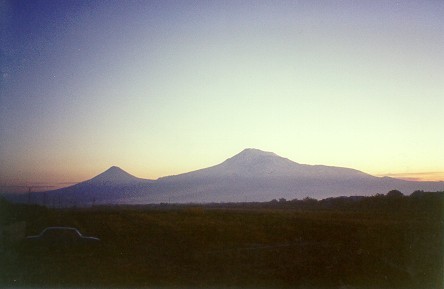
Mt. Ararat at Sunset
This is a picture near the small town of Artashat, about one hour from Yerevan. I spent a weekend staying with a family just outside the town, which is located in the Ararat plains which are a rich source of farming for the country. Mt. Ararat, pictured above, is largely seen as the symbol of Armenia. The only catch is that it is now located inside of Turkey. Armenia used to stretch from the Black Sea all the way over to the Caspian Sea, but through the years, and because of many wars, it has been shrunk down to it's current size. The Turkish border is closed to Armenians and and it is quite a national sore point that the mountain is located outside its borders. Despite being located in Turkey, Armenians say that the mountain is only beautiful when viewed from this side. It is said that when viewed on the other side, from Turkey, it looks as if the mountain has it's back to them, and is not nearly as beautiful. On the right is the "Massis" (5156m), and on the left is the "Sis" (3914m).
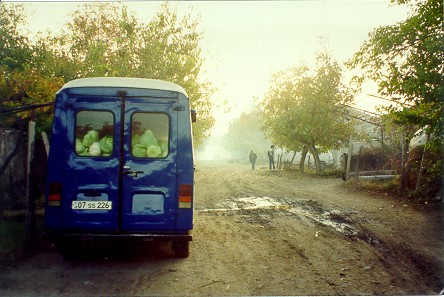
This is an early morning scene near Artashat. The truck is filled (quite literally) with cabbages which will likely be driven into Yerevan to be sold. Here in the Ararat plains, many fruits and vegetables are grown. The majority of people living here survive on farming. Armenian fruits and vegetables are VERY tasty. They are famous for their apricots and many other fruits. I have seen apples the size of grapefruits, grapes the size of walnuts and figs the size of golf balls. While not celebrated outside the country, I think that they should also be known for their tomatoes, which are incredibly juicy and fresh.
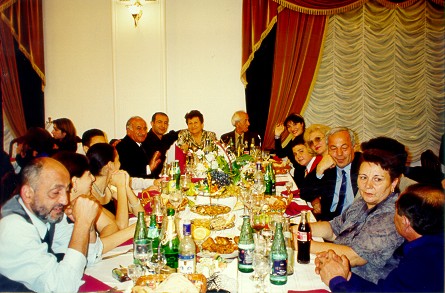 This is my table
at a baptism party I was fortunate enough to
be invited to. There were about 10 tables like this - a party of wedding
proportions. The baptism service was relatively short - about 15 minutes,
but the celebrations went late into the night. The food and drink kept
coming and coming, and by the end I could hardly move. They even got me up
to try Armenian dancing. It wasn't that hard a dance, but was rather nerve-racking
since all eyes in the room were on the un-coordinated westerner trying to dance. Armenians spend a lot of time celebrating, socializing and enjoying
the company of others. They would much rather spend their money on these
types of things than on gadgets or other material possessions.
This is my table
at a baptism party I was fortunate enough to
be invited to. There were about 10 tables like this - a party of wedding
proportions. The baptism service was relatively short - about 15 minutes,
but the celebrations went late into the night. The food and drink kept
coming and coming, and by the end I could hardly move. They even got me up
to try Armenian dancing. It wasn't that hard a dance, but was rather nerve-racking
since all eyes in the room were on the un-coordinated westerner trying to dance. Armenians spend a lot of time celebrating, socializing and enjoying
the company of others. They would much rather spend their money on these
types of things than on gadgets or other material possessions.
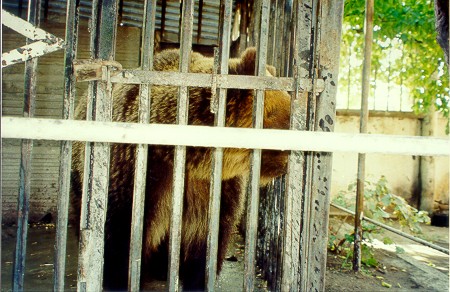
While on my "Armenian Family" weekend, the grandfather of the house took me to see a monastery. On the way home we stopped at his work, which fixes trucks and buses. Well, wasn't I surprised to find that they also had a bear...quite logical really?!? This poor 6 year old female bear lives here in this small cage. It was actually quite sad to see her all locked up.
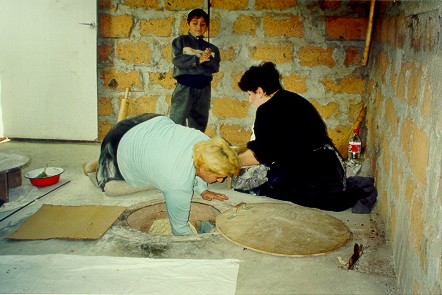 I was also
fortunate enough to witness the baking of Armenian
lavash, a very traditional flat bread that is somewhat like what you
would use to make a fajita, but different. I'll try and explain the
process, which was quite interesting to see. They start by making the
dough, which is very simple: water, flour and matsoon (a type of plain yoghurt).
So they make the dough and form it into small balls. After letting it rise
for a while, they take it into this building, which has been built exclusively
for this purpose. In the floor, there is a pit about 2m deep.
They make a fire in the pit and let it get VERY hot, incredibly hot actually.
I was also
fortunate enough to witness the baking of Armenian
lavash, a very traditional flat bread that is somewhat like what you
would use to make a fajita, but different. I'll try and explain the
process, which was quite interesting to see. They start by making the
dough, which is very simple: water, flour and matsoon (a type of plain yoghurt).
So they make the dough and form it into small balls. After letting it rise
for a while, they take it into this building, which has been built exclusively
for this purpose. In the floor, there is a pit about 2m deep.
They make a fire in the pit and let it get VERY hot, incredibly hot actually.
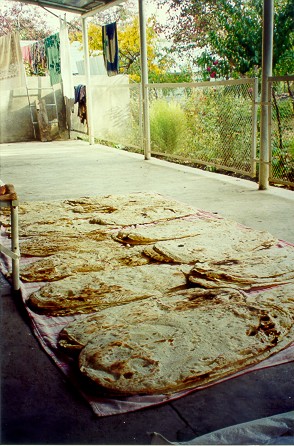
After the fire has turned into coals the cooking begins. They take one of the balls of dough and stretch it out on a board that resembles a small ironing board. They then take this board and SLAM it against the brick wall of the pit (as seen above), which is very hot. The dough sticks to the wall and starts cooking. Two or so minutes later, they peel it off the wall, and BAM, fresh lavash. What you see to the left is the fruits of their work. This day, they were making enough to last them the entire winter.
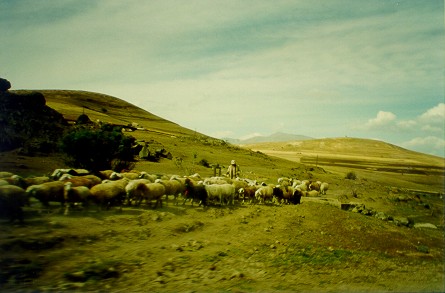 As I mentioned above,
many Armenians survive on farming. Some produce fruits and vegetables, but
a large portion produce meat: lamb, beef, pork etc. Here is a sheppard with
his flock by the side of the road. It is not unusual to see cows, goats
or sheep munching away on plants at the side of the road, or even in gardens in
the smaller towns outside of Yerevan. I was also told an interesting fact
yesterday. Apparently, pork here is more expensive than beef - the
opposite of home. Armenians also have very many ways of cooking
meat. I've only sampled a few, but they are all very tasty. Many
ways involve cooking over coals like a kebab. They sure know how to BBQ
here!
As I mentioned above,
many Armenians survive on farming. Some produce fruits and vegetables, but
a large portion produce meat: lamb, beef, pork etc. Here is a sheppard with
his flock by the side of the road. It is not unusual to see cows, goats
or sheep munching away on plants at the side of the road, or even in gardens in
the smaller towns outside of Yerevan. I was also told an interesting fact
yesterday. Apparently, pork here is more expensive than beef - the
opposite of home. Armenians also have very many ways of cooking
meat. I've only sampled a few, but they are all very tasty. Many
ways involve cooking over coals like a kebab. They sure know how to BBQ
here!