 |
| Al Capone |
|
|
-->
For years Capone remained immune to prosecution for his criminal activities. In June 1930, after an exhaustive investigation by the federal government, Capone was indicted for income tax evasion. One of the most notorious criminals of the 20th century--the man held most responsible for the bloody lawlessness of Prohibition-era Chicago--was imprisoned for tax evasion. The trial was highly publicized. Hollywood celebrity Edward G. Robinson, who had portrayed a Capone-like character in the movie "Little Caesar," attended 1 day to observe the gangster role model, Capone. The names, addresses, and occupations of the 12 jurors who decided the case and signed this verdict were printed in Chicago newspapers. To reduce the chances of jury tampering, the judge tried to keep the trial as short as possible and confined the jury at night. During the trial, the prosecution documented Capone's lavish spending, evidence of a colossal income. The government also submitted proof that Capone was aware of his obligation to pay federal income tax but failed to do so. After nearly 9 hours of deliberation, the jurors found Capone guilty of three felonies and two misdemeanors, relating to his failure to pay and/or file his income taxes between 1925 and 1929. Judge Wilkerson sentenced Al Capone to serve 11 years in prison and to pay $80,000 in fines and court costs.
Alphonse Capone � who would come to symbolize all that was wrong with America in the 1930�s � was born on January 17, 1899, the son of Italian immigrants Gabriel and Theresa. The boy, one of nine children, grew up on the mean streets of the New York slums. Here young Italian gangs continued the ethnic rivalries of the mother country and young Alphonse was soon involved in the vandalism and street fighting common to gang life. He become a feared member of the Forty Thieves Juniors at the age of eleven � renowned for his large size as well as his hot temper. Though a capable student, Alphonse got expelled from school at age fourteen for assaulting his teacher.
Capone was now rich and powerful but he still had the explosive temper which got him thrown out of school six years earlier. During the early twenties, Chicago saw crackdowns on gang activity by the Mayor, but also increasing collusion with the police. The gangs began combining under Torrio but this led to many rivalries. On January 24, 1925 John Torrio was gunned down outside of his home. He survived, but decided he had had enough of gang life. He handed control over to Capone.
Capone engaged upon a campaign of violence in order to gain total control of the Chicago gangland. He would arrange for the murder of rival gang leaders one by one. Over the next two years a vicious gangland war ensued. When the smoke cleared, Al Capone was the man left standing.
By 1927 Capone had reached celebrity status. He was invited to major social functions that were normally out of bounds for criminals. He was worth millions of dollars and his power was absolute. By paying attention to the poor and downtrodden of Chicago � even opening soup kitchens � he was seen as a romantic Robin Hood figure by many. The authorities, however, were beginning to put the pressure on Capone and his operations.
On February 14, 1929 the notorious St. Valentines Day Massacre occurred, in which Capone�s henchmen, dressed as police officer�s, mowed down seven members of rival Bugsy Moran�s gang. This ruthless mass murder galvanised the police in their efforts to get Capone. About this time Capone discovered a plot to overthrow him from within his own organization. He personally beat the three perpetrators with a baseball bat before having them shot to death. Deciding to lay low for a while, Capone struck upon the novel idea of having himself arrested on a minor charge and spending a couple of months in jail. The authorities, however, seized their opportunity and on the petty charge of carrying a concealed weapon he was given a years imprisonment.
By the time of his release on March 17, 1930 the authorities had a new weapon against Capone. A law had recently been passed to the effect that illegally earned income was taxable. The IRS could now be used against the underworld. Al Capone was the focus of IRS operations and in the summer of 1930 they had their first breakthrough when one of Capone�s minor players, Edward O�Hare decided to do a deal with them. The second breakthrough came with the surfacing of a set of accounts that had been seized during a raid years before. The books showed that Capone did indeed have an income.
Capone was arrested and the scene was set for the most celebrated trial of the century. Initially Capone pleaded guilty, expecting a light sentence. In an unprecedented move, however, the trial judge announced he would not be bound by any such deal. The guilty plea was then revoked and a new trial date set.
Of the twenty three counts against him, Capone was found guilty of just five. But that was enough for him to be sentenced to 11 years imprisonment. The most notorious gangster in history was going to jail for tax evasion.
Capone tried to be a model prisoner but became involved in several prison fights, once being stabbed with a pair of scissors. In the late 30�s he began to display signs of mental instability. He spent the rest of his prison term in hospital. He was released from prison on 16 November, 1939. He lived out his last years in peaceful ill health, dying of a heart attack on January 25, 1948. Al Capone, a gangster is a notorious mob leader. |
| Gangsters |
 |
|
 |
|
|
|
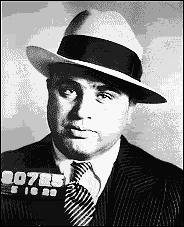 Al Capone, 1930