
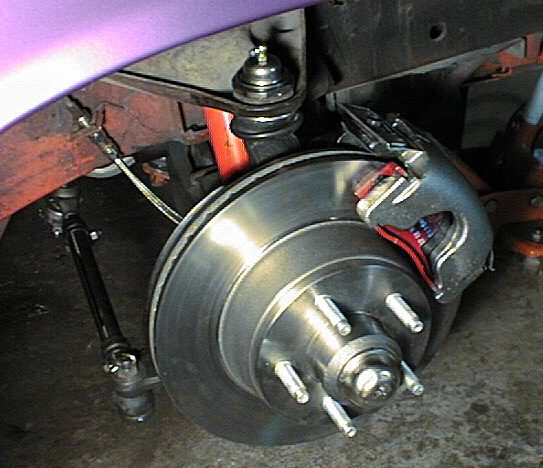
There are two swaps that can be performed. Both require one key component: the disc brake spindles from a '73-'74 E-body or a '73-'76 A-body (and if you already have one of these cars with disc brakes, then the factory already did the first swap for you). These are the only cars/years that you can get the spindles from. I have seen other "disc brake swap" articles that have said that other car's spindles will also work, but they WILL NOT!
11" (10.75" actual size) "standard size" disc brake swap
The first "standard size" swap uses the 11" disc found on '73-'76 A-bodies and '73-'74 E-bodies (the discs are also used on other cars like Volares and '75-'76 B-bodies). This setup can be used with 14" wheels, and although this seems like it is a waste on a car that already has the older type 11" discs, and would only be worthwhile on a front-drum-brake-equipped car, it does have these worthwhile attributes:
1. It uses larger inner wheel bearings than the older (up to '72) disc setup.
2. The disc is readily available and costs $35, whereas the older disc (if one can be found) costs upwards of $200 apiece.
3. The disc is a one-piece design, and is less prone to warpage than the older two-piece design.
4. Due to the larger wheel bearing, the spindle is bigger, meaning it is stronger.
12" (11.75" actual size) "big disc" swap
The second "big disc" swap uses the 12" rotor (it happens to use the same wheel bearings as the 11" disc in the first swap) from '77 and up Chrysler/Dodge/Plymouth B/R-body cars (ask for discs for a '79 Chrysler Cordoba and you'll get the right part). This swap requires 15" wheels. This rotor gets you better braking, along with the larger wheel bearing, one-piece design and a $50 price tag (each). Be careful if you get rotors from the junkyard, as a lot of the full-size cars (Monaco, New Yorker, etc.) also use a 12" disc which is thicker, and won't work correctly (the rotor you want is 1" thick).
Calipers and caliper adapters: Pin or Slider?
Once you figure out which size disc you want to use, then you need to decide on which calipers to use.
Chrysler used two types of calipers on the '70-'74 E-bodies, '73-'76 A-bodies, and on into the late '70's (and early '80's) when the 12" equipped cars were being produced. The first is the "pin" type caliper which was found on the older style disc equipped '70-'72 E-bodies and some of the later cars. The second is the "slider" type, which was found on the '73-'76 A-bodies and the rest of the later cars that weren't "pin" type caliper equipped (again, be careful at the junkyard, as the full-size cars also used a slider type caliper which is larger and has a larger caliper adapter, both of which aren't compatible with the A/E-body spindle we're using. A quick identification can be made by measuring the caliper's piston diameter. The full-size car's caliper has a 3" piston, where the A/B/E/R body slider calipers have a 2 3/4" piston). Both pin and slider types work well, and have their respective advantages/disadvantages. It really boils down to personal preference, what you already have on the car, or what caliper adapters you are able to find. For whatever reason, a lot of people prefer the pin type, but the majority of the later 12" equipped cars seem to have the slider type setup.
Now that you know what caliper you want to use, it won't do you any good without a caliper adapter to mate it to the spindle.
Besides the spindles and the discs/bearings/seals, you'll need the appropriate caliper adapters, either 11" pin or slider type (off of a E-body, '73-'76 A-body, or a 11" equipped '75-'76 B-body) or 12" pin or slider type (found on '77-'79 B-bodies like Furys or Coronets, or on other body types like Cordobas, well, you get the idea). At the local pick-n-pull, I scored a set of 12" pin-type off of a '77 Fury and a set of 12" slider type off of a '79 Cordoba. Don't forget to snag the dust shields (and any other hardware like the spindle washer/nut/retainer and dust cap) while you're there! You'll also need a pair of calipers unless your car is already pin or slider caliper equipped, in which case you could reuse your old ones if you find the appropriate adapters, but I recommend getting new calipers anyway if the ones you have are over 5 years old, since they're only $25 a piece. When ordering pin type calipers, just tell them it's for a '70 Plymouth Barracuda and you'll get the right ones. If it's the slider type you want, then ask for '73 Plymouth Duster or '79 Chrysler Cordoba calipers. One final note: on some B bodies and on A bodies, it may be necessary to swap the spindles side to side, since the caliper will need to be located to the rear of the rotor due to sway bar interference. This is not required on E bodies, and the calipers can stay to the front of the rotor.
Other Parts
Another worthwhile upgrade that's easy to do while everything is apart, is changing the rubber hoses to Russell stainless steel braided lines (which are DOT approved). I also recommend an adjustable proportioning valve spliced into the line going to the rear brakes, since the rears lock up so badly on our light-assed, nose-heavy mopars.
Master Cylinder
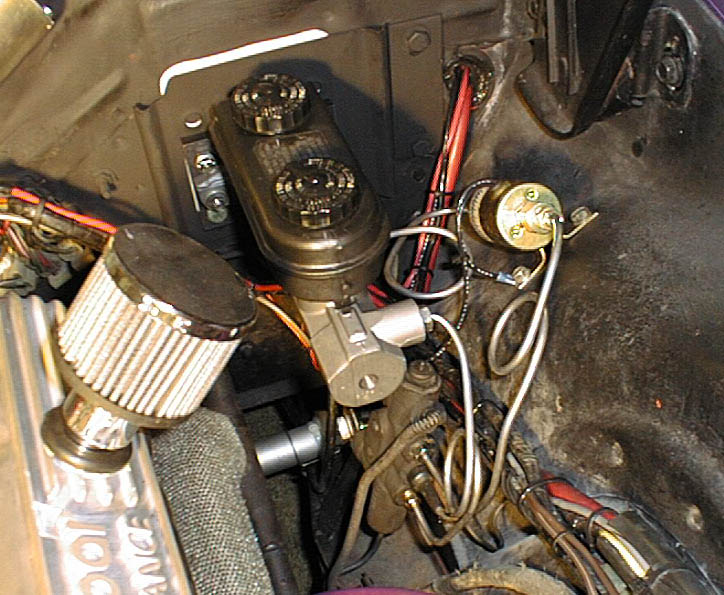
If your car is already front-disc-equipped, then changing the master cylinder is not required. If your car is equipped with front drums, then you need to get a new master cylinder (if you're looking to keep things looking stock, then ask for a master cylinder for a disc-equipped E-body). The trick item these days is the Mopar Performance aluminum master cylinder (1 1/32" bore). If you have power brakes, now is the time to toss the vaccum booster. Not only will braking improve, but you won't have to worry anymore about running a large cam and not having enough vaccum to run the booster. Manual brake cars have the pedal directly connected to the master cylinder pushrod, but power brake cars have an extra linkage setup (built onto the back of the booster) with a 2:1 ratio, which means only half of your effort gets put into the master cylinder through the booster! This is why if you toss the booster, driving your car won't be like driving a fully-loaded dumptruck. In fact, pedal feel is increased, as is braking control, and although it takes more effort to push the pedal, you can actually exert more pressure than before since eliminating the 2:1 linkage alone doubles the force you can input to the master cylinder. I have done this swap and I can tell you, it works!
Here's a quick rundown of the parts needed to do either of these swaps:
Spindle: used from '73-'74 E-body or '73-'76 A-body
11" (10.75 actual size) rotor: used from a '73-'74 E, '73-'76 A, '75-'76 B-body or a Volare or Diplomat with 11" discs, or new (order rotors for a '73-'76 Dart or Duster)
Wheel bearings and seals: used (you could, but why?) or new (again, order for a '73-'76 Dart or Duster)
Dust shield: used from any 11" disc equipped E, A, R or B body
Spindle nut/washer/retainer/dust cap: used from any of the cars listed above or new ('73-'76 A or '73-'74 E or any other later car with the 11" or 12" discs)
Caliper adapter: used, pin or slider type from a '73-'74 E, '73-'76 A, '75-'76 B-body (and possibly from an appropriate year Volare or Diplomat)
Calipers: pin or slider used (why bother?) from any of the above mentioned cars, including B and R-bodies up to '79 (and some even later), new (rebuilt) readily available in pin (ask for '70 Barracuda) or slider type (ask for '73-'76 Dart or Duster)
Order brake lines for a disc equipped version of whatever car you are putting the brakes on
Spindle: same as 11" swap
12" (11.75" actual size) rotor: From '77-'79 B-bodies (Fury, Coronet) or R-bodies (Cordoba) or new (ask for rotors for a '79 Chrysler Cordoba)
Wheel bearings and seals: used (again, why?) or new ('79 Cordoba)
Dust shield: used from any 12" equipped B or R-body
Spindle nut/washer/retainer/dust cap: same as 11" swap
Caliper adapter: used, pin or slider type from a '77-'79 B or R-body
Caliper: same as 11" swap
Order brake lines for a disc equipped version of whatever car you are putting the brakes on