|
New
Oratorio by John Galea
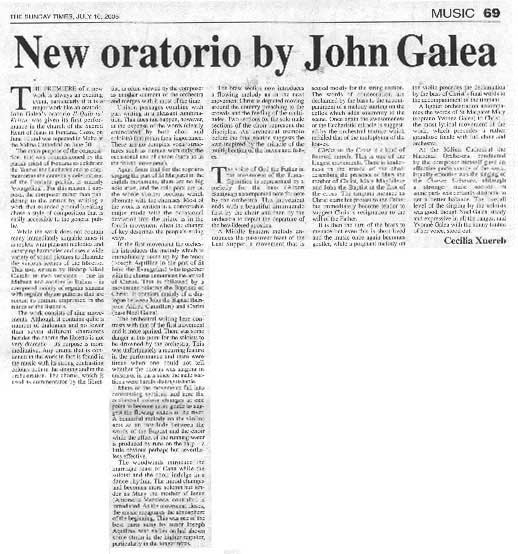
THE PREMIERE of a new work is
always an exciting event, particularly if it is a major
work like an oratorio. John Galea's oratorio ll-Qalb ta'
Kristu, was given its first performance in the church of
the Sacred Heart of Jesus in Fontana. Gozo, on June 10 and
was repeated in Malta at the Mdina Cathedral on June 30.
The main purpose of the
composition, that was commissioned by the parish priest of
Fontana to celebrate the Year of the Eucharist and to
commemorate the centenary celebrations of the Fontana
parish, is mainly 'evangelical'. For this reason, I
suppose, the composer rather than pandering to the critics
by writing a work that sounded ground-breaking chose a
style of composition that is easily accessible to the
general public.
While the work does not
contain many immediately singable tunes it is replete with
pleasant melodies and satisfying harmonies and uses a wide
variety of sound pictures to illustrate the various scenes
of the libretto. This too, written by Bishop Nikol Cauchi
in two versions - one in Maltese and another in Italian -
is composed mainly of regular stanzas with regular rhyme
patterns that are meant to remain imprinted in the minds
of the listeners.
The work consists of nine
movements. Although it contains quite a number of
dialogues and no fewer than seven different characters
besides the chorus the libretto is not very dramatic - its
purpose is more meditative. Any drama that is contained in
the work in fact is found in the music with its strong
contrasting colours both in the singing and1 in the
orchestration. The chorus, which is used as commentator by
the libret-
tist, is often viewed by the
composer as another element of the orchestra and merges
with it most of the time.
Unison passages combine with
part writing in a pleasant combination. This does not
happen, however, at the expense of the words (clearly
enunciated by both choir and soloists) that retain their
importance. There are no complex vocal structures such as
fugues with only the occasional use of canon (such as in
the fourth movement).
Apart from that for the
soprano singing the part of St Margaret in the eighth
movement, there are no big solo arias, and the solo parts
are on the whole shorter sections which alternate with the
choruses. Most of the work is written in a comfortable
major mode with the occasional deviation into the minor as
in the fourth movement when the change of key describes
the people's erring ways.
In the first movement the
orchestra introduces the melody which is immediately taken
up by the tenor (Joseph Aquilina in the part of St John
the Evangelist) who together with the chorus announces the
arrival of Christ. This is followed by a movement relating
the Baptism of Christ. It consists mainly of a dialogue
between John the Baptist (baritone Alfred Camilleri) and
Christ (bass Noel Galea).
The orchestral writing here
contrasts with that of the first movement and is more
spirited. There was some danger at this point for the
soloists to be drowned by the orchestra. This was
unfortunately a recurring feature in the performance and
there were times when one could not tell whether the
chorus was singing in unison' or in parts since the male
sections were hardly distinguishable.
Many of the movements fall
into contrasting sections and here the orchestral colour
changes at one point to become more gentle to suggest the
flowing waters of the river. A beautiful melody on the
violins acts as an interlude between the words of the
Baptist and the choir while the effect of the running
water is produced by runs on the harp - a little obvious
perhaps but nevertheless effective.
The woodwinds introduce the
marriage feast of Cana while the soloist and the choir
indulge in a dance rhythm. The mood changes and becomes
more solemn but tender as Mary the mother of Jesus (Antonella
Mercieca, contralto) is introduced. As the movement
closes, the music recaptures the atmosphere of the
beginning. This was one of the best parts sung by tenor
Joseph Aquilina, who earlier on had shown some strain in
the higher register, particularly in the longer notes.
The brass section now
introduces a flowing melody as in the next movement Christ
is depicted moving around the country preaching to the
crowds and the feeding of the multitudes. Two sections for
the solo male sections of the choir represent the
disciples. An orchestral tremolo before the final section
suggests the awe inspired by the miracle of the
multiplication of the loaves and fishes.
The voice of God the Father in
the movement of the Transfiguration is represented by a
melody for the bass (Albert Buttigieg) accompanied note
for note by the orchestra. This movement ends with a
beautiful diminuendo first by the choir and then by the
orchestra to depict the departure of the bewildered
apostles.
A Middle Eastern melody
announces the pass-over feast of the Last Supper, a
movement that is scored mostly for the string section. The
words of consecration are declaimed by the bass to the
accompaniment of a melody starting on the cellos which
adds solemnity to the scene. Once again the awesomeness of
the Eucharistic miracle is suggested by the orchestral
texture which recalled that of the multiplying of the
loaves.
Christ on the Cross is a kind
of funeral march. This is one of the longest movements.
There is tenderness in the music of the choir describing
the presence of Mary the mother of Christ, Mary Magdalene
and John the Baptist at the foot of the cross. The timpani
menace as Christ starts his protest to the Father but
immediately become tender to suggest Christ's resignation
to the will of the Father.
It is then the turn of the
brass to menace but even this is short-lived and the music
once again becomes gentler, while a poignant melody on
the violin precedes the
declamation by the bass of Christ's final words to the
accompaniment of the timpani.
A lighter orchestration
accompanies the words of St Margaret Mary (soprano Yvonne
Galea) to Christ -the most lyrical movement of the work,
which precedes a rather grandiose finale with full choir
and orchestra.
At the Mdina Cathedral the
National Orchestra, conducted by the composer himself gave
an effective performance of the work. Equally effective
was the singing of the Chorus Urbanus, although a stronger
male section in some parts was certainly desirable to get
a better balance. The overall level of the singing by the
soloists was good, though Noel Galea, steady and
expressive in all the ranges, and Yvonne Galea with the
sunny timbre of her voice, stood out.
CECILIA XUEREB
|