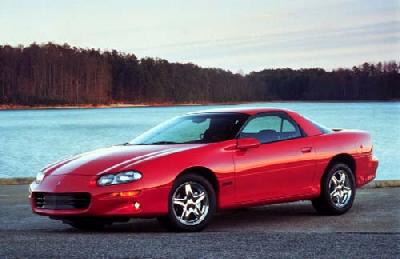
Very few cars on production today have the history of the Camaro.For more than 30 years Camaros have been the typical "small" American muscle car. The 2000 Camaro retains all the strong points of its predecessors. The Z28 version is powered by a massive 5.7 lt. V8 producing 285 bhp that are able of propelling the distinctive coupe or convertible versions to 60 mph in 5.4 sec. The most impressive thing about the Camaro, though, is its price which is hardly higher than that of the average boring family sedan. The Camaro is a legend that lives on thanks to Chevrolet who has kept it alive and respected its history producing every time a better car than the previous model.
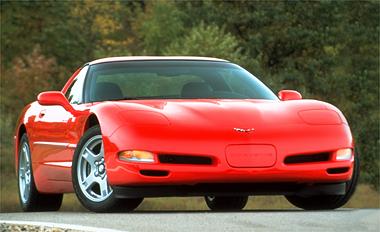
There is no need to say many things about the Corvette. It is simply the dream of almost every American car enthusiast. The all new Chevrolet Corvette on which the 99 model is based was introduced in early 1997. This model follows the Corvette tradition yet still it is a much better car than its predecessors. Acceleration to 60 mph takes just over 4.6 sec, and the Corvette is able (and willing...) to leave behind most Ferraris. If you happen to come across a '99 model check out the revolutionary head up display projecting onto the windscreen. On the road the latest Vette is simply excellent. The thing about Corvettes, though, is much more than that. It is owning one that really counts...
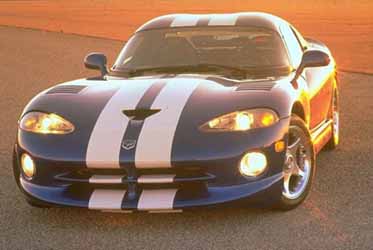
The Dodge Viper, introduced in 1993, is the American version of a Fantasy Car. Featuring the largest engine among the cars on this site, and one of the largest to be fitted in a production car ever, an 8.0lt unit producing more than 400bhp and a much more impressive amount of torque (662Nm). The Viper has been praised for its direct race car feel and it surely is not a game to play with. How, anyway could a car with more than 400 bhp driving the rear wheels only and without any type of electronic help be a game to play with? Viper's muscle car design is fully justified given that it is directed, primarily, for the American market. Various different versions have appeared during the last years after the initial RT/10 Model
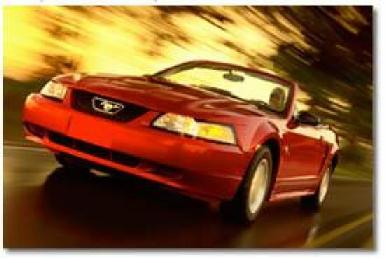
The latest model has kept unchanged the things that have made Mustangs distinctive over the years. The Mustang Cobra goes even further than that with its 305 bhp 32-valve powerhouse which is more than enough to give acceleration to 60 mph in 5.6 sec. All Mustangs, and especially the Cobra are an absolute blast to drive. They are not, by any way, friendly easy cars, yet they have their own crude way of making their driver get involved in driving them. Like the Chevrolet Camaro, the price of a Ford Mustang is very low, comparable with that of a dull family saloon. We, here at FantasyCars.com, hope that the Ford Mustang, along with the others of the bunch of legendary American sports cars will continue their way well into the 21st century.
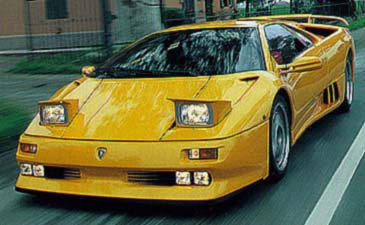
Do you feel that a Ferrari is too soft, too civilized for you? Then go for a Lamborghni Diablo. The historic Italian marque keeps producing a car as cars were meant to be until some years ago. The Diablo is an object of desire, a car that speaks to its owner's heart more than any other car on production today (remember that Ferrari F50 and McLaren F1 are not produced anymore). You can't really understand the size of a Diablo until you actually see one on the road and you surely can't understand the feel of a Diablo until you actually drive it. It makes more noise than you can imagine, yet, the sound of its V12 can instantly stir you up, it is more impractical than anything else you have seen in your life, yet still it is irresistible. Many versions have been spawn off the original Diablo with the latest '99 SV getting a 530bhp engine. All in all it's simple enough: This is (most) probably the last supercar as supercars ought to be.
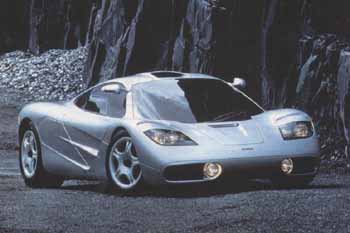
Introduced in 1993, McLaren F1 is, by far, the world's most expensive supercar and the fastest one as well. Designed as a Formula 1 for 2 (or even 3) McLaren F1 feautures a 6.0lt. BMW engine that can reach 60mph (97km/h) in 3.1 seconds. The car incorporates many world firsts for a road car: a fully carbon fibre monocoque structure, fully active fan-assisted ground effect aerodynamics, a central driving position with two offset rear passenger seats. The car's production has now stopped, after only some more than 100 F1s were built. So you have to try the used car market in order to get your hands on the world's fastest car...