Locomotives and Rolling Stock




There are some details that are on many railroads. These are standard details such as multiple unit (mu) hoses and mu detail, air hoses, plows or pilots, uncoupling levers, speed recorders, drop steps, and lift rigs. Not all of the railroads use these, but many of them do use some. Railroads also relocate horns to other areas of the locomotives. Rolling stock can include air hoses, uncoupling levers, grab irons, ladders, or tack boards. Look through catalogs to see many of the details available in your scale.
To paint locomotives, using an airbrush is a good idea. Spray cans will work, but are difficult to use and may not produce the same results as an airbrush. Mask the sides with blue painters' tape or masking tape. Make sure that there is a straight, flat edge to paint. You can cut the tape on a piece of glass with a number 11 hobby knife to make straight edges. Spray at an acute angle and not towards the straight edge of the tape otherwise it may bleed under the tape and ruin a nice finish. Pull away the tape at an acute angle. Paint the handrails by brush. When finished, you can put a coat Testor's Dullcote that comes in a can or bottle. This prepares the surface for decaling.
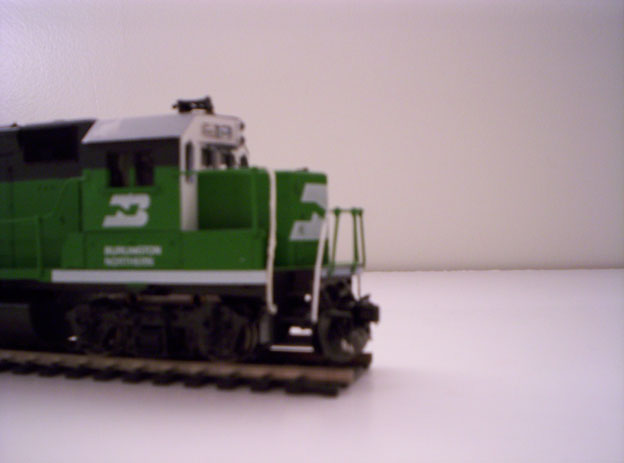
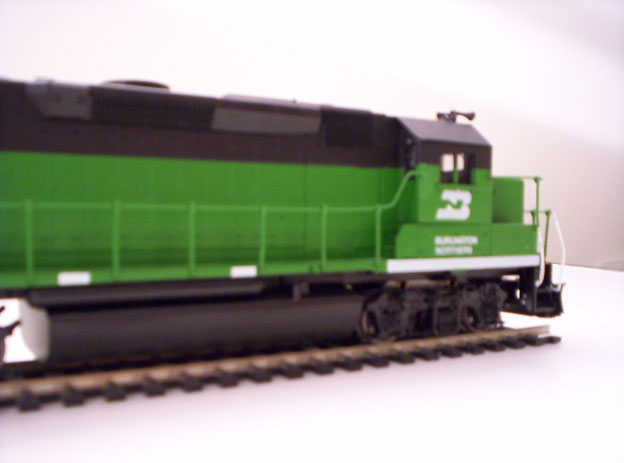
Here is a Burlington Northern GP-50 made by Athearn. It has been detailed to represent one of the prototype units that Burlington Northern had. It has a front plow, mu hoses, and a beacon. The handrails have been painted green with white on the ends to represent the locomotive paint scheme that the BN used. Many railroads paint the ends of the railings in a bright color for safety reasons.