|

Remembering Madera's Chinatown
Madera
Tribune
Tuesday, May 17, 2005
by Bill Coate
“There was a time when the alley streets of Madera, which to the
Chinese were main thoroughfares, teemed with maidens, children and busy
merchants,” wrote a Madera Mercury reporter in 1923.
By the
time he wrote his article, however, there were only a few tumbled down
shacks, with less than a dozen men and no women or children living
there.
It was on June 24, 1923 that the reporter took a ride
to Madera’s Chinatown. After leaving the news office, he crossed the
southern pacific tracks at Yosemite Avenue, traveled west until he
reached G Street and then turned north.
As he made the
corner, the newspaperman reached his destination, the remnants of
Madera’s old Chinatown. Bordered at one time by I Street, Central
Avenue, F Street (Gateway Drive), and West Yosemite Avenue, this abode
of Madera’s Chinese residents was now a shadow of its former self.
The first structure that the writer met had once been a Chinese hotel,
but was at the time entirely “unoccupied and extremely dilapidated.”
In the next block, near where City Hall and the Madera Valley Inn are
now located, several buildings stood and most of them, although run
down, were still occupied. The main one in this array of weathered
structures was the “China Store.”
The reporter pulled over and
stopped. The China Store was the congregating place for the few Chinese
who were left in Madera. Inside he saw “quantities of rice, packages of
tea, tobacco, chopsticks, quaint little flowered bowls, and pretty,
embroidered, tiny slippers made by China girls.”
Surprising
to the modern reader is the fact that inside this Chinese establishment
was a large photograph of William Conley, taken just after he had
become the first Superior Court Judge of Madera County in 1893.
The reporter, with the characteristic hyperbole of the time, wrote that
Conley “looked down upon the assembled remnants of the Chinese
population in the loving kindness of the friend who participated in the
affairs of long ago, meeting out justice and mercy to these hearts that
knew no other land and had drifted to western shores and were a part of
the great melting pot of this corner of California.”
From the
China Store, the reporter went a bit further north to perhaps the most
important spot of Madera’s Chinatown - the Joss House.
The
late Mildred Eaves, long-time historic sites chairperson of the Madera
County Historical Society, remembered that the old Chinese place of
worship stood at 718 North G St., now an empty lot.
The Joss
House was built in 1888 and stood on G Street until the 1930’s. When
the reporter arrived on that summer day in 1923, he was given a guided
tour through the “Chinese Churchey House’” by Jake Jaun Tong. The
inside was described as musty and dark, “reeking with the odor of the
punk stick burned yet on certain occasions before the altar.”
There, an image of the god the Chinese worshipped could be found behind
the altar. He was well preserved and in days had been given little
bowls of rice and tea. It was reported that whenever the Chinese wanted
to know when “will come the rain,” the image was consulted.
As the reporter walked to the rear of the temple, he found a Chinese
“hospital.” Broken jugs and vases that contained “Chinese medicine”
were found in the deep, dried grasses in the backyard, which at the
time was secluded by a broken down fence.
Returning to the
inside, the visitor took note of the bronze, wooden, and clay
candlesticks. A large brass bowl full of sacred ashes reposed beneath
elaborate bouquets of paper flowers, “brilliantly hued, ages old, but
still retaining color.”
Strange stools, which were once used
as chairs at the meetings, were piled in the corners. Scattered around
in other corners were the old instruments of a Chinese band, and in
various places were honor rolls written in Chinese. These rolls
included the names of donors who helped build the temple.
The
one item left in the almost abandoned Madera Joss House that most
impressed the reporter was a religious tapestry. It had been placed
above the altar years ago, but still retained the lovely color of the
embroidered threads of dragons and “curious emblems of Chinese
understanding woven into the silken folds.”
The reporter left
the Chinese place of worship and returned to the east side of the
tracks. He wrote his story which was entitled “Chinatown is now only a
Remnant.” He reminded his readers that “when Madera was in its early
days, Chinatown extended down to what is now the imposing Lincoln
Grammar School (presently the Madera County Government Center). Little
by little, one by one, the dwellings and business houses of the race
that haunt our shores and throng our western coast cities are tumbling
down or are being torn away.”
By the beginning of the next
decade, Madera’s Chinatown had no buildings at all. However, not
everything was lost. Sheriff John Barnett saved that beautiful Joss
House cloth, and it is now displayed at the Madera County Courthouse
Museum, along with other memorabilia from Madera’s Chinatown.
• • •
Bill Coate can be reached by visiting www.twistintime.com |
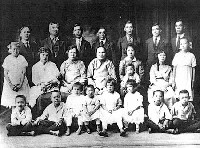 |
File Photo
The
Yee Chung family, with Mrs. Yee Chung shown in the middle of the second
row, as they appeared in the 1920s. Shown here with his wife are all of
Yee Chung's children and grandchildren. |
| |
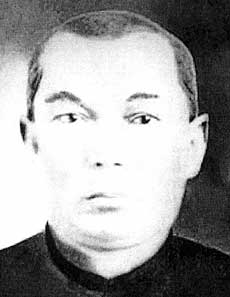 |
File Photo
Yee
Chung, shown in this photograph, was a leader in Madera's Chinese
community. Although he never lived in its Chinatown, many of his
customers in the fruit business no doubt did. |
|


