| HISTORY
(Continued from A1) who first
started arriving in the middle of the nineteenth century. Many
worked building the trans-
continental
railroad and remained in California after its completion.
Many left Madera in the early twentieth century and almost no record
remains except for a few stories in the newspaper.
The descendant of one of those families asked Coate if his class
could help find information about his ancestors' experiences in
Madera. Ron Chong, a teacher in Los Angles, had heard about
Coate's work with his students in conducting historical research and
thought they would be able to help him.
What they found was a link to a Madera man named Yee Chung who had died
in 1902. Chong's grandmother was named Ah Moy, which was also the
name of the daughter of Yee Chung. The students discovered a story
in the Madera Mercury, a newspaper that preceded the Madera Tribune,
about Ah Moy detailing how she had been sold in marriage to two
men. The Chong family had a photo showing an ancestor named Moy
Sun. The photo showed several generations of the family which
appeared to match the information in the newspaper about Yee Chung's
family.
What the students didn't know was what had happened to Yee Chung's
descendants after they left Madera after his death. That's the
information Ron Chong and his brother Darryl brought with them to
Madera Wednesday afternoon.
|
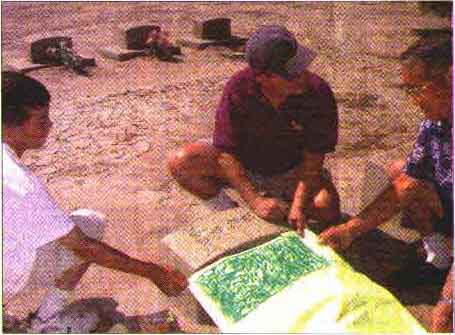
Manuel Serrano,
center, helps Ron Chong, right, and his nephew Kurt Chong, with a
tombstone rubbing from one of the graves at Borden Cemetery on Avenue
12.
|
_____
Kurt Chong came with his father Darryl to Madera on
Wednesday afternoon. The 11-year old was about the same age as
the students in the Sierra Vista classroom he was visiting and he was a
bit surprised at all the attention over his family, especially about a
girl names Ah Moy who was about their age back around the turn of the
twentieth century.
Kurt passed out copies of a photograph so each student in the
classroom. It showed a photograph of Kurt's great-grandmother Moy
Sun and her extended family. Along the top and bottom were the
names of all 23 people in the picture.
"This is my father George," pointed out Ron Chong as he held up a copy
of the photo-
graph.
The students study the photo and find the young boy sitting second from
the right in the bottom row.
|
______
"How come she doesn't look Chinese," asked student Crystal Gonzalez,
after examining the photo.
"What do you mean, 'she doesn't look Chinese,'" said Coate.
"Well, she looks like an American," continued Gonzalez.
"What does an American look like," asked Coate. "You don't know
how deep that question really is. I don't understand what it is
to look Chinese. How do you know I don't look Chinese?"
"Well, you were born here," said Gonzalez. "Your mother and
father were born here."
"You know nothing about my mother or father," said Coate. "Suppose I
were born in Shanhai? Some people will ask me what I am, am I
White or Mexican ... I say I'm colorblind.
"That's part of what this project is all about: Seeing life
|
|
through the eyes of
someone else. We've done projects on Mexicans, African-Americans,
Anglos, and every one of them was born and every one of them died, ...
and the lesson for you is you'd better do something good with your life."
______
Ron Chong tells the students about the recent history of the family and
how they migrated throughout the state. One daug-
hter of
Ah Moy, he said, had become a dancer and had performed in San
Francisco. One of the people who had seen her perform was a Lt.
Ronald Reagan.
"The family retained its roots in agriculture," continued Chong.
They formed a business in Sacramento called the General Produce Company
and were "one of the largest produce companies around." The
business employs 225 people including around six family members.
Chong suggests the students could pay a visit to the business to meet
the other members of the family and the students reacted excitedly to
the prospect of a field trip.
The students had their own story to tell and recounted to the Chong
family what they had found of microfilm and from the Internet.
They told the story of how Yee Chung had died on April 26, 1902, and
how the newspaper reported the death. Coate asked the students
whether they thought it unusual that the death of a Chinese man would
be on the front page of the newspaper.
|
Students suggested it may be because Yee Chung was a prominent resident
in town. The Chongs were told about the last words their
great-grandfather had spoken, "Don't worry, I'm not going to die."
A few years after his death, a story appeared about the daughter of Yee
Chung being sold for marriage to two men.
On the wall of the classroom were large facsimiles of the articles
about Yee Chung and his descendants. The students gave the Chong
family copies of the information they had uncovered from the early
twentieth century.
"This fills a void in our family history," remarked Darryl Chong.
"It makes me very satisfied to see what has happened and to find out
more about our family than I ever thought possible," said Ron Chong to
the students.
The Chongs brought with them a gift for each student in appre-
ciation
for the research they had done. The red-paper-wrapped Li Shee is
a traditional good luck trinket given at celebrations such as New
Year's, weddings, and birthdays. Inside is a small token, usually
a coin or a piece of candy. On the red wrapper is an image of a
large boat. It symbolizes a successful voyage of discovery and is
supposed to be lucky for both the giver and the recipient.
The Sierra Vista students continue their research on the Chinese
history in Madera and will compile their information into a book to be
released next year on the 100th anniversary of Yee Chung's death. |