|
(continued from A1)
of
the Los Angeles teacher.
Chung had died in 1902 and his death had made the front page of the
Madera Mercury. Disputes over settlement of his estate led to
other stories in the following months.
The most intriguing story came several years later when reporters wrote
about Ah Moy, the daughter of Yee Chung, who had been sold in childhood
to a man for marriage, but then was resold later to a wealthy
Coulterville merchant.
The story made the front page and also was the link connecting the
family history of Chong with the Madera Chinese pioneers. Chong
had a family photograph from 1907 showing members of his
great-grandfather's family. In it is a photo identifying one
woman as Ah Moy, who was married to a wealthy merchant. The names
and family connections matched.
"The photo is significant since it is the only photo showing members of
Madera's Chinese community from that time," said Coate. Another
photo only shows a store owned by a Chinese community
|
member but does not have any identifiable people in it.
On Wednesday, Chong will visit Coate's students, bringing with him a
copy of that photo showing a rare glimpse of Madera's early Chinese
residents.
"The children will present the documents they discovered about his
family, including the five newspaper articles, and the documents they
found online in the National Archives," said Coate.
Later in the day, members of the class will escort Chong to the Borden
Cemetery located on Avenue 12 near the Madera Irrigation District
offices. There they will view the graves of several of Madera's
Chinese pioneers.
_______
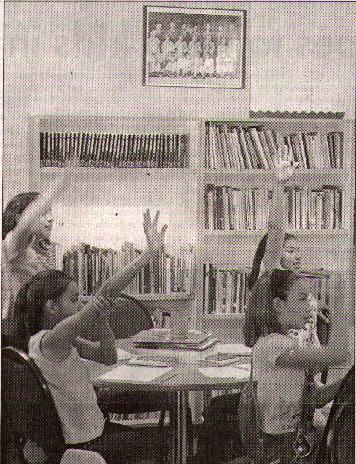
During a lecture last Thursday, Coate tells his students, "One of Ah
Moy's daughters may come and visit out class."
Excited gasps from the children shoot around the room.
"They will see, in flesh and blood, and meet the family members of Yee
Chung's descendants. It takes history out of the abstract
and makes it concrete for them,"
|
explained Coate.
"It also ties in well with our Social Studies unit on ancient
China." The walls of the classroom are covered with decorations
from Chinese calendars and scrolls donated by Madera restaurants for
the project.
"That 30 year period from 1885 to 1915 tells the story of the Chinese
in Madera and is set against the backdrop of the Chinese in Madera and
is set against the backdrop of the Chinese experience in California.
"Not a one of these kids know about the Chinese Exclusion Act," said
Coate. "It will be interesting to see how one group of people was
ostracized, not only in Madera, but around California, too."
The project will continue through the year as the students uncover more
material and will culminate in a book that will be released on April 26,
2002, the 100th anniversary of the death of Yee Chung.
Coate is looking forward to what his students will find in their
research. "I've been working on these types of projects since
1984, and I can tell you, this is going to be a good one."
|