

For those interested in any of the following, Chiriqui is the place to find them: flowers growing, trout fishing, medicinal springs, alpine farms, coffee, beer tasting, oranges growing, cattle ranches, thoroughbred farms, hunting, birdwatching and white water river rafting.
Visitors coming down the Panamerican Highway receive Chiriqui as their Welcome cocktail as soon as they cross the border at Paso Canoa.
Alternatively, for car renters and bus riders, the western welcome mat is spread six or seven hours drive up the Pan American Highway- abundant restaurant and sighseeing along the way.
Chiriqui, you can hear it said, has it all.
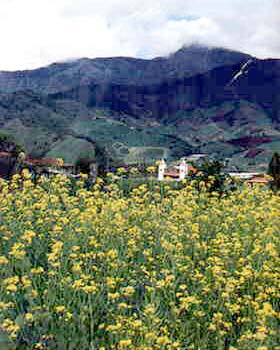
David, third city of the Republic, is the provincial capital of Chiriqui. Most sighseeing spectacles are within easy range of here, but a number of alluring mountains hotels can be found in the cooler climate of Boquete and Volcan. Boquete is the nation s flower garden, prime supplier for the capital city s florists. Chill streams bounding down from el Volcan Baru (11,450 feet) through Boquete, Cerro Punta or Volcan contain a caveat for those who believe corvina reigns unchallenged as Panama s tastiest fish. in Volcan s lakes you can fish for mountains trout in the othodox manner. In some of Volcan s hotels you can deploy your trout rod from the bedroom window.
Hot springs can be found at Boquete, Bugaba, David, Gualaca, San Felix, and Tole. For more informationcontact the Panama Tourist Bureau in David.
The high farms of Chiriqui looks Swiss in the greenness and husbandry. Homes and haciendas on the slopes yodel Swiss chalet architecture. Unsurprising perhaps, since a Swiss farming colony arrived there years before the first road. Following them were Yugoslav farmers.
las Lajas, about an hours drive from David, is the best known of Chiriqui beaches.
The moist and misty vales of Boquete cradle Panama s coffee growing industry. Tours of fincas can be arranged. Oranges and other citrus fruit grow throughout Panama, but Chiriqui is the focus of their industrialization. Boquete oranges are a sought-after delicacy among Panamanians. Chiriqui is also cattle country and the nation s prime throughbred raising area.
Sugar cane is another crop of the Chiriqui plains; and from sugar-rum. the famous Carta Vieja rum is and distilled and aged at an attractive hacienda not far from the Pan American highway between David and Concepcion. Visitors are welcome
Birdwatchers will find almost 1,000 species along the Chiriqui border with Costa Rica. Distinguished resident includes the quetzal, who set Chiriqui as his southern most abode.
Bananas are Chiriquispecial. The plantations around Puerto Armuelles can tell the history-botanical, commercial and political-of the Central America banana industry.
The turnoff point to Volcan and Cerro Punta is at Concepcion, the saddlemaking centre of Panama s cowboy country. The Guymi Indians are Panama sbest-known Indian tribe after the Kunas of San Blas. Chiriqui s central cordillera is their homeland.
The easiet place to meet the Guaymi is at Tole, just off the Pan American Highway, where you will also find one of Panama favorite tourist souvenirs-the chaquira, a wide necklace woven with strings of fine beads.
Bibliography "Focus Panama" volume 26 No. 2
