
The downside is that they require more frequent maintainance, are enviromentaly more dirty, and cylinder wear can be a problem due to the ports that need to be placed in it.
High performance 2 stroke engines can have cooling problems and cylinder - piston distortion due to the heat exposed to the piston that does "double duty". They also can really gobble fuel at an amazing rate depending on how highly tuned they are, and how many cylinders they have. In general most 2 stokes run at very low compression ratios, usually less than 7:1 and can use regular unleaded fuel.
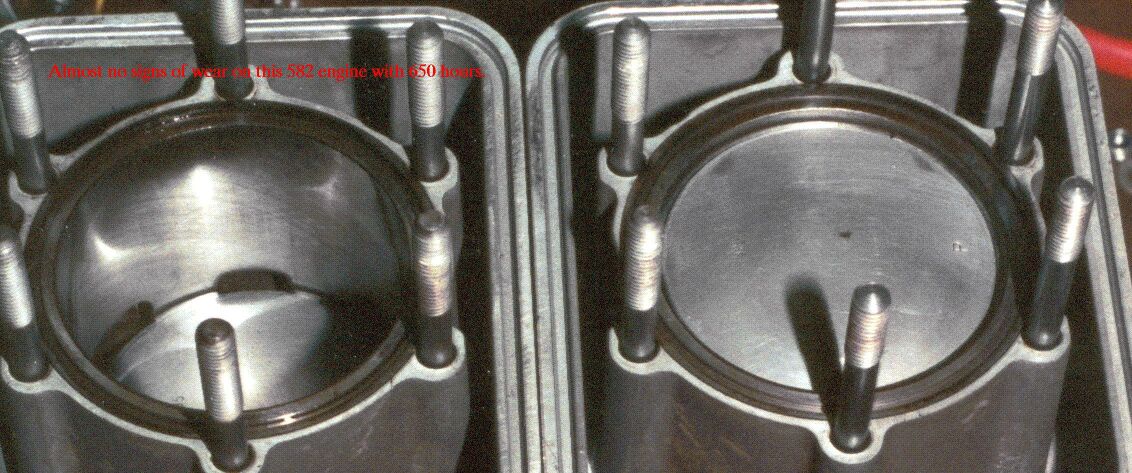
You cannot check for stuck rings by looking in the exhaust port. They usually get stuck near the antirotation pin on the intake side of the piston.
When removing the rings to decarbon the grooves, be sure to keep the same ring on the same piston and the same face up. These parts are matched to the cylinder. They will last for years if you do this properly.
New rings require honing, and if the engine has many hours, boring and honing to put the cylinder round.
If regular decarboning is not done, rings can get so stuck, that a new piston and a bore job would be required, and this will be costly.
I am often asked what type oil I use: Pennzoil AIR COOLED, and decarbon at no more than 350 hours.
It costs me very little to keep my engine running, but I do my own work. I now have 500 hours more on it since these photos were taken, and 1200 hours are on the engine in total.
I run my engine at 6250 RPM static. ( maximum torque ) High RPM on the larger engines will probably shorten your crankshaft life. ( At 5000 RPM a ball bearing should run 1500 hours in oil mist before there is any detectable wear.) Some won't agree with this, but most folks don't run around in their cars using only first gear unless they are drag racing or hill climbing. If you have a short field, or an underpowered plane, then you might need to pitch for maximum horsepower, but don't expect fuel economy or a long engine life.
My Chinook with this Rotax 582 will motor around and maintain altitude at 4000 RPM when solo. If I am in a hurry, I might turn 5000 RPM, but I take it easy on the engine, so the power will be there when I need it.
Please check Rotax fuel consuption chart for 4000 RPM. I get better fuel milage than my 447 Quicksilver did.