
Summary of modifications: (12/28/02)
Road///Race Engineering 2.25" Upper and 2" Lower Intercooler Pipes
GReddy Type-S Blow-Off Valve
S&B Dual-cone Coaxial Type, Cotton Element Filter
A'PEXi, Racing Sport 85mm Exhaust
A-Pillar Guage Mount
Autometer Phantom 52mm Boost Guage
Cyberdyne A/F Guage
Clear Bumper Lights
Rear Tint - Llumar Titanium 5% Limo
Front and Rear Strut Tower Bars
Rear Lower Tie Bar
Twin-Piston GSX Calipers
275mm PowerSlot Slotted/Vented Rotors
Axxis Metal Master, Semi-Metallic Brake Pads
Kumho Ecsta Supra 712 P225/50WR16
GReddy Turbo Timer
Removed WGS Restrictor
Removed Side MAS Restrictors
3" Stainless Steel Downpipe NO CAT
Crankcase Breather
NGK Race Plugs
______________
JOURNAL - 2ND GENERATION ECLIPSE
& TOO MUCH TIME
THE QUEST FOR PERFORMANCE
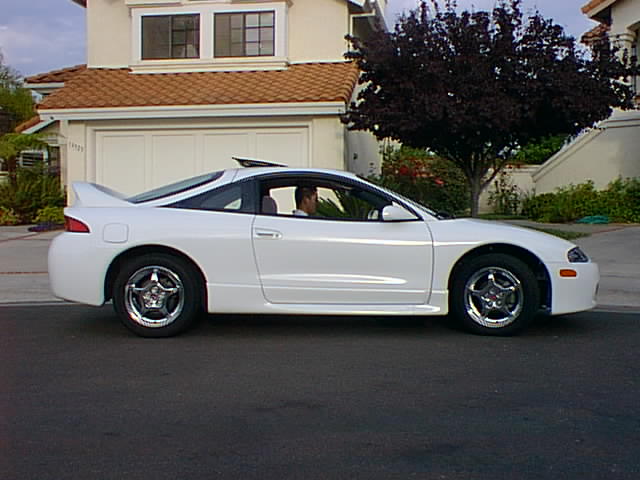 The
thundering purr of a muscular engine makes it's way closer as you sit patiently
at a red light. A middle aged man sits agressively in his 1999 Dodge
Viper GTS-R. The rumbling beast proudly displays its bright orange
racing stripes on its white skin. He revs his engine, and all ten
pistons pound the exhaust into a harmonious roar. By now you're more
than impressed by this sight. Not only has this man made his way
into a $150,000 pure bred sports car, but he has also made his way to your
side. He's good to go. You tap the gas, and your Type-S hisses
loudly. You wonder why a Viper dares to even touch your japanese,
road tearing, asphault hugging, fuel burning, turbocharging, street racer.
In your mind, you picture the Viper ten car lengths behind you as you whip
into third. You laugh to yourself, "Haha, watch me spank this fool!"
The light turns green, and the game begins. Both engines scream,
as the race begins. The Viper rips its massive foot wide rear tires
into a cloud of vaporized rubber. Your turbocharged Eclipse sprints
ahead with minimal wheelspin. Nearing the end of first, you continue
laughing, still wondering why any american car would dare to race you.
You look down at the shifter, and snap to second. You rip the tires
for a full second before catching the road. Your turbo whistles proudly
as the car makes it way to the top of second. The viper emerges out
of its cloud of smoke. The V10 hustles quickly and blows by your
whimpy four cylinder, rice burner. You haven't even shifted to third,
as the GTS-R screeches into second. Once again, a cloud of smoke
billows out of from underneath the rear tires, as the monster accelerates
down the road. You finally slop the changer into third, and look
once again. Your jaws drop as you watch the GTS-R continue ripping
its monster wide rear tires, nearly 20 car lengths ahead. It looks
more like a white spec than a hurculean american roadster that just "owned"
you. You watch the spec pass the second set of green lights, wondering
how much longer it will be before you reach the first...
The
thundering purr of a muscular engine makes it's way closer as you sit patiently
at a red light. A middle aged man sits agressively in his 1999 Dodge
Viper GTS-R. The rumbling beast proudly displays its bright orange
racing stripes on its white skin. He revs his engine, and all ten
pistons pound the exhaust into a harmonious roar. By now you're more
than impressed by this sight. Not only has this man made his way
into a $150,000 pure bred sports car, but he has also made his way to your
side. He's good to go. You tap the gas, and your Type-S hisses
loudly. You wonder why a Viper dares to even touch your japanese,
road tearing, asphault hugging, fuel burning, turbocharging, street racer.
In your mind, you picture the Viper ten car lengths behind you as you whip
into third. You laugh to yourself, "Haha, watch me spank this fool!"
The light turns green, and the game begins. Both engines scream,
as the race begins. The Viper rips its massive foot wide rear tires
into a cloud of vaporized rubber. Your turbocharged Eclipse sprints
ahead with minimal wheelspin. Nearing the end of first, you continue
laughing, still wondering why any american car would dare to race you.
You look down at the shifter, and snap to second. You rip the tires
for a full second before catching the road. Your turbo whistles proudly
as the car makes it way to the top of second. The viper emerges out
of its cloud of smoke. The V10 hustles quickly and blows by your
whimpy four cylinder, rice burner. You haven't even shifted to third,
as the GTS-R screeches into second. Once again, a cloud of smoke
billows out of from underneath the rear tires, as the monster accelerates
down the road. You finally slop the changer into third, and look
once again. Your jaws drop as you watch the GTS-R continue ripping
its monster wide rear tires, nearly 20 car lengths ahead. It looks
more like a white spec than a hurculean american roadster that just "owned"
you. You watch the spec pass the second set of green lights, wondering
how much longer it will be before you reach the first...
...you catch
up to this white spec on the freeway. It's 3:00AM and not a car in
sight This time your car is rigged with a T3/T4 Garret Turbo and
a Spearco front mount intercooler with custom welded end tanks and mandrel
bent piping. You set the APEXi computer to full boost. Your
9x18" OZ Racing F1 Cup Rims are wrapped by a set of Nitto NT555 Street
Racing Drag Radials. Nearing 70mph you approach this beast that claimed
you as his prey a few months ago. He squints to look, as your Philips
HID Xenon Lights burn daylight into his face. This time youre not
laughing. He laughs, wondering why your puny engine that has less
than half the amount of pistons pounding, and 1/4 of the displacement, is trying to race him. He waits for your signal. Cat
out, no piping, you blow clouds of exhaust out the downpipe. The
GTS-R guns it, and starts pulling....hard. As he begins to edge forward
,the T3/T4 whines with surges of energy. As boost builds, you flip
the solenoid trigger for the dual NOS tanks in the trunk. Instantaneously,
your tires rip an eighteen inch-wide, track of black rubber on the freeway.
With a frenzie of tuned power your Northstar White Japanese Roadster lurches
forward. You yank back the knob to fourth and let loose the Cusco Dual Disc clutch.
The turbo and NOS rip the front tires right off the pavement, and burn
up the Nitto Drag Slicks once more. The tires catch, and lunge you
back in your seat. The Viper looks like a parked car as it drops
several car lengths in that same instant. You hear the roar of his
ten cylinders slowly die as the turbo purrs with delight. Edging
forward with an uncanny rate of acceleration, the old man stares at your
rice burner in terrific astonishment. Straight
off the lot the Eclipse GS-T is no slouch. With 210hp stock, and
hefty 214lb-ft of torque at just 3000rpm, we're talking serious power here
in a car that weighs less than 3,000lbs. In stock formation, this
car is capable of propelling itself to 60mph in a mere 6.5seconds, and
completing a 1/4mile run in 15 flat. Simply rolling into the throttle
off the line builds boost so fast that the front Goodyear P205/55R16's
turn instantly to smoke. As fast as this car is, it's got waaaaaay
more potential. As people realize this, so does the aftermarket for
such a car, and today, the Eclipse is right up with Honda and Acura with
its aftermarket parts.
Straight
off the lot the Eclipse GS-T is no slouch. With 210hp stock, and
hefty 214lb-ft of torque at just 3000rpm, we're talking serious power here
in a car that weighs less than 3,000lbs. In stock formation, this
car is capable of propelling itself to 60mph in a mere 6.5seconds, and
completing a 1/4mile run in 15 flat. Simply rolling into the throttle
off the line builds boost so fast that the front Goodyear P205/55R16's
turn instantly to smoke. As fast as this car is, it's got waaaaaay
more potential. As people realize this, so does the aftermarket for
such a car, and today, the Eclipse is right up with Honda and Acura with
its aftermarket parts. 
 When
Mitsubishi's engineers constructed this car, they did so in a fashion that
promoted sales in a country where smog emissions regulations are strict,
and where drivability is a real issue. What this means is, the car
has to be pretty quick, with a relatively small engine, while maintaining
very little amounts of engine vibration, a quiet passenger cabin, good
gas mileage, quiet exhaust, low emissions, and a car thats pretty forgiving
of those here and there careless owners that forget their oil changes regularly,
and have had the same fluids in their car, since they first purchased it.
So when all of these issues are factored in, you're left with a pretty
toned down form of the car you initially started with. To most of
us, this is normal and there is no urge to change the norm. We drive
the car we have, and have no urge to make it perform like it was meant
to...
When
Mitsubishi's engineers constructed this car, they did so in a fashion that
promoted sales in a country where smog emissions regulations are strict,
and where drivability is a real issue. What this means is, the car
has to be pretty quick, with a relatively small engine, while maintaining
very little amounts of engine vibration, a quiet passenger cabin, good
gas mileage, quiet exhaust, low emissions, and a car thats pretty forgiving
of those here and there careless owners that forget their oil changes regularly,
and have had the same fluids in their car, since they first purchased it.
So when all of these issues are factored in, you're left with a pretty
toned down form of the car you initially started with. To most of
us, this is normal and there is no urge to change the norm. We drive
the car we have, and have no urge to make it perform like it was meant
to...
So my question is, what kind of person buys a performance car and just leaves it at that? If you don't want to go fast, then just buy a Civic or Corolla and save the many thousands for other things. If you buy a performance car, the assumption is, you're out for performance, and with that....I am here to explain what kind of performance potential this baby has.
REMOVED INTERCOOLER RESTRICTION
 The
first modification that was done to this car was the removal of the plastic
wall that was situated behind the side mounted intercooler. The intake
is relatively unblocked for the intercooler, but behind it, is a large
plastic wall that keeps it clean and unseen from rocks and other road debris
that may damage it. But what good is an intercooler if it cannot
perform to its maximum efficiency. If you're blowing a certain amount
of air into the intercooler you need to make sure that air can also get
out just as quickly. Say for example you have pipe, and you blow
into it. The air that you forced in from one end, comes out to the
other. This is an example of perfect or near perfect flow.
Now lets say you put your hand on one end of the pipe and completely cover
that end. Now blow into the other end. Hard, huh? Your
hand covering the other end is the same influence the intercooler wall
is creating on the air stream path for the intercooler. Remove this
wall, and a free flow of cold air will be allowed to the intercooler, and
let it perform its job. As for road debris, if you're not driving
in constant sand or off road, then you shouldn't have too much of a problem,
its high enough off the ground to be away from any road debris.
The
first modification that was done to this car was the removal of the plastic
wall that was situated behind the side mounted intercooler. The intake
is relatively unblocked for the intercooler, but behind it, is a large
plastic wall that keeps it clean and unseen from rocks and other road debris
that may damage it. But what good is an intercooler if it cannot
perform to its maximum efficiency. If you're blowing a certain amount
of air into the intercooler you need to make sure that air can also get
out just as quickly. Say for example you have pipe, and you blow
into it. The air that you forced in from one end, comes out to the
other. This is an example of perfect or near perfect flow.
Now lets say you put your hand on one end of the pipe and completely cover
that end. Now blow into the other end. Hard, huh? Your
hand covering the other end is the same influence the intercooler wall
is creating on the air stream path for the intercooler. Remove this
wall, and a free flow of cold air will be allowed to the intercooler, and
let it perform its job. As for road debris, if you're not driving
in constant sand or off road, then you shouldn't have too much of a problem,
its high enough off the ground to be away from any road debris.
REMOVED
DUMP TUBE
The next modification
was made the same day. The Blow-off-Valve (BOV) dumps back into the
intake tract, right behind the MAS. The "dump-tube" as it is called
blocks a large portion of the intake air flowing to the turbochargers compressor
assembly. It extends a good four inches into the intake stream, seriously
impeding air flow. When the throttle plate is closed (when you let
go of the gas pedal), the excess pressure being generated by the spooled
turbo needs to be expelled or blown off to prevent the pressure from surging
back into the turbo, where it could cause rapid deceleration of the turbo
and possible damage. This is why the BOV exists. To blow off
that excess pressure. By doing so, a "pitshhhhhh" sound is created
from the pressurized air rapidly losing pressure. To quiet this sound,
the dump tube goes far down into the intake away from where sound may escape.
While this causes the BOV to remain quiet during operation, there is absolutely
no excuse for the existence of this tube. Cut the tube off, and you
have the cost of a louder Blow off, but at a gain of increased throttle
response. We want the throttle response, it makes our car perform
better, who cares about a little bit more sound.
HIGH FLOW COAXIAL-TYPE CONE INTAKE
 The
next modification was to remove the extremely restrictive air-filter box
assembly. By creating a box for air to flow through, there is a serious
reduction in the sound produced by the air rushing into the turbo.
Because all of the sound is encased within the box, even with a turbocharger
that sucks the intake in with a fan that spins at many tens of thousands
of RPMs the car still remains relatively quiet in operation. But
the cost seriously outweighs the gain. By doing this, the airflow
to the engine has been seriously restricted. Less air per volume
means less combustion charge. Less combustion power means less overall
power given by the engine. This problem can be easily fixed with
an aftermarket intake system. I chose the S&B high flow intake
for its reasonable price and its effectiveness. It's completely washable
and reuseable for the life of the car and even comes with a Million Mile
Warranty (probably originally made by K&N). The filter is made
of cotton and outflows the stock airbox. This does create a considerably
louder intake sound, and a louder blow off, but a sound that I really like.
This simple mod alone adds a good 10hp to the car, and you can really feel
that power, especially when boost kicks in.
The
next modification was to remove the extremely restrictive air-filter box
assembly. By creating a box for air to flow through, there is a serious
reduction in the sound produced by the air rushing into the turbo.
Because all of the sound is encased within the box, even with a turbocharger
that sucks the intake in with a fan that spins at many tens of thousands
of RPMs the car still remains relatively quiet in operation. But
the cost seriously outweighs the gain. By doing this, the airflow
to the engine has been seriously restricted. Less air per volume
means less combustion charge. Less combustion power means less overall
power given by the engine. This problem can be easily fixed with
an aftermarket intake system. I chose the S&B high flow intake
for its reasonable price and its effectiveness. It's completely washable
and reuseable for the life of the car and even comes with a Million Mile
Warranty (probably originally made by K&N). The filter is made
of cotton and outflows the stock airbox. This does create a considerably
louder intake sound, and a louder blow off, but a sound that I really like.
This simple mod alone adds a good 10hp to the car, and you can really feel
that power, especially when boost kicks in.
TURBO TIMER
 To
keep the turbo from cooking in the oil that makes it run, a turbo timer
was installed. This simple device allows the car to run for a preset
amount of time, after the driver has removed the key from the ignition.
While the car rests for this preset time, the oil in the turbo is still
being circulated by the oil pump, and allows the oil to be cooled down
to a safe limit before the engine is shut down. Without the turbo
timer, when the driver removes the key, the oil in the turbo assembly stops
right where it is, and is no longer pumped because the engine has been
shut off. The turbo which gets as hot as 800 degrees centigrade literally
cooks the oil that is sitting in it, which leaves a thick harsh coke that
can damage the bearings and turbo shaft. Allowing the engine to run
for several minutes after driving, lets things get a little cooler and
prolongs the turbos life.
To
keep the turbo from cooking in the oil that makes it run, a turbo timer
was installed. This simple device allows the car to run for a preset
amount of time, after the driver has removed the key from the ignition.
While the car rests for this preset time, the oil in the turbo is still
being circulated by the oil pump, and allows the oil to be cooled down
to a safe limit before the engine is shut down. Without the turbo
timer, when the driver removes the key, the oil in the turbo assembly stops
right where it is, and is no longer pumped because the engine has been
shut off. The turbo which gets as hot as 800 degrees centigrade literally
cooks the oil that is sitting in it, which leaves a thick harsh coke that
can damage the bearings and turbo shaft. Allowing the engine to run
for several minutes after driving, lets things get a little cooler and
prolongs the turbos life.
FRONT STRUT TOWER BAR
 The
Eclipse is a baby's car when it comes to chassis rigidity. Although
the stock GS-T handles better than a stock Integra, much of this is owed
to suspension tuning. The new 2000 model Eclipses have a chassis that is
over 40% more rigid. When you take your car on an offramp at high
speeds, you car leans to one side, and all of the weight shifts to that
side as well. This causes one end of the chassis to flex, as a result
of the added force from the cornering load you have created by turning
the wheel. When the chassis flexes the components attached to it
moves with it as well. The suspension is slightly off balance as
a result of the strut towers flexing inward, and pre-mature wheel "chirp"
may occur as a result of the lack of traction created by this incident.
A simple cure comes in the form of a steel bar that connects the strut
towers together. In a turn, as they attempt to lean towards each
other, the bar exerts an equal amount of effort in the opposing direction
by resisting the flex. This eliminates a certain percentage of chassis
flexing, especially at the strut towers where the suspension is connected
to. Body flex still occurs in other sections of the car, but at the
most important part, where the front suspension is, this flex has been
eliminated. Also note that, each time your body flexes, it becomes
more and more 'flexible' and flimsy. The abuse this creates makes
an old car creak on hard turns. The strut tower brace prolongs the
life of your chassis by alleviating some of that abuse.
The
Eclipse is a baby's car when it comes to chassis rigidity. Although
the stock GS-T handles better than a stock Integra, much of this is owed
to suspension tuning. The new 2000 model Eclipses have a chassis that is
over 40% more rigid. When you take your car on an offramp at high
speeds, you car leans to one side, and all of the weight shifts to that
side as well. This causes one end of the chassis to flex, as a result
of the added force from the cornering load you have created by turning
the wheel. When the chassis flexes the components attached to it
moves with it as well. The suspension is slightly off balance as
a result of the strut towers flexing inward, and pre-mature wheel "chirp"
may occur as a result of the lack of traction created by this incident.
A simple cure comes in the form of a steel bar that connects the strut
towers together. In a turn, as they attempt to lean towards each
other, the bar exerts an equal amount of effort in the opposing direction
by resisting the flex. This eliminates a certain percentage of chassis
flexing, especially at the strut towers where the suspension is connected
to. Body flex still occurs in other sections of the car, but at the
most important part, where the front suspension is, this flex has been
eliminated. Also note that, each time your body flexes, it becomes
more and more 'flexible' and flimsy. The abuse this creates makes
an old car creak on hard turns. The strut tower brace prolongs the
life of your chassis by alleviating some of that abuse.
BLOW OFF VALVE & UPPER INTERCOOLER PIPE

 Because
of the large stock airbox, the pipe that runs from the intercooler outlet
to the throttle body has very little space to work with. As a result,
this plastic pipe is bent up into three 90 degree angles where the airbox
is, not to mention it sizes down to about an internal diameter of 1.5".
Compare that to the 2.25" aftermarket pipe I purchased through Road///Race
Engineering in Huntington Beach the stock pipe offers immense restriction.
As you can see in the photo the Road//Race pipe has only one small mandrel
bend, as opposed to the stock pipe, which is mangled up into a series of
bends in order to pass air around the airbox. The fact that the compressor
bypass valve is mounted on this pipe, means that, by removing the stock
pipe, we are also removing that compressor bypass valve which is attached
to it. Simply placing a Road//Race pipe on does no good if there
is no compressor bypass valve to replace it. This mod is a double-up
mod, which means you need the other to make it work.
Because
of the large stock airbox, the pipe that runs from the intercooler outlet
to the throttle body has very little space to work with. As a result,
this plastic pipe is bent up into three 90 degree angles where the airbox
is, not to mention it sizes down to about an internal diameter of 1.5".
Compare that to the 2.25" aftermarket pipe I purchased through Road///Race
Engineering in Huntington Beach the stock pipe offers immense restriction.
As you can see in the photo the Road//Race pipe has only one small mandrel
bend, as opposed to the stock pipe, which is mangled up into a series of
bends in order to pass air around the airbox. The fact that the compressor
bypass valve is mounted on this pipe, means that, by removing the stock
pipe, we are also removing that compressor bypass valve which is attached
to it. Simply placing a Road//Race pipe on does no good if there
is no compressor bypass valve to replace it. This mod is a double-up
mod, which means you need the other to make it work.  The
stock valve leaks past 11psi so its no good to make all of these intake
modifications only to have them being leaked out through a crappy plastic
valve. Closer inspection of the valve is a bit upsetting. The
stock valve that was equipped with the car has no gasket or any type of
seat to seal the valve. It's simply plastic to plastic contact, with
a flimsy spring. I can't imagine how air can be contained with such
cheap construction. I chose the Greddy Type-S adjustable bypass valve,
which is one of the better and more popular valves out on the market.
This valve does not leak, and is made out of metal rather than plastic,
and simply, looks a lot nicer. With these two mods, there was a significant
increase in the power of the car. At about 3,000rpm when the turbo
is fully active, the car literally punches forward with no additional effort
on the gas. The turbo no longer dies off at 3000rpm as experienced
previously. It continues to spool hard and allows sufficient boost
to build at Wide Open Throttle (WOT).
The
stock valve leaks past 11psi so its no good to make all of these intake
modifications only to have them being leaked out through a crappy plastic
valve. Closer inspection of the valve is a bit upsetting. The
stock valve that was equipped with the car has no gasket or any type of
seat to seal the valve. It's simply plastic to plastic contact, with
a flimsy spring. I can't imagine how air can be contained with such
cheap construction. I chose the Greddy Type-S adjustable bypass valve,
which is one of the better and more popular valves out on the market.
This valve does not leak, and is made out of metal rather than plastic,
and simply, looks a lot nicer. With these two mods, there was a significant
increase in the power of the car. At about 3,000rpm when the turbo
is fully active, the car literally punches forward with no additional effort
on the gas. The turbo no longer dies off at 3000rpm as experienced
previously. It continues to spool hard and allows sufficient boost
to build at Wide Open Throttle (WOT).
REMOVED WGS RESTRICTOR
 I
still wanted more power and I knew it would be a little bit longer before
I got my exhaust installed so I started looking for more free mods, and
of course, I found one. This one involves removing a small plastic
insert in the Wastegate Solenoid. The plastic insert restricts airflow
and reduces pressure in the hose that connects to the wastegate.
With less pressure, the wastegate valve opens prematurely to bypass the
exhaust from the turbo, which means, you guessed it, less power.
By removing this restriction, more air is flowing into the hose, which
allows the wastegate valve to hold a bit longer before it bypasses the
exhaust. This mod is totally safe and does not cause boost creep
or overspooling. It's supposed to be good for about an extra two
pounds of boost.
I
still wanted more power and I knew it would be a little bit longer before
I got my exhaust installed so I started looking for more free mods, and
of course, I found one. This one involves removing a small plastic
insert in the Wastegate Solenoid. The plastic insert restricts airflow
and reduces pressure in the hose that connects to the wastegate.
With less pressure, the wastegate valve opens prematurely to bypass the
exhaust from the turbo, which means, you guessed it, less power.
By removing this restriction, more air is flowing into the hose, which
allows the wastegate valve to hold a bit longer before it bypasses the
exhaust. This mod is totally safe and does not cause boost creep
or overspooling. It's supposed to be good for about an extra two
pounds of boost.
HEADLAMP UPGRADE
 That
was it for the power mods for a little bit of time. I would have
done more, but it takes time to order parts and install them, and with
only several days left until school started, I was out of time. But
I knew there was enough time for one more simple mod. They came to
me in the form of a two sided plastic package. A clear plastic front
with a black plastic plate behind it. In this case were two PIAA
Platinum Series Super White high-output bulbs. These are the only
aftermarket lightbulbs that are SAE and DOT approved, which means the only
aftermarket bulbs that are legal for street use. These are absolutely
the best halogen bulbs you can purchase for your car. They are 35%
brighter than stock, while consuming no additional power. PIAA achieved
this by winding the filament tighter, and putting the gases under more
pressure. If you are in need of the added safety of better road illumination,
I seriously recommend these bulbs. They are a bit steep for the price
of halogen bulbs, but PIAA went through the trouble of making these legal
for road use.
That
was it for the power mods for a little bit of time. I would have
done more, but it takes time to order parts and install them, and with
only several days left until school started, I was out of time. But
I knew there was enough time for one more simple mod. They came to
me in the form of a two sided plastic package. A clear plastic front
with a black plastic plate behind it. In this case were two PIAA
Platinum Series Super White high-output bulbs. These are the only
aftermarket lightbulbs that are SAE and DOT approved, which means the only
aftermarket bulbs that are legal for street use. These are absolutely
the best halogen bulbs you can purchase for your car. They are 35%
brighter than stock, while consuming no additional power. PIAA achieved
this by winding the filament tighter, and putting the gases under more
pressure. If you are in need of the added safety of better road illumination,
I seriously recommend these bulbs. They are a bit steep for the price
of halogen bulbs, but PIAA went through the trouble of making these legal
for road use.
FOGLIGHT
UPGRADE & LOWERING SPRINGS
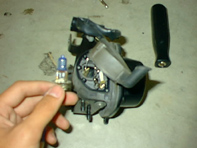
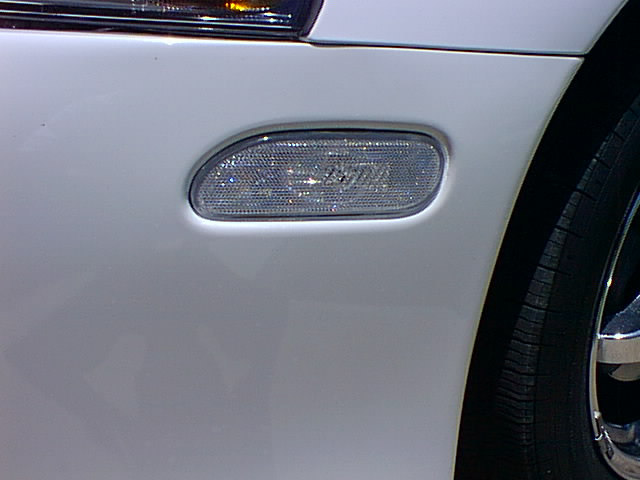 I've
already gone through a set of clear corners, seems like they're still pretty
popular, because they were stolen off my car the next day. My quest
for night time illumination has lead me to American Products Company's
Xenon Plasma H3 Foglight bulbs. Rated at 100 watts, they illuminate
130 watts of equivalent light output. This definitely helped.
The power consumption over stock is noticeable. At idle, the activation
of the foglights, dim the PIAA's, but around 1200rpm, everything's cool.
I also received my Tanabe Super Down Precedio Springs, (Tuesday, 12/14/99)
which are noticeably stiffer than stock, and bring the car another two
inches lower to the ground. Not only do I turn heads with this low
riding, nice handling car, but I also shread precious rubber, as the lower
stance pushes the suspension higher up into the camber curve. At
night, it seems like everyone's driving with their brights on. In
shopping malls, speed bumps are a chore. Small potholes in the road,
send rigid kicks into the car, and inconceivable dips in the road, now
seem like huge cliffs. When I get out of my car, no need to step
down, I'm already at ground level. I'm so low to the ground, I could
bottom out on a grain of sand. Whatever practicality that used to
be in this car, is now sitting in two boxes on the shelf of my garage.
Do I like it? HECK YAH! Though I imagine the novelty of driving
a lower car will wear off in a couple of months, no car is complete without
being closer to the earth, and its center of gravity. There have
been problems with handling though. I anticipated exceptional lateral
traction and excellent road holding abilities, but I gained just the opposite
of that. During hard cornering, the car felt unstable and
I've
already gone through a set of clear corners, seems like they're still pretty
popular, because they were stolen off my car the next day. My quest
for night time illumination has lead me to American Products Company's
Xenon Plasma H3 Foglight bulbs. Rated at 100 watts, they illuminate
130 watts of equivalent light output. This definitely helped.
The power consumption over stock is noticeable. At idle, the activation
of the foglights, dim the PIAA's, but around 1200rpm, everything's cool.
I also received my Tanabe Super Down Precedio Springs, (Tuesday, 12/14/99)
which are noticeably stiffer than stock, and bring the car another two
inches lower to the ground. Not only do I turn heads with this low
riding, nice handling car, but I also shread precious rubber, as the lower
stance pushes the suspension higher up into the camber curve. At
night, it seems like everyone's driving with their brights on. In
shopping malls, speed bumps are a chore. Small potholes in the road,
send rigid kicks into the car, and inconceivable dips in the road, now
seem like huge cliffs. When I get out of my car, no need to step
down, I'm already at ground level. I'm so low to the ground, I could
bottom out on a grain of sand. Whatever practicality that used to
be in this car, is now sitting in two boxes on the shelf of my garage.
Do I like it? HECK YAH! Though I imagine the novelty of driving
a lower car will wear off in a couple of months, no car is complete without
being closer to the earth, and its center of gravity. There have
been problems with handling though. I anticipated exceptional lateral
traction and excellent road holding abilities, but I gained just the opposite
of that. During hard cornering, the car felt unstable and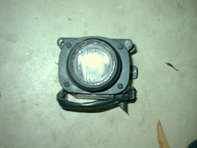
 wobbly, and the tires squealed sooner into the turn. Cornering hard
and hitting a bump proved even worse, causing the car to handle unpredictably
and sending a loud "kurchunk" sound into the cabin. What happened
as a result of the lowering was, the level of suspension travel was reduced
by exactly the same amount the car had been lowered, two inches.
This meant that during compression, the suspension had two inches less
of travel over stock, which meant it was prone to "bottoming out."
This occurs when under a hard load, the suspension reaches its maximum
amount of compression and no longer absorbs shock. Any additional
level of compression will consequently force the shock assembly to channel
additional energy to the chassis as well as the bump stops that keep the
suspension from destroying the car. When this happens, as in a hard
turn while hitting a bump, for all intensive purposes, the dampening level
becomes infinite and the tires reach slip angles beyond the tuning specifications
of the suspension. When a car manufacturer designs the suspension,
they take careful consideration of the slip angle caused by each tire and
use that to help tune the suspension. When a car is lowered, the
slip angle is also changed, generally as a result of the lack of wheel
travel, and the additional stiffness of the spring, without change in the
level of compression dampening by the shock. This is also a reason
why shocks are important when lowering a car. Lowering a car also
causes different imputs by the suspension. Because the car is so
low, and the camber is pushed up higher into its curve, a bump might send
steering imputs into the
wobbly, and the tires squealed sooner into the turn. Cornering hard
and hitting a bump proved even worse, causing the car to handle unpredictably
and sending a loud "kurchunk" sound into the cabin. What happened
as a result of the lowering was, the level of suspension travel was reduced
by exactly the same amount the car had been lowered, two inches.
This meant that during compression, the suspension had two inches less
of travel over stock, which meant it was prone to "bottoming out."
This occurs when under a hard load, the suspension reaches its maximum
amount of compression and no longer absorbs shock. Any additional
level of compression will consequently force the shock assembly to channel
additional energy to the chassis as well as the bump stops that keep the
suspension from destroying the car. When this happens, as in a hard
turn while hitting a bump, for all intensive purposes, the dampening level
becomes infinite and the tires reach slip angles beyond the tuning specifications
of the suspension. When a car manufacturer designs the suspension,
they take careful consideration of the slip angle caused by each tire and
use that to help tune the suspension. When a car is lowered, the
slip angle is also changed, generally as a result of the lack of wheel
travel, and the additional stiffness of the spring, without change in the
level of compression dampening by the shock. This is also a reason
why shocks are important when lowering a car. Lowering a car also
causes different imputs by the suspension. Because the car is so
low, and the camber is pushed up higher into its curve, a bump might send
steering imputs into the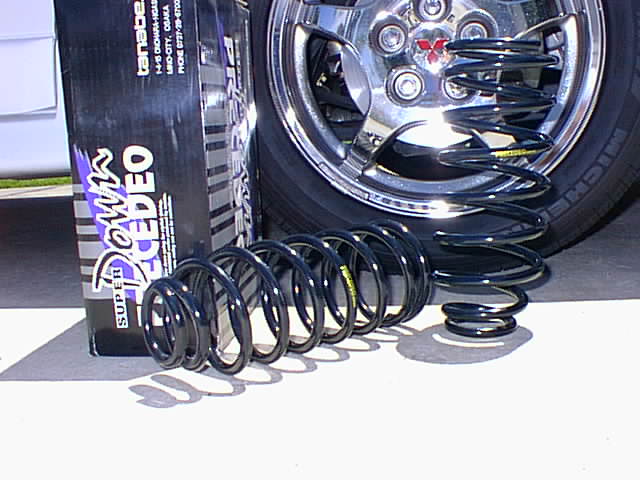 suspension. Instead of absorbing the bump, the suspension now channels
that shock into a directional movement which will cause the car to move
in a direction which is not approved by the driver. The only possible
benefits lowering your car can have is A) reduction of the center of gravity
B) improved looks. A reduction in the center of gravity will help
improve the handling of your car, but you must also take into account the
resulting change in your suspension geometry. When your car turns,
the suspension compresses, which causes a change in the camber that will
enable the tires to remain parallel to the pavement. However, when
you lower your car, you are also simulating a hard turn to your suspension.
Your suspension will act as if you car was constantly turning by a level
of two inches or whatever height your car is lowered. Consequently
your camber will also increase no longer allowing the suspension to hold
the tire parallel to the ground during normal driving. This in itself
not only causes a problem for the handling of your car, but also causes
severe tire wear, normally on the inside portion of the tire tread.
The contact patch is also reduced to that small portion of the inner tire
which is experiencing the most wear. The outside portion rarely contributes
to traction, and as a result your car will have a higher slip angle than
anticipated by your manufacturer. If you are simply going for a lousy
ride and just want looks, then this information does not pertain to you.
If you can afford to get toasted on the onramp by a stock car because you
wanted your car to look good, that is your choice. But if you want
a good ride, and one that can handle well, lower your car an inch or inch
and a half at most, and get a set of good adjustable shocks to compensate.
The shocks will reduce the level of suspension travel under load, by providing
more dampening force which will ultimately prevent your suspension from
bottoming out. The increased stiffness of your springs is not enough
to accomplish this task. Your car will also have improved transient
response (weaving in and out of traffic) as a result of this modification.
P.S. I no longer have these springs on my car. =) They're for sale.
Anyone interested?
suspension. Instead of absorbing the bump, the suspension now channels
that shock into a directional movement which will cause the car to move
in a direction which is not approved by the driver. The only possible
benefits lowering your car can have is A) reduction of the center of gravity
B) improved looks. A reduction in the center of gravity will help
improve the handling of your car, but you must also take into account the
resulting change in your suspension geometry. When your car turns,
the suspension compresses, which causes a change in the camber that will
enable the tires to remain parallel to the pavement. However, when
you lower your car, you are also simulating a hard turn to your suspension.
Your suspension will act as if you car was constantly turning by a level
of two inches or whatever height your car is lowered. Consequently
your camber will also increase no longer allowing the suspension to hold
the tire parallel to the ground during normal driving. This in itself
not only causes a problem for the handling of your car, but also causes
severe tire wear, normally on the inside portion of the tire tread.
The contact patch is also reduced to that small portion of the inner tire
which is experiencing the most wear. The outside portion rarely contributes
to traction, and as a result your car will have a higher slip angle than
anticipated by your manufacturer. If you are simply going for a lousy
ride and just want looks, then this information does not pertain to you.
If you can afford to get toasted on the onramp by a stock car because you
wanted your car to look good, that is your choice. But if you want
a good ride, and one that can handle well, lower your car an inch or inch
and a half at most, and get a set of good adjustable shocks to compensate.
The shocks will reduce the level of suspension travel under load, by providing
more dampening force which will ultimately prevent your suspension from
bottoming out. The increased stiffness of your springs is not enough
to accomplish this task. Your car will also have improved transient
response (weaving in and out of traffic) as a result of this modification.
P.S. I no longer have these springs on my car. =) They're for sale.
Anyone interested?
CAT-BACK EXHAUST

 Got
the APEXi RS Exhaust on (Tuesday, 1/1/00), and darn does it help.
The piping is very different from most typical exhaust systems for the
GS-T. First of all it is currently the largest piping available for
the GS-T model. The A pipe that bolts onto the cat is sized down
to 70mm in order to fit onto the cat, but enlarged to 75-80mm after about
three inches of piping. It expands again at the rear, after the resonator,
to 85mm where it goes through the straight through muffler and exits the
4.5" tip. This "megaphone" style piping has been pioneered by APEXi
based on the concept that exhaust gases travel on the outside of the pipe.
The gradual increase in the pipe allows the gases to move out freely with
minimal backpressure and resistance. Most other pipes that I could
find for this car, only had one piping size, generally at 70mm. This
is roughly 2.75" which is pretty large, but not large enough. Turbo
cars need the least amount of backpressure in order to operate efficiently.
Another interesting thing I noted was the fact that, the APEXi pipe goes
below the rear suspension frame as it connects to the muffler. All
other exhausts make a sharp bend over the suspension frame and then proceed
into the muffler.
Got
the APEXi RS Exhaust on (Tuesday, 1/1/00), and darn does it help.
The piping is very different from most typical exhaust systems for the
GS-T. First of all it is currently the largest piping available for
the GS-T model. The A pipe that bolts onto the cat is sized down
to 70mm in order to fit onto the cat, but enlarged to 75-80mm after about
three inches of piping. It expands again at the rear, after the resonator,
to 85mm where it goes through the straight through muffler and exits the
4.5" tip. This "megaphone" style piping has been pioneered by APEXi
based on the concept that exhaust gases travel on the outside of the pipe.
The gradual increase in the pipe allows the gases to move out freely with
minimal backpressure and resistance. Most other pipes that I could
find for this car, only had one piping size, generally at 70mm. This
is roughly 2.75" which is pretty large, but not large enough. Turbo
cars need the least amount of backpressure in order to operate efficiently.
Another interesting thing I noted was the fact that, the APEXi pipe goes
below the rear suspension frame as it connects to the muffler. All
other exhausts make a sharp bend over the suspension frame and then proceed
into the muffler.
I had some time to test out the drivability differences
between the stock exhaust and APEXi exhaust, and was immediately surprised
by the differences. The APEXi system was surprisingly quiet, I thought
it was going to be much louder when I first started the car up. The
stock exhaust was decent, but had small piping and several resonators,
not to mention a very restrictive muffler. Ultimately it was quieter
even under hard acceleration, but was seriously depriving the car of high
end power. The car did not like to pull after 4000rpm, I could actually
feel the car losing its power as I edged toward 6000rpm, and after about
6000rpm, the car was only making a harsh noise and not really accelerating.
It felt like the car was begging me to shift to the next gear so it could
go back down to a more efficient rpm range. The APEXi system made
considerably more power at the top end and pulls hard all the way to 5000rpm,
and starts to die off after that. Around 6500rpm I also noticed the
car wasn't really pulling, but rather making more sound that anything.
This is not a fault of the exhaust system, rather, the fault of the turbo.
The turbo is geared toward low RPM torque, as proven by the 3000rpm torque
peak. This means that anything after that RPM, the torque decreases,
and the higher RPM you get up to, the less torque you get. The APEXi
did a good job leveling out the torque curve, not dropping as much after
the peak, but only gradually decreasing in power, and then finally losing
it around 6000rpm. The stock exhaust seem like it was fine till about
4000rpm, where then it just decided to make sounds and not really flow
out the exhaust. The APEXi exhaust also allowed boost to build up
more quickly especially when transitioning from normal driving to wide-open-throttle,
where as the stock exhaust seemed to hum a bit and gradually reach effective
boost pressure.
 When
compared to the Tanabe G-Power Medalian system designed for the GS-T, I
noticed pretty interesting differences, in both the engineering and design
of the exhaust, as well as the sound of the exhaust. The Tanabe
G-Power Medalian is a bit bassier and deeper sounding than the RS.
It grabs more attention with its audible tune when idling or at Wide Open
Throttle (WOT). The RS is much quieter under normal circumstances,
but a bit harsher at WOT. The piping in the exhausts are also fairly
different. The design of the mandrel bends and their travel path
are also quite different. The stock exhaust makes a steep bend above
the rear suspension frame reducing the flow of the exhaust. The Tanabe
system also uses the same bend over the suspension frame, which, may be
stractegic planning in backpressure levels. The APEXi exhaust system
prefers to have its pipe go under the suspension frame with less intense
bends. This however makes the piping closer to the ground, which
poses a problem in lowered cars. Even at stock height, the pipe scrapes
the ground when I go up the driveway. The APEXi clearly has larger
piping, exiting at 85mm after the resonator, as opposed to 70mm on the
Tanabe system. Since the Tanabe system has an extra resonator, and
smaller piping, I would have to say that there is considerably more backpressure
when compared to the bigger diameter, less restrictive APEXi system.
The Tanabe system allows the car to have a bit more mid-range torque where
as the APEXi system seems to shine at higher RPMs. Both systems are
of excellent quality, but I prefer the larger piping on the APEXi system,
and better high speed high end power characteristics. If you're looking
for a system that has good mid-range punch, I recommend the Tanabe system.
It flows way better than stock, without sacrificing mid range torque, so
you get the best of both worlds. Get the APEXi if you like racing
(me) and dont mind a slight increase in noise (not much louder than Tanabe,
both systems are extremely quiet!) and don't really care too much about
backpressure (me). If you don't care about noise, get the N1 or Dunk
system by APEXi. They both have the same pipe configuration as the
RS, but have different muffler configurations for different tastes in sound
and style.
When
compared to the Tanabe G-Power Medalian system designed for the GS-T, I
noticed pretty interesting differences, in both the engineering and design
of the exhaust, as well as the sound of the exhaust. The Tanabe
G-Power Medalian is a bit bassier and deeper sounding than the RS.
It grabs more attention with its audible tune when idling or at Wide Open
Throttle (WOT). The RS is much quieter under normal circumstances,
but a bit harsher at WOT. The piping in the exhausts are also fairly
different. The design of the mandrel bends and their travel path
are also quite different. The stock exhaust makes a steep bend above
the rear suspension frame reducing the flow of the exhaust. The Tanabe
system also uses the same bend over the suspension frame, which, may be
stractegic planning in backpressure levels. The APEXi exhaust system
prefers to have its pipe go under the suspension frame with less intense
bends. This however makes the piping closer to the ground, which
poses a problem in lowered cars. Even at stock height, the pipe scrapes
the ground when I go up the driveway. The APEXi clearly has larger
piping, exiting at 85mm after the resonator, as opposed to 70mm on the
Tanabe system. Since the Tanabe system has an extra resonator, and
smaller piping, I would have to say that there is considerably more backpressure
when compared to the bigger diameter, less restrictive APEXi system.
The Tanabe system allows the car to have a bit more mid-range torque where
as the APEXi system seems to shine at higher RPMs. Both systems are
of excellent quality, but I prefer the larger piping on the APEXi system,
and better high speed high end power characteristics. If you're looking
for a system that has good mid-range punch, I recommend the Tanabe system.
It flows way better than stock, without sacrificing mid range torque, so
you get the best of both worlds. Get the APEXi if you like racing
(me) and dont mind a slight increase in noise (not much louder than Tanabe,
both systems are extremely quiet!) and don't really care too much about
backpressure (me). If you don't care about noise, get the N1 or Dunk
system by APEXi. They both have the same pipe configuration as the
RS, but have different muffler configurations for different tastes in sound
and style.
HIGH INTENSITY GAS DISCHARGE HEADLAMP
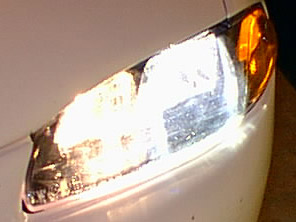
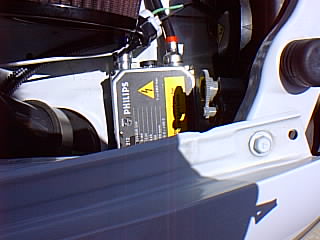 Got
the true HID's installed (Thursday 5/18/00). No more PIAA's.
The High Intensity Gas Discharge system is custom fabricated by Philips
and Hella Lighting Systems. The headlight conversion was relatively
painless and offers an extraordinary increase in lighting. The system
consists of two ignition ballasts with fast re-strike capabilities, receiving
power directly from the battery. The bulbs consist of a filamentless
capsule of gas filled with noble gases including Xenon. The electrodes
at each end of the capsule are charged with high voltage current which
allows the gas to ignite and form the bright purplish-white beam of light.
The HID bulbs are placed in the stock location with no modifications to
the housing, and are linked to the ignition ballasts by thick high voltage
cabling. The ignition voltage of the XENON light is 25,000 volts
and emits a high pitched whine under normal operation. Upon cold
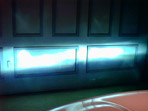
ignition, the HID's emit a bright blue light that slowly warms to a bright
white within a minutes time (see pictures). The illumination in lumens
is about three times as much as my PIAA's, while only consuming 35watts
as opposed to 51W. Previously, when I turned my foglights on I noticed
a dramatic increase in the amount of diffused light being projected in
front of me, but now, activation of the foglights shows almost no difference
in the amount of light being observed on the road. The HID's are
just too powerful. Because the Eclipse has a seperate lamp housings
for the High-Beams, the addition of HID's did not cause for the removal
of the high beam system as common in dual filament installs, such as Honda's.
I am thoroughly impressed with the performance of these HID's. I
no longer need to activate my high bea
Got
the true HID's installed (Thursday 5/18/00). No more PIAA's.
The High Intensity Gas Discharge system is custom fabricated by Philips
and Hella Lighting Systems. The headlight conversion was relatively
painless and offers an extraordinary increase in lighting. The system
consists of two ignition ballasts with fast re-strike capabilities, receiving
power directly from the battery. The bulbs consist of a filamentless
capsule of gas filled with noble gases including Xenon. The electrodes
at each end of the capsule are charged with high voltage current which
allows the gas to ignite and form the bright purplish-white beam of light.
The HID bulbs are placed in the stock location with no modifications to
the housing, and are linked to the ignition ballasts by thick high voltage
cabling. The ignition voltage of the XENON light is 25,000 volts
and emits a high pitched whine under normal operation. Upon cold
ignition, the HID's emit a bright blue light that slowly warms to a bright
white within a minutes time (see pictures). The illumination in lumens
is about three times as much as my PIAA's, while only consuming 35watts
as opposed to 51W. Previously, when I turned my foglights on I noticed
a dramatic increase in the amount of diffused light being projected in
front of me, but now, activation of the foglights shows almost no difference
in the amount of light being observed on the road. The HID's are
just too powerful. Because the Eclipse has a seperate lamp housings
for the High-Beams, the addition of HID's did not cause for the removal
of the high beam system as common in dual filament installs, such as Honda's.
I am thoroughly impressed with the performance of these HID's. I
no longer need to activate my high bea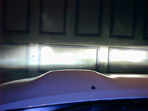
 ms
in poorly lit back country roads. Having gone through many halogen
light bulbs that promise to provide the illumination of HID's, I've been
through the quest of searching for the brightest lights. The blue
bulbs actually put more strain on my eyes at night. There
is nothing that can compare to the intensity of true Xenon. Blue
bulbs have a blue coat on the bulb which produces blue light as a primary
source of road illumination. While blue light has a higher resolving
power than normal yellowish light, the wattage must be increased in order
to compensate for the reduction in lumens caused by the blue tint on the
bulb. True HID's have no such tint on the bulb. The purplish
tint you see is the bi-product of the of the gases, the actual useable
color is in the upper color temperatures. In contrast, those "Hyper/Super/Plasma
White Bulbs" with Xenon on their labeling have some sort of tint on their
bulb. Halogen lights emit light in the color temperature range of
3200K. This is the primary color of the useable light. The
blue tint on the bulb filter light below around 4100K. So now you
have a bulb that burns at 3200K, produce light at 4100K. Halogen
bulbs were not meant to do this, and you will see that with all of the
useable light blocked out, everything will be blue and dim These
bulbs normally consume more wattage than stock in order to compensate for
their lack of road illumination. If you are a riceboy and just want
blue lights that look different, then you can settle for cheap imitations.
If you are an intelligent person and are looking for better road illumination
for added safety, and cannot afford the steep price of HIDs, I recommend
the PIAA Platinum Series Bulbs.
ms
in poorly lit back country roads. Having gone through many halogen
light bulbs that promise to provide the illumination of HID's, I've been
through the quest of searching for the brightest lights. The blue
bulbs actually put more strain on my eyes at night. There
is nothing that can compare to the intensity of true Xenon. Blue
bulbs have a blue coat on the bulb which produces blue light as a primary
source of road illumination. While blue light has a higher resolving
power than normal yellowish light, the wattage must be increased in order
to compensate for the reduction in lumens caused by the blue tint on the
bulb. True HID's have no such tint on the bulb. The purplish
tint you see is the bi-product of the of the gases, the actual useable
color is in the upper color temperatures. In contrast, those "Hyper/Super/Plasma
White Bulbs" with Xenon on their labeling have some sort of tint on their
bulb. Halogen lights emit light in the color temperature range of
3200K. This is the primary color of the useable light. The
blue tint on the bulb filter light below around 4100K. So now you
have a bulb that burns at 3200K, produce light at 4100K. Halogen
bulbs were not meant to do this, and you will see that with all of the
useable light blocked out, everything will be blue and dim These
bulbs normally consume more wattage than stock in order to compensate for
their lack of road illumination. If you are a riceboy and just want
blue lights that look different, then you can settle for cheap imitations.
If you are an intelligent person and are looking for better road illumination
for added safety, and cannot afford the steep price of HIDs, I recommend
the PIAA Platinum Series Bulbs.
REAR TINT
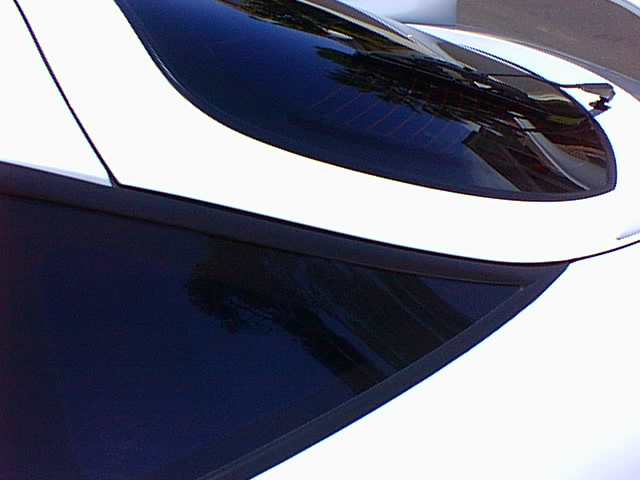 The
windows were treated with Llumar Titanium Film Tuesday (6/20/00)
with a 5% light transmittance on rear three windows. The tint reduces
heat and blocks out 99% of UV light. The amount of heat reduced by
just the rear tint was tremendous. During the hot summer days that
immediately proceeded the application of the tint, the interior of the
car remained significantly cooler than previously. You can easily
feel the heat of the sun burn through untinted glass when cruising on the
freeway, even though my front windows came treated with UV protection straight
out of the factory. But the rear windows offer immense protection
from the sun. The tint also helps at night by reducing the amount
of glare caused by bright lights from higher sport utilities or trucks.
This used to annoy me on the freeway, when a large truck with a higher
beam angle would blind me from the rear. Now with the light transmittance
being reduced, the lights dont look so bright anymore. The tint also
added a more stylish visual appeal, something that I don't mind having.
The
windows were treated with Llumar Titanium Film Tuesday (6/20/00)
with a 5% light transmittance on rear three windows. The tint reduces
heat and blocks out 99% of UV light. The amount of heat reduced by
just the rear tint was tremendous. During the hot summer days that
immediately proceeded the application of the tint, the interior of the
car remained significantly cooler than previously. You can easily
feel the heat of the sun burn through untinted glass when cruising on the
freeway, even though my front windows came treated with UV protection straight
out of the factory. But the rear windows offer immense protection
from the sun. The tint also helps at night by reducing the amount
of glare caused by bright lights from higher sport utilities or trucks.
This used to annoy me on the freeway, when a large truck with a higher
beam angle would blind me from the rear. Now with the light transmittance
being reduced, the lights dont look so bright anymore. The tint also
added a more stylish visual appeal, something that I don't mind having.
BOOST GAUGE
Happy Birthday to me! (7/10/00) My friend
Ben gave me a -30-0-30 Phantom 52mm Boost Gauge by Autometer for my Birthday.
Thanks Ben! Installation was pretty simple. A T-fitting had
to be purchased, since one did not come with the boost guage. This
was the only additional item that was required for proper setup of the
boost guage. The T-fitting mounts to the hose that runs directly
out of the intake plenum. This is the best source for reading boost/vacuum
in the car. Since I am not writing a "how-to" page, I won't go over
the install details. If you need help though, you can always contact
me by email. The engine idles at around -20psi of pressure (a.k.a.
vacuum). Back to 'Boost 101.' All cars should idle at vacuum
since the engine is sucking in air from the intake plenum causing a reduction
in pressure. In naturally aspirated cars, a maximum of 0psi, or 1atm
of pressure can be reached at WOT. The pressure inside the plenum
is equal to the outside pressure, since the throttle body is open, and
the air pressures can be matched. (During idle, the throttle plate
is closed, and air is obtained through a seperate valve) In turbocharged
and supercharged cars, 'boost' can be obtained, whenever the pressure exceeds
that of the standard atm. This is accomplished by a compressor which
is operated by exhaust gases (turbocharging) or by the motion of
the crankshaft (supercharging). The compressor allows the
engine to receive air pressures that are greater than the standard of the
atmosphere,  allowing
more efficient volumetric combustion of gases. At 14.7psi, or 1 kg/cm2
of boost (two times the amount of standard atm) the engine is, in
effect, receiving double the charge of oxygen (as that which can be
obtained from a naturally aspirated engine). More oxygen per
volume, means better combustion (assuming the proper ratio of fuel is
added). Careful attention to the boost gauge revealed interesting
results during many driving situations. With the current mods (everything
above this paragraph) typical driving on the street yields about 6-10psi
of pressure (a.k.a. boost). Boost spikes of 19-20psi were
detected at initial WOT in second gear. However, these values leveled
to around 14psi. The maximum constant boost pressure that I could
obtain was about 16psi in 4th gear, WOT, at around 90-100mph. The
addition of an electronic boost controller should allow me to safely increase
boost levels for better performance.
allowing
more efficient volumetric combustion of gases. At 14.7psi, or 1 kg/cm2
of boost (two times the amount of standard atm) the engine is, in
effect, receiving double the charge of oxygen (as that which can be
obtained from a naturally aspirated engine). More oxygen per
volume, means better combustion (assuming the proper ratio of fuel is
added). Careful attention to the boost gauge revealed interesting
results during many driving situations. With the current mods (everything
above this paragraph) typical driving on the street yields about 6-10psi
of pressure (a.k.a. boost). Boost spikes of 19-20psi were
detected at initial WOT in second gear. However, these values leveled
to around 14psi. The maximum constant boost pressure that I could
obtain was about 16psi in 4th gear, WOT, at around 90-100mph. The
addition of an electronic boost controller should allow me to safely increase
boost levels for better performance.
A/F GUAGE & A-PILLAR MOUNT
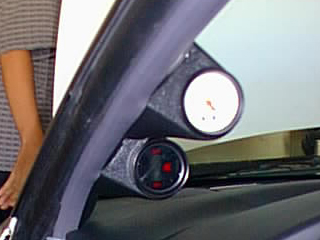 No
more 'ghetto-rigged' boost guages sitting on the dash. Now the guages
are more or less professionally mounted on the A-Pillar. Too much
rice? Maybe, but with the addition of an Electronic Boost Guage,
I think these are going to be a necessity for careful tuning. The
Cyberdyne A/F Guage consists of 10 multicolored LEDs that measure the voltage
off the O2 sensor to determine the ratio of Air to Fuel. It is a
helpful tuning tool when raising boost levels beyond stock, but it is not
as accurate as some guages that measure exact voltage. Still, it
will warn you of an extremely rich or lean condition. As for the
A-Pillar Guage Mount, I found it kind of bulky and unsettling. I
should have had it painted to match my interior, but still, even then it
probably would'nt have looked all that great. My main complaint is
in regards to the ergonomics of the mount. The mount is made of extremely
thick plastic which makes it difficult for proper mounting. It is
also heavy. The plastic screws that came with it are a joke, as well
as the double stick tape. I had to drill a seperate hole for a real
screw, and now I'm going to have three or four holes in my A-Pillar when
the guages come off. I also feel that it makes my car uglier, but
that is the only place I could think to mount them. Enough complaints,
on to more important things.
No
more 'ghetto-rigged' boost guages sitting on the dash. Now the guages
are more or less professionally mounted on the A-Pillar. Too much
rice? Maybe, but with the addition of an Electronic Boost Guage,
I think these are going to be a necessity for careful tuning. The
Cyberdyne A/F Guage consists of 10 multicolored LEDs that measure the voltage
off the O2 sensor to determine the ratio of Air to Fuel. It is a
helpful tuning tool when raising boost levels beyond stock, but it is not
as accurate as some guages that measure exact voltage. Still, it
will warn you of an extremely rich or lean condition. As for the
A-Pillar Guage Mount, I found it kind of bulky and unsettling. I
should have had it painted to match my interior, but still, even then it
probably would'nt have looked all that great. My main complaint is
in regards to the ergonomics of the mount. The mount is made of extremely
thick plastic which makes it difficult for proper mounting. It is
also heavy. The plastic screws that came with it are a joke, as well
as the double stick tape. I had to drill a seperate hole for a real
screw, and now I'm going to have three or four holes in my A-Pillar when
the guages come off. I also feel that it makes my car uglier, but
that is the only place I could think to mount them. Enough complaints,
on to more important things.
REAR STRUT TOWER BAR
Like the front strut tower bar, the rear bar
was successful in adding a significant amount of torsional and structural
rigidity to the chassis. As stupid as I am, I drove for nearly a
year with only a front tower bar thinking my handling was going to improve.
For my use, I think it actually deteriorated. While the chassis was
stiffer, the front was now much stiffer than the rear, which made the car
prone to understeer, a characteristic which is horrible for skidpad style
manuevers. With the addition of the rear strut tower bar there was
a noticeable increase in handling. On-ramps are no longer a chore
at double the posted speed limit. With a hint of rear tire chirp,
the car carves the turn with confident precision. I am still searching
for other ways to stiffen the rear chassis, since this now seems to be
the ultimate goal in performance handling. The Eclipse comes out
of the lot with a really flimsy rear. This supposedly prevents disaster
caused by an inexperienced driver. Generally, most FF (front engine,
front wheel drive) cars have a noticeable amount of understeer by nature.
During a hard turn, a typical FF car will start losing traction in the
front tires, earlier than the rear tires. This means, the front starts
sliding towards the outside portion of the curve. You will notice
that when this occurs, you will fly off the road if you continue to accelerate.
Realizing this, the would-be inexperienced driver, would take a course
of action to correct, generally, slow down, regain traction to the front
tires, and make the turn. But this is the slowest way around a turn.
In reality, for an experienced driver, you would want a stiff rear, so
that the front no longer loses traction first, rather, the rear.
Now, on a hard turn, you are not sliding outside of the curve, but instead
you will be sliding the rear end out, which means orientating the front
towards the center of the circle. This is called oversteer.
Most FR, MR, and RR cars have this type of behavior. This, however,
makes the car a bit more unpredictable, since the driver is unable to tell
whether the rear will slide out completely and force the car into a complete
spin. Careful applicate of traction loss is what makes FF cars potentially
awesome on turns that would normally only be conquered by RWD vehicles.
FF cars are also more stable around a turn when accelerating, since the
front tires are taking care of putting the power to the ground. You
get serious issues if you have RWD, since you have to worry about not putting
too much power into the throttle. In FF cars, constant application
of power to the front tires, continuously correct the steering angle on
a turn.
REAR LOWER TIE BAR
 I
think this thing is more of a joke than a functional part. The tie
bar connects two bolts that are attached to the rear subframe. The
rear subframe is one of the most rigid parts of the car, and why a bar
would have any additional effect is beyond me. In my eyes, the rear
lower tie bar is just a shiny, polished stainless steel gimick that adds
a good 3-4 pounds to the car. I didn't really notice any differences
in handling. I would try and use more space by typing some useful
information, but I suppose useful information only comes from useful parts.
I
think this thing is more of a joke than a functional part. The tie
bar connects two bolts that are attached to the rear subframe. The
rear subframe is one of the most rigid parts of the car, and why a bar
would have any additional effect is beyond me. In my eyes, the rear
lower tie bar is just a shiny, polished stainless steel gimick that adds
a good 3-4 pounds to the car. I didn't really notice any differences
in handling. I would try and use more space by typing some useful
information, but I suppose useful information only comes from useful parts.
BIG BRAKES
What good is go fast modifications without something
to slow you down safely and efficiently? Many people do not realize
how important it is to have an adequate brake system to match the extra
power generated in modifications. When you start moving faster, you're
going to need a brake system that can handle that extra speed. Generally,
your stock brake system will suffice, however, in some cases, an upgrade
will be necessary. There are exceptions. With this reasoning,
I would have to be pretty arrogant in thinking my car is too fast for the
stock brake system, so I will say, this is one of those exceptions.
Generally speaking, most cars use single piston calipers to bind the pads
onto the rotors, and  in
effect, slow the car to a stop. The problem with a single piston
is not the fact that adequate effort cannot be generated, rather the fact
that it does not distribute the brake force efficiently. The center
of the brake pad may experience the most friction, while the edges experience
less. The trick is to get the most frictional surface area possible.
Let's say you get larger pads. Sure this is going to give you more
surface area, but how will the single piston be able to distribute all
of its power, to the large swept area of the bigger pad? Using two
pistons, instead of one does the job. Having two pressure points
spread out over a large surface area will help you generate more friction
over the surface of the bigger pad, and allow you to stop in less distance
than a single piston might afford. A few cars employ twin piston
calipers, including the Corvette, Mustang GT, Eclipse GSX, etc. Some
manufacturers even go to added lengths and equip their cars with four-piston
calipers. These cars include, Supra Turbo, 3000GT Turbo, 911 Turbo
(I am not biased toward turbo cars =), etc. I have some oppurtunities
to test out these brakes, with impressive results. They dont lock
up, like I thought they would under heavy braking, but they do stop the
car instantly. The amount of braking effort required to stop in a
certain distance, is less than the stock single piston calipers.
The brakes also work effectively under repeatedly stopping. It was
difficult for me to distinguish if any brake fade was present. If
anything, the brakes bit harder when hot. Road///Race Engineering
did the conversion using OEM GSX calipers, high performance Axxis Metal
Master Brake Pads, and PowerSlot Slotted/Vented Rotors. The packaged
set is dubbed,
in
effect, slow the car to a stop. The problem with a single piston
is not the fact that adequate effort cannot be generated, rather the fact
that it does not distribute the brake force efficiently. The center
of the brake pad may experience the most friction, while the edges experience
less. The trick is to get the most frictional surface area possible.
Let's say you get larger pads. Sure this is going to give you more
surface area, but how will the single piston be able to distribute all
of its power, to the large swept area of the bigger pad? Using two
pistons, instead of one does the job. Having two pressure points
spread out over a large surface area will help you generate more friction
over the surface of the bigger pad, and allow you to stop in less distance
than a single piston might afford. A few cars employ twin piston
calipers, including the Corvette, Mustang GT, Eclipse GSX, etc. Some
manufacturers even go to added lengths and equip their cars with four-piston
calipers. These cars include, Supra Turbo, 3000GT Turbo, 911 Turbo
(I am not biased toward turbo cars =), etc. I have some oppurtunities
to test out these brakes, with impressive results. They dont lock
up, like I thought they would under heavy braking, but they do stop the
car instantly. The amount of braking effort required to stop in a
certain distance, is less than the stock single piston calipers.
The brakes also work effectively under repeatedly stopping. It was
difficult for me to distinguish if any brake fade was present. If
anything, the brakes bit harder when hot. Road///Race Engineering
did the conversion using OEM GSX calipers, high performance Axxis Metal
Master Brake Pads, and PowerSlot Slotted/Vented Rotors. The packaged
set is dubbed,  "Road
Race Big Brake Upgrade." Indeed they are. Aside from having
two-pistons and bigger pads, the rotors themselves are also larger.
The Big Brake Rotors are 20mm bigger than there smaller counterpart, measuring
275mm, roughly 10 3/4." Still, considerably smaller than AEM Rotor
Upgrades, but the magic is not really in the rotor (I never noticed any
problems with heat) but in the caliper. Afterall, the rotors job
is to simply disappate heat efficiently; its the caliper thats doing the
work. I'd imagine braking distances under 120ft on even surfaces,
even without antilock brakes. This is considerably better than the
126ft distance with the stock calipers. GSX's manage to get 118ft
with anti-lock brakes, and 200lbs of drivetrain added. [right: stock
setup; left: RRE Big Brake Upgrade; bottom: rear view of caliper with twin
pistons showing
"Road
Race Big Brake Upgrade." Indeed they are. Aside from having
two-pistons and bigger pads, the rotors themselves are also larger.
The Big Brake Rotors are 20mm bigger than there smaller counterpart, measuring
275mm, roughly 10 3/4." Still, considerably smaller than AEM Rotor
Upgrades, but the magic is not really in the rotor (I never noticed any
problems with heat) but in the caliper. Afterall, the rotors job
is to simply disappate heat efficiently; its the caliper thats doing the
work. I'd imagine braking distances under 120ft on even surfaces,
even without antilock brakes. This is considerably better than the
126ft distance with the stock calipers. GSX's manage to get 118ft
with anti-lock brakes, and 200lbs of drivetrain added. [right: stock
setup; left: RRE Big Brake Upgrade; bottom: rear view of caliper with twin
pistons showing
SPARK PLUGS:
Felt, heard and smelled nothing different.
Car's probably too slow to take advantage of it.
TIRES: (10/23/02)
The stock Goodyear Eagle RS-A's are nice tires.
They benefit from expensive tire construction (tires are directional AND
asymmetrical) with decent wear characteristics. But they're not exactly
performance tires. They are H rated which means they're only good
up to 130mph. Any faster and they're bound to overheat. This
also means sidewall construction is not as stiff as say, a ZR or even VR
rated tire. I solved the problem with a set of four new Kuhmo Ecsta
Supra 712's. Not only are they wider (225/50R16 vs. 205/55R16) but
rhey're W speed rated for high speed stability (excess of 168mph) and relatively
good performance all around. Kumho tires are not known for their
longevity; their soft tire compound works well when the tenacious grip
is needed, but at the cost of increased wear rate. Note: Its
harder to drift on these tires because they're so sticky, but the car will
still throw its back end out when trail braking into high speed turns (or
with liberal use of the E-brake =).
DOWNPIPE (12/23/02)
Three inch stainless steel straight through downpipe.
Seat of the pants self dyno suggests additional acceleration. Nice
growl between 2700-3200RPM. Definitely better throttle response,
less turbo lag, and more top end power. Smells like a race car now
too.
CRANKCASE BREATHER: (12/26/02)
Checked all the piping from where the fumes vent
into the intake all the way to the throttle body. Oil made it halfway
up the upper IC pipe, and drenched the intercooler, lower IC pipe and compressor
side of turbo with oil. Definitely needed this illegal modification.
LOWER INTERCOOLER PIPE: (12/28/02)
Rewelded the holes in the intercooler and cleaned
out the oil then stuck a nice 2" mandrel bent hard S-pipe from the turbo
to the IC. Car pulls more at the top end and when turbo initially
comes on. Getting some strange boost creep now, that I never noticed
before.