CHAPTER 15
THE HYMN
| "Ellay! Ilam kiliye! Innum Urangudhiyo?" "Chil endru azhaiyenmin, Nangaimeer! Podharugindrane." "Vallai Un katturaigal! Panday un Vaai aridhum." "Valleergal neengalaay! Naanedhaan aayiduga!" "Ollai nee podhaai, Unakkenna verudaiyai?" "Ellaarum pondhaaro?" "Pondhar, pondhennikkol!" "Vallaanai Kondraanai, maataarai matrazhikka Vallaanai, Maayanai Paadu Elorempaavaai!"
|
 |
 |
|
|

SIGNlFICATION
 |
"Parrot-like young one! Still sleeping ?" "Don't chide, me girls! I am coming!" "How you talk! Well, we already know about your virulent tongue!" "It is you, who are abusive. Alright! Let it be myself! I concede!" "Why are you late? What is so special about you?" "Has everybody come?" "Yes, come out and count yourself. We shall sing about The Supreme, who killed the elephant named Kuvalayapeetam and who destroys the innate enmity in the minds of the enemy" |
CURTAIN RAISER
This stanza is the most interesting and unique, among all the poems. It is eulogised as
 |
Hitherto, Andal was speaking out, awakening the gopis. This stanza alone is in the conversation type. Secondly, the distinctive qualities of Sri Vaishnavism are traced out in this poem. There is yet another specialty. This poem refers to Thirumangai Aazhvar as well as Nigamantha Maha Desika. Hence the encomium, that this is the best stanza in Thiruppavai - beautiful and meaningful.
THIRU MANGAI AAZHVAR
He was the youngest among the Aazhvars and so was called, young parrot. He was the incarnation of Saarngam, the Bow of The Lord. His poems are considered to be of very high
quality, saturated with deep sense and significance. They are compositions of superb beauty of thought, emotion and language. Magnificent that they are, they are said to be creations of
feeling and imagination. Melody and deep devotion shine like gems, throughout his poems. The great Ramanuja himself was an
ardent admirer of Thirumangai Aazhvar's lyrics.
He had the unique distinction of demanding Special Privilege from The Almighty (Unakkenna Verudaiyai).
"My Lord! Please do not consider me as one among the cattle", he pleaded. "I had never asked you to do anything for me. I
had never ordered you about! I had never demanded privileges, out of right, from you. The one and only thing I crave for, is
your glorious darshan. Nothing more, do I desire for", said he, with feeling. But The Lord had other ideas. He was captivated
by the beauty of the Aazhvar's songs and wanted to hear more of them. He thought
that if He granted His Darshan as desired, the aazhvar would stop singing poems. So, He parried. The Aazhvar continued to sing. He adored, he
idolised, he entreated The Lord and he shed tears. But Baghavan would not budge! He was enjoying the aazhvar's lyrics
thoroughly!
At last, the aazhvar's patience gave out. "Oh, my dear Father!", he cried out loudly, "I hoped to have your darshan by worshipping and praising you. I wept with grief. I fainted with frustration. You seem to be completely unmoved. Why are you so cruel to me? My Lord! What have I done, to deserve such a treatment? Did I ask you for anything? I just wanted to have a look at you ! If you are unwilling to grant me even that ! Well, wel!!. Please yourself! May you live long! Let me perish!"
So saying, he cursed himself. Immediately, Baghavan, who could never bear the
agony of His bakthas, fulfilled The aazhvar's wish. The aazhvar enjoyed the Lord's
darshan to his heart's content. Thus written in Tamil, Thirumangai Aazhvar's poems are
considered far superior to anybody else's poems.
NIGAMANTHA MAHA DESIKA
As stated supra, this stanza refers to the Vaishnavaite Guru, Swamy Desika too. Nigamantha Maha Desika was the
youngest among the Vaishnavaite preceptors. Hence the phrase, 'young
parrot', applies to him also. Swamy Desika himself said that he was like a parrot. "I am an ignorant simpleton. I do not know anything. Lord Srinivasa of The Seven Hills wrote the
poe m,'Daya Sadhakam'. I repeated it like a parrot!", he said. Swamy Desika was an erudite scholar. He was
an
m,'Daya Sadhakam'. I repeated it like a parrot!", he said. Swamy Desika was an erudite scholar. He was
an authority
on Vedas and Sastras. He was a multi-linguist, with special knowledge in Sanskrit and Tamil. Well
versed in writing
poems
containing all the 9 rasas, he had deep knowledge and extensive imagination. He converted Vedas and the
Brahma Sutras into poems. Ever so many poets have sung about Baghavan's Lotus Feet. But it was
Swamy Desika alone, who had produced
a series of thousand poems, extolling the Baghavan's Paduka. It is said that The Lord Himself wrote the poems, as Swamy
Desika went on dictating them. A stupendous privilege indeed! (What is special about
you?) Lord Ranganatha, sitting along with Mother Ranganayaki, was enjoying
Swamy Desika's poems. Extremely pleased with Desika's erudition, The Lord granted him the
title, 'Kavitharkika Simham', meaning a 'Lion among the Poets'. But The Mother was not happy. She felt that Desika's work could be called superlative and that after
all, Baghavan was too miserly in doing justice to Desika's scholarship! With benevolence overflowing
her loving motherly heart, She, with the consent of The Lord, bestowed the
excellent title,'Sarva Thanthra Swathanthra', meaning 'Learned in all Faculties'. An extraordinary privilege indeed!
(What is special about you?) Who else could have been so fortunate?
authority
on Vedas and Sastras. He was a multi-linguist, with special knowledge in Sanskrit and Tamil. Well
versed in writing
poems
containing all the 9 rasas, he had deep knowledge and extensive imagination. He converted Vedas and the
Brahma Sutras into poems. Ever so many poets have sung about Baghavan's Lotus Feet. But it was
Swamy Desika alone, who had produced
a series of thousand poems, extolling the Baghavan's Paduka. It is said that The Lord Himself wrote the poems, as Swamy
Desika went on dictating them. A stupendous privilege indeed! (What is special about
you?) Lord Ranganatha, sitting along with Mother Ranganayaki, was enjoying
Swamy Desika's poems. Extremely pleased with Desika's erudition, The Lord granted him the
title, 'Kavitharkika Simham', meaning a 'Lion among the Poets'. But The Mother was not happy. She felt that Desika's work could be called superlative and that after
all, Baghavan was too miserly in doing justice to Desika's scholarship! With benevolence overflowing
her loving motherly heart, She, with the consent of The Lord, bestowed the
excellent title,'Sarva Thanthra Swathanthra', meaning 'Learned in all Faculties'. An extraordinary privilege indeed!
(What is special about you?) Who else could have been so fortunate?
Once there was a debate in the Brahma Loka, as to who was greater, Goddess Mahalakshmi or Goddess Saraswathy. Brahma, The Creator, delivered judgement, in favour of Mahalakshmi. Saraswathy, caught up with anger, left Brahma immediately. She went away to do penance. When Brahma had to do a yagna, He replaced Saraswathy with Gayathri, His second wife. Saraswathy's anger knew no bounds. She rushed like a hurricane to destroy the yagna. Swamy Desika has described Saraswathy's uncontrolled anger with words, as swift and rash, as the floods of river Ganges and as excitingly sprightly as the spate of the river Cauvery.
The best service that Swamy Desika has rendered to Vaishnavism is to impart the pith of Visishtadhwaitha, that is The Philosophy of Saranagathi, in a single poem, containing only eight lines. There, he put the whole philosophy in a nutshell.
| Author's notes: Please Memorize and Chant these verses daily! |
 |
Nin arulaam Gathi indri Matrondru illane! |
|
Swamy Vedanta Desika |
|
He says:
| "I am utterly helpless, without your Grace. I have come a long way from my sinful past. I am craving for your kind benevolence. I have resolved to do Saranagathi at your Feet. Kindly drive out the darkness of ignorance in me. To attain salvation, I depend upon thee. Let your Grace release me from all my responsibilities. Oh, Lord! Accept me as your sincere refugee". |
INTERPRETATION
NAANEDHAN AAYIDUGA
This gopi is angry. She hears Andal making fun of her. She hits out at Andal, using pungent language. But, immediately better sense prevails. She realizes that it is a sacrilege to insult bakthas of Sri Krishna. She admits her mistake and owns her misdemeanour. This is one of the important principles of Sri Vaishnavism. One must have the courage and integrity to admit one's mistakes and have the determination to mend oneself.
|
|
If a person hurts us by using insulting words, we must, at the
outset, analyze it - prima facie.
|
|||
|
|
||||
| Well. If that is the case, the question arises as to how the person, who abused me, knew about my previous birth? It can be interpreted that the person did not speak by himself, and that The Lord residing in him speaks out. Is there anything, that the omniscient does not know? | ||||
|
Therefore, we have no option but to accept it with good grace. This gnana is a characteristic feature of Vaishnavism. |
||||
Paraasara Butter was insulted by the people around him. He presented his ring to them and thanked them for reminding him of his sins.
OLLAI NEE PODHAAI
|
INSIGHT FROM INSIDE It is the convention of Vaishnavism to associate oneself with bakthas. |
ELLORUM PONDHAARO?
|
INSlGHT FROM INSIDE Sri Vaishnavism is not anyone's personal property. Anybody can follow it. The principle is to follow the traditions of our ancestors, without seeking special previleges.
|
VAL YAANAI KONDRAANAI
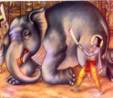
Kamsa sent an asura in the guise of an elephant called Kuvalayaapeetam. The huge pachyderm had tremendous strength. When it rushed on to attack Sri Krishna, the latter broke its valuable tusks and killed it with ease.
MAATRAANAI MAATRAZHIKKA
God has no enemies. If anybody treats God as his enemy, He, with His infinite mercy, destroys, not the person, but the
enmity, which is latent in him. Ravana considered Sri Rama as his arch enemy. But Sri Rama never reciprocated that feeling.
In Kamba Ramayana, tamil poet Kamban portrays Mandodhari, Ravana's queen, as lamenting thus, when Ravana was
fatally injured by Sri Rama's arrows:
"Sri Rama is benevolence personified. He would not try to kill my husband. But His arrows have pierced the strong body of
my husband, very closely. I wonder, whether all these arrows penetrated into him to find out where his wicked, illicit love for
Sita is concealed !"
When Ravana died, Sri Rama asked Vibhishana to perform the last rites due to his brother. Sri Rama said
quietly, "Vibhishana! Do not consider Ravana as your enemy. He is dead now. With him died his hostility towards me.
Dead persons do not hate others, neither can the living bear any ill-will towards
the dead. So do your duty to Ravana, as his younger brother. Perform his last rites in a
befitting manner. If you refuse to do it, I shall take it upon myself, and per form the
obsequies myself!"
 |
Such is the limitless Grace of The Lord, the Treasure Trove of Benevolence. |