|
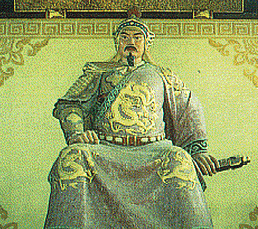
The Terracotta Emperor - Qin
Shi Huang
| Emperor Qin
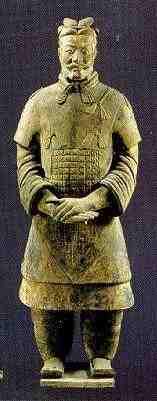
Shi Huang attained world fame in the late 1970's, with the discovery of
the incredible Terracotta Soldiers near his tomb in Xian. For a man who
only reigned for 37 years, he certainly made an impact, even at that
time. Prior to the excavations which revealed the fabulous Terracotta
Army, for which he was responsible, his claim to fame was one of
notoriety, because he was also responsible for one of China's greatest
tragedies, the saga known as The Burning of the Books. Not
content with burning books, he was also responsible for having scholars
buried, in an attempt to rewrite history.
It is ironic that the man
responsible for destroying so much of China's past, should now be
remembered for providing it with it's biggest tourist attraction.
However, the man who was also responsible for initiating possibly
China's greatest architectural feat, the Great Wall and who was also
responsible for the unification of China and as a result, became the
First Emperor in 221 BC, was also obsessed with the search for
immortality.
|
 |
Although he only ruled
for 37 years, his list of achievements is phenomenal and he was clearly
a very determined man. He had an early start in life and the age of 13
his father died and he became the King of Qin, one of the 7 principle
states which, at that time, prior to unification, were constantly in
conflict with each other. Having defeated the other states, in 221 BC he
was proclaimed the First Emperor of a unified China and he then set
about implementing a centralised form of control.
He initiated the Great
Wall by joining together two smaller walls belonging to previous states
and proclaimed that the wall should be extended to cover the entire
border. He also introduced a universal system of currency as well as
standard weights and measures.
|
|
In contrast to this, he was also
responsible for some terrible deeds, carried out to act as a deterrent
to anyone who wanted to oppose him. As time went on, he became even more
ruthless and in 213 BC, he ordered the arrest of hundreds of scholars
from every region of China. He had already ordered the burning of tens
of thousands of books, but this did not satisfy him and he decided that
all the scholars that had been arrested should be buried alive to
prevent them from writing anything else.
Even his eldest son, Fu Su, tried to
stop him from carrying out this dreadful deed and he was very lucky to
escape with his life and instead was banished to a remote region of the
Empire.
Not surprisingly, Emperor Qin had many
enemies, not only from all the states that he had conquered, in order to
achieve his dream of unification, but also from the common people and
artisans. It has been estimated that tens of thousands of workers, many
of whom were conscripted, died working on the Great Wall and other
architectural feats. It is said that his tomb that he had built, used
nearly 750,000 workers and at that time, the casualty rate was very high
and many lost their lives. He was many things, but popular was not one
of them.
|
 |
After a number of unsuccessful attempts
on his life, he became increasingly suspicious and in his later years,
he retreated more and more to the safe confines of his palaces. He
became obsessed with death and believed that he would discover the
secret of immortality. Feng Shui clearly played a part, since he went
to extraordinary lengths when it came to the construction and fitting
out of his tomb. The great historian, Su Ma Qian, recorded some of the
details of the tomb, which has to date, never been excavated.
|
|
However spectacular the Terracotta
Army is, there is no doubt in my mind, that the tomb he constructed for
himself on Mount Lishan, was an even greater achievement. This
underground palace had, according to the Historical Records written by
the great historian, Su Ma Qian, a banqueting hall large enough to cope
with dinner for over 100 guests, but this was perhaps the least
remarkable feature.
Records mention a " Lake of
Mercury ", using some kind of mechanical device to imitate the
movement of the oceans. The ceiling is also mentioned and was
constructed to imitate the heavens, using precious stones and gems to
symbolise the stars and the planets, laid out in precise detail.
In the centre of the tomb, a huge
scale model of China was constructed and gold, silver and precious gems
were used to make models of everything from palaces, to birds. This must
surely have resulted in an incredible sight, the Emperor's vision of
Heaven and Earth, laid out in perfect harmony in an attempt to
encapsulate perfection. He was a man who paid attention to every detail,
as the Terracotta Army demonstrates and there is no doubt that his tomb,
was his finest hour.
Although there has been a lot of
excavation in the surrounding area, the tomb itself has not yet been
excavated, although many believe that the tomb was robbed many years
ago. Has it survived ? If it has and it ever comes to light, it will
surely rank as one of the world's greatest wonders.
|
 |
To many, he was a tyrant and there are
a number of interesting stories relating to his death. One tells of a
meteorite that landed in Puyang and somebody inscribed 7 Chinese
characters on it. This was said to symbolise that after his death,
China would revert back to a group of states, each with it's own King.
He was furious and had all those living in the district arrested, when
no explanation was forthcoming, he had them all executed. However, the
prophesy came true and within 12 months, he died.
|
|
His death was shrouded in secrecy,
just as he had spent much of his later years and even though he had
banished his eldest son Fu Su, it was clear that he wanted him to
succeed him, however there were many others, far more powerful than Fu
Su who decided to take the kingdom for themselves. One of these was a
younger son of the Emperor, Hu Hai, who along with the Prime Minister
and others conspired to manipulate the situation to their advantage.
It was decided to keep the Emperor's
death as quite as possible, for as long as possible and even during the
long journey to Xian, near the tomb on Mount Lishan, the officials
brought food and had private audiences, in order to continue the
deception. When the Royal procession arrived in Xian, those seeking to
grab the power for themselves finally announced the death of the Emperor
and by that time, they had forged all the paperwork needed.
This involved forging documents from
the old Emperor, claiming Fu Su to be a traitor and along with others
who were also considered to be a threat, was put to death and Hu Hai was
duly installed as the second Emperor.
It is said that Emperor Qin Shi Huang
wanted his legacy to last for thousands of years and for his dynasty to
be the perpetual rulers of China, itself a name derived from Qin or as
it is also known, Chin, but it only lasted for two generations.
The final twist in the tale came very
swiftly, because the rebellion that was to lead to the downfall, was
started by two men who had both been conscripted to work on the Great
Wall. Revenge must have been sweet, for those who had suffered at the
hands of the fanatical Emperor and although his legacy remains today, in
the form of the Terracotta Army, we should not forget the lives that
were sacrificed in order to carry out his orders and in reality, the
Terracotta Army is a legacy to all the workman involved in their
creation.
Since the site has never been fully
excavated, it is still possible that his name will once again dominate
the world's headlines. However magnificent his others works were, the
Great Wall included, his real masterpiece, was his tomb. The ultimate,
underground model village, where a model of China was laid out complete
with rivers and oceans and overlooked by the Heavens in perfect scale
and complete harmony, for all time . . . . . . .
|
Return
to Top
Return to mythology
Return Home
|