|




| |
The Legend of the Chinese Dragon

|
The Chinese New Year Dragon has a
colorful history. The emblem of guardianship and vigilance, it was consecrated
in the earliest religion of the Chinese people.
|
|
In ancient days the dragon was regarded
as a most sacred animal, and used to be the imperial emblem of Chinese emperors.
It is the first of the four Divine Creatures to Chinese-the others being the
unicorn, the phoenix and the tortoise. Unlike the evil dragon the West, the
Chinese Dragon is a beneficent and gracious creature and is worshipped as the
divine ruler of Lakes, Rivers and Seas. It is the powerful yet gentle ‘Loong"
that brings rain to the earth, hasten the crops and cools the toiling framer. It
is one of the most popular of Chinese art motifs, being sculptured on stone
pillars of Chinese temples and embroidered on beautiful gold and silk
tapestries.
|
|
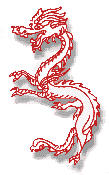
As imagined by the Chinese, the dragon
has the head of a camel, the horns of a deer, fiery eyes and a long beard. Its
ears are like those of a cow, its paws like the tiger’s and its claws sharp
like an eagle’s. Its neck is serpentine; it has the belly of a frog and the
scales of a carp. The Dragon first appeared in the sky, legend tells us, while
an heir to the throne was born, and the country was blessed with peace and
prosperity for many generation thereafter. Thus, the Dragon also served as a
symbol of good fortune.
|
 |
|
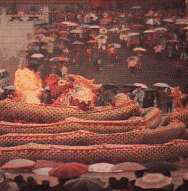
In parade appearance, the dragon performs
its gyrations in pursuits of a costumed figure who holds aloft a pole with a
ball on the end called the "Precious Pearl." The creature’s movement
and tempo are controlled by this leader who manipulated the "pearl"
according to plan, accompanied by drums and gongs.
|
 |
Return
to Top
Return to mythology
Return Home
|