|
By the mid sixteenth
century, actual moon phases were occurring four days prior to those in
ecclesiastical tables, so Easter was sometimes being celebrated prior to
the vernal equinox rather than following it as had been specified by the
A.D. 325 Council of Nicaea. A decree on fasts and feast days that
addressed this problem was approved in A.D. 1563 at the Council of
Trent.
According to the Trent council, two main things
needed to be accomplished regarding the calendar: reestablish the vernal
equinox date of March 21 and determine the Easter moon's 14th day.
Easter would then be observed on the following Sunday. Following some of
the council's recommendations, Pope Pius V modified both the
intercalation rule and lunar tables used to determine Easter's date.
Pius V's successor was Pope Gregory XIII, who
had been a representative of Paul III at the Trent Council. Aloysius
Lilius and others urged Gregory to complete the Trent recommendations.
In Gregory's tenth year this step was taken. Lilius, considered to be
principal author of the Gregorian Calendar, had proposed that the
seasonal error should be corrected by dropping ten intercalations during
the following forty years. This was apparently based on his observation
that vernal equinoxes then occurred on March 11. It now appears that
dropping eleven days rather than ten would have been more successful in
placing the vernal equinox on March 21 in most of the following years.
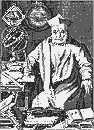
Others, including mathematician and astronomer
Christopher Clavius (shown above) agreed with the ten-day correction but
believed that they should be dropped all at once. Gregory took this
advice and shortened October of A.D. 1582 by ten days. Thursday, October
4, 1582 (Julian) was followed immediately by Friday, October 15, 1582
(Gregorian).
Gregory completed modification of the old
intercalation rule by specifying that any year whose number ended with
00 must also be evenly divisible by 400 in order to have a 29-day
February. He also changed the ecclesiastical table of moon phases used
to help determine Easter's date.
Regardless of these improvements to the formula
and table values used, and because lunations are out of sync with
Earth's revolution around the sun, Easter is observed in some years
during March and others in April.
Except for predominently Catholic countries,
nations were slow in adopting Gregory's changes. Among the last European
power to accept it was Great Britain. That empire and its colonies
(including those in America) put it into effect in 1752. By then, in
order to stay in sync with nations that had already adopted Gregory's
changes, the switch involved eliminating eleven days from the old Julian
Calendar. At the same time, they changed the beginning of their legal
year from March 25 to January 1.
Because of Gregory's refinement of the leap
year rule, our Western calendar has almost kept pace with seasons.
As time goes by, correspondence between seasons
and Gregorian Calendar dates vary, and tend to become further removed.
This is because Gregory's leap year rule is a rigid formula whose
calculated results do not match year lengths over extended periods of
time. One way to keep the calendar more closely coordinated with seasons
over the long term is to use a method that is based on
observation.
|