|



| |
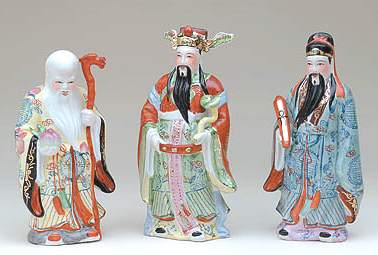 |
Fu Shen, Lu Shen,Shu
Shen
Happiness, Prosperity and
Long Life
|
|
The 3
Lucky Gods
|
|
These are
often known by their Cantonese names, Fu'k, Lu'k and Sau, or even more commonly
as the Gods of Health, Wealth and Happiness and they are a very familiar sight
in traditional Chinese homes, offices and restaurants. They are not worshipped
as Gods in a religious sense, but it is fair to say that they have a huge cult
following and are considered to be very lucky.
|
|
In Classical
terms however, it is better to think of them as the spirit of Happiness, Office
and Longevity, simply because it helps to remind us of their true origins.
Strictly speaking, Shen are regarded not as Gods, but as supernatural beings, in
the form of spirits, not people.
|
|
However, as
is often the case, over the course of time they have all been linked with other
legendary characters and in the process, acquired a human form and identity.
|
| Fu Shen is
regarded as the God of Happiness in this trio and we can trace his " human
" origins back to the 6th century, during the reign of Emperor Wu Ti
(502-550 AD)
|
|
It is said
that the Emperor had a particular fancy for dwarves, who he liked to have as
servants and court jesters in the Palace, in order to keep himself amused. In
fact, it is rumoured that he had so many from one district in particular, Tao
Chou, in the province of Hunan, that he was in danger of causing a rebellion,
because of the number of families that had been broken up as a result of his
constant demands.
|
|
Yang Ch'eng
was the Criminal Judge for the Tao Chou district and he went to see the Emperor
and pointed out that although the people of Tao Chou were his subjects, they
could not be regarded as his slaves.
|
|
He must have
been a very brave man, after all, there were not too many people who were
prepared to put their life at risk by confronting the Emperor. Yang Ch'eng was
only a Judge and not only did he challenge Emperor Wu Ti, he was also attempting
to deprive him of one of his greatest pleasures. Challenging the Top Dog is one
thing, but trying to take away his bone as well, Yang Ch'eng must have been very
brave indeed.
|
|
Legend has
it, that the Emperor was so touched by Yang Ch'eng's actions, that not only did
he order the supply of dwarves to be stopped, he also sent those already in the
Palace back to their homes.
|
|
Naturally,
Yang Ch'eng became an instant hero and the people of Tao Chou erected statues of
him and offered up sacrifices as a mark of respect, in recognition of what he
had achieved. Since his actions had united so many families again, he was
considered to be The Spirit of Happiness and thus Yang Ch'eng became the
earliest human example of Fu Shen, the God of Happiness. This is one of the
reasons why he is often depicted wearing the blue robes of an official, after
all, he was the Judge of Tao Chou, in the province of Hunan.
|
|
The origins
of Lu Shen can be traced back even earlier, when he was known as Shih Fen during
the time of Emperor Ching Ti (156-140 BC) Shih Fen was a humble scholar,
beginning life as a poor student, but he worked so hard that he was recognised
by the Emperor's court officials and eventually, he was fortunate to land a job
at the Emperor's Palace.
|
|
Legend has
it that he worked and studied so hard that the Emperor began to lavish honours
and titles on him and as a result, he became very rich. He became so successful,
that his name was synonymous with High Office and Honours
|
|
Although
this is the earliest reference to him, it is the one least remembered, at least
by the vast majority of people, but we think that it deserved a mention because
it is explains why Lu Shen is thought of more correctly as Office, rather than
Wealth. This is important to remember, because Lu Shen encourages good fortune
through effort not luck.
|
|
Shou Shen's
story is perhaps the oldest of them all, since according to classical scholars,
it was the name given to a particular group of Stars that were produced only
when two other groups were visible at the same time. It is interesting to note
that the two groups of Stars that made up this particular configuration, were
Chio, the horn of the Dragon and K'ang, the neck of the Dragon. Both of these
are in the Eastern Palace and they are the first 2 of the 28 Constellations and
as a result, classical writers referred to Shou Shen, or Shou Hsing as The Star
of Longevity Legends inform us that many believed that when it appears there is
peace and when it disappears, there is war.
|
|
The earliest
known references, indicate that Emperor Ch'in is believed to be the first to
offer sacrifices to this Star in 246 BC a custom that continued for many, many
years.
|
|
However, as
usual, something more human was needed and it is at this point that we are
introduced to the old man. He is always depicted carrying a huge peach of
immortality with a very high forehead, usually dressed in yellow and with a
happy disposition. Sometimes he is seen riding a Stag and at other times he is
seen with a bat flying above his head, both of which indicate happiness.
|
|
Legend has
it that a famous, celebrated face reader Kuan Lo told someone that their son
would not live past the age of 19. The Spirit of the North Pole and the Spirit
of the South Pole intervened and decided to have a bet.
|
|
The ancient
Chinese believed that the Spirit of the North Pole determined the time of death,
just as the Spirit of the South Pole determined the time of birth. Needless to
say, the North Pole won and he turned the prediction of Kuan Lo from 19 into 90,
both of which sound very similar. The symbols of happiness are obviously
associated with the fact that the son did not die at 19 as predicted, but lived
to the ripe old age of 90, so he had every reason to be happy.
|
|
A word of
caution then, against taking predictions too seriously, after all, you never
know just who may decide to intervene.
|
Return
to Top
Return to mythology
Return Home
|