|



| |
The Feast of the August Moon
|
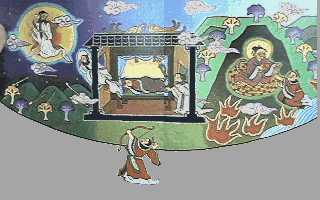 |
The Feast of the August Moon, or as it is known in
Chinese "Chung Ch'iu Chieh", the"Mid autumn Festival" . The
festival is traditionally a time for going into the countryside up on a hill and
looking at the full moon. This full moon is the most beautiful of all year
,according to the Oriental viewpoint. |
| The name "Feast of the august
Moon" is wrong. It results from a mis-translation of the alternate Chinese
name of this festival "Feast of the 15th day of the Eighth (Lunar)
month." However, this name has become embedded in the English language,
most particularly from the stage play and movie "The Teahouse of the August
Moon " which is about the okinawan occupation at the end of the Second
world War. August is the eighth month in the solar calendar , but August does
not translate as "eighth month" that would be, if anything, October,
which is derived from the Latin for "eighth month." This year it does
match, but normally it does not. |
| Throughout Chinese history, the phases of the moon
have had special significance for the Chinese. In the West we often speak of the
"inconstant moon." To the Chinese, on the other hand, the
ever-changing moon is a symbol of constancy. The first day of a month is always
the new moon, the fifteenth always the full moon, and so on. The Western
calendar, of course, arbitrarily marks the year off into twelve more or less
equal parts. This calendar takes no notice of the moon (even though the word
month is derived from words which mean moon).
|
| Thus, there is no way to know the phase of the moon
from the day of the month. There is no more than the roughest correlation
between "moon" and "month." So we think of the moon as
changing without pattern, as being "inconstant." The Chinese calendar,
on the other hand, is absolutely geared to the moon, in fact anther name for it
is the "lunar calendar." Thus, the Chinese date always marches in step
with the phases of the new moon. The first of a month is the day of the new
moon. The seventh shows a waxing crescent. The fifteenth has a full moon every
month. And, the twenty-second day shows the waning crescent. Almost any Chinese
can look out the windows on any clear night and determine the day of the month
just by looking at the moon. Thus, there is a consistence, a
"constancy," about the phases of the moon in the eyes of the Chinese.
|
| Why the Chinese name of "Mid-Autumn
Festival" for a day that falls on the fifteenth day of the eighth month of
the lunar calendar? This year that day falls, as I said, on the first of October. According to our calendar Autumn has not yet begun, so why
Mid-autumn? We mark the beginning of the seasons by the solar events of the sun
reaching the tropics of Capricorn and Cancer for Summer and Winter Solstice.
Spring and Autumn are marked by the arrival of the Vernal Equinox and the Autumn
Equinox, the exact middle of fall. Back to the full moon. Poetry and prose
writings that praise the beauty of the full moon abound throughout Chinese
literature. Meetings are held at pavilions set in the mountains with each
scholar attending the meeting contributing a poem or prose piece commemorating
the meeting and extolling the beauty of the moon or the feelings the moon
engenders in the viewer.
|
|
Li Pai  701-762 AD, one of the
two greatest poets of the Sung Dynasty, known as "The immortal of
Poetry," wrote a short poem that is still so well known that almost every
student in China can recite it. It epitomizes the Chinese love for home,
heart-sickness at being away from home, and the feelings for this deep
homesickness that the beauty of the moonlight and the moon itself can engender. 701-762 AD, one of the
two greatest poets of the Sung Dynasty, known as "The immortal of
Poetry," wrote a short poem that is still so well known that almost every
student in China can recite it. It epitomizes the Chinese love for home,
heart-sickness at being away from home, and the feelings for this deep
homesickness that the beauty of the moonlight and the moon itself can engender.

-The bright moon rays in front of my bed

-Seemed like frost on the ground

-I lifted my head and regarded the moon

-I lowered my head and thought of my old home.
|
Return
to Top
Return to mythology
Return Home
|