|



| |
 |
Chinese New Year Customs
A Look at some of the New Year
Activities
A Time for Food for Festivals and
for Fun
|
 |
A Story about Dumplings
The clock has struck
midnight, the New Year arrives with a bang and many people in the West
begin to get tucked into glasses of champagne. The New Year in China
begins in a very different way, since champagne is not the order of the
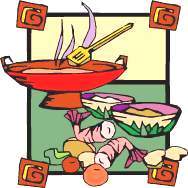
day, but bowls of freshly steamed dumplings, or Jiaozi. These are
served, freshly cooked, just after the stroke of midnight and like the
English tradition of putting a sixpence in the Christmas pudding, a
Chinese coin is hidden in one of the dumplings. The person who finds the
coin is said to receive good luck over the coming year and is regarded
at that point as the luckiest member of the family.
|
|
It's very difficult to say when the custom
began and almost every family has it's own collection of stories. Many of them
involve a poor family who find themselves without any food or fuel on New Year's
Eve. Without food or fuel, the family were too cold and too depressed to go to
sleep and sat there waiting to hear the drums signal the start of the coming
year.
|
| The women of the family were determined to
keep their spirits up and the began to joke with the old man of the family. They
made light of their lack of food and asked the old man of the family, what he
wanted to eat. The old man, eager to join in the spirit of things, said that he
wanted dumplings made of gold, cooked over a fire of gold bars. The women
laughed, but the old man was serious and told them to start preparing it and in
order to keep the game going, they went into the kitchen to see what could be
done.
|
| They used the dust that was left in the flour
jar and dug up a few frozen vegetables from the garden and managed to make a few
dumplings. With no fuel, they used the wooden fence to make a small fire and
once this had been done, they went and told the old man that the meal that he
had ordered, would be served soon. Of course, he was very surprised, especially
when he saw the smoke and went to fire to see what the women had prepared.
|
|
At this point in the story, as is often the
case, a god appears, this time the god of wealth and he was touched by the
actions of the family and as a result, he decided to play a little game on the
family himself . . . .
|
|
When the old man went in to the kitchen, he
couldn't believe his eyes, because on top of the fire were some real gold bars
and when he looked into the pot, he noticed that some of the dumplings were made
of pure gold.
|
|
The family were the talk of the village and
everyone came to see the gold and they were convinced that it was the dumplings
that the women had made which had produced this incredible good fortune. As a
result, many people began to make these dumplings at New Year, in the hope that
it would encourage a visit from the god of wealth. This led to the present
custom of putting a coin inside, since it ensured that at least one member of
the family would receive good luck.
|
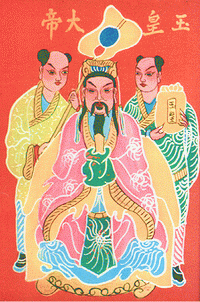 |
The Jade Emperor & The Kitchen
God
A Chinese saying reminds us to
always behave as if a hundred people are watching and to ensure a
least one permanent visitor, traditional Chinese families hang a
picture of the Kitchen God up at New Year. This is after sending the
old image up to Heaven, so that he can report directly to the Jade
Emperor, providing an account of the family's behaviour. It is the
custom to smear the old image with a traditional Chinese sticky sweet,
some say to sweeten up the kitchen God so that he makes a good report.
Others say it is to stick his lips together, to prevent him from
speaking, but there is no doubt who he reports to.
|
|
During the course of the year, he takes note
of everything that he hears and sees in the kitchen, the traditional place of
the tang, the fire and in many ways, the heart of the house. He is always
placed in this room, hence the familiar term Kitchen God.
|
| In traditional Chinese terms, Heaven is
thought of as a version of society, complete with it's ministers, officials and
usual bureaucrats and The Jade Emperor is the man in charge. He is the top
figure, the supreme god, in an establishment which serves the one true god. As
such, he is considered to be a very powerful figure, even if somewhat remote. He
has been around for at least 1000 years, although his character, like many, may
well have even older origins.
|
|
If the Kitchen God makes a favourable report,
the Jade Emperor will look favourably on you and since so many other powerful
figures work for him, this can only be good, after all, as we all know, it pays
to be in good standing with the boss.
|
|
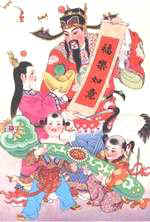
In the Chinese establishment of Heaven, many
are associated with wealth and to make things even more confusing, some are
known by different names, but everyone knows Tsai Shen. During the 15 days of
the New Year celebrations there are many old customs and superstitions involving
the money luck for the coming year. Wheels are spun to symbolise getting things
off to a flying start and everyone is optimistic about their chances for the
coming year, mind you, they try to improve their luck by any means possible,
after all, why take the chance.
|
Tsai Shen - The God of Wealth
|
|
|
|
|
Even though the Chinese are famous for their
love of gambling, there are certain things that they would never gamble against
and they try to take as many precautions as possible. Even the slightest
suggestion that fate is conspiring against them, would make them think again.
|
|
The use of brooms is frowned on by many during
the New year, since it is said that they can sweep away the good fortune. Knives
are also considered to be unlucky on New Years day, since they are said to cut
the good luck and some go as far as not washing their children, for fear of
washing away the good fortune.
|
|
|
|
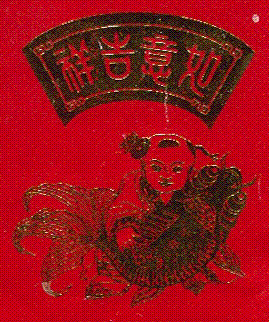
One of the most popular New Year activities,
is the distribution of what is termed, good luck money which is usually
presented in a highly decorative, red envelope.
|
 |
|
This is a very auspicious time
for children, who are often the recipients of the good luck money. Those who
give it are considered even more fortunate than those who receive it, after
all, as the Chinese proverb reminds us; for every bar of silver that you
give away, a hundred will return. Many families will purchase a new
Almanac, since it is considered to be very lucky in itself and the new copy is
usually hung up near the family shrine. Many people treat themselves to new
clothes, believing that this will encourage future prosperity, much in the
same way that old coins are said to represent old money and therefore, the
wealth of previous generations.
|
Return
to Top
Return to mythology
Return Home
|