
Demerger foes routed in mega-city debate
By Martin C. Barry
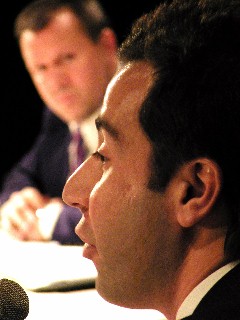
Mega-city advocates Robert Libman and Dida Berku found themselves fending off the repeated attacks of demergerites during an intense debate at Côte St. Luc-Hampstead-Montreal West Borough Hall last week, sponsored by The Chronicle.
During an initial period reserved for opening statements, Borough President Libman, who along with city councillor Berku is a member of the mega-city's executive committee, set the confrontational tone of the evening.
He accused former Côte St. Luc councilman Mitchell Brownstein, sitting across from them with Borough Councillor Anthony Housefather on the demerger side of the debate, of exaggerating the disrepair of Côte St. Luc's streets to further the cause of demerger.
"Mitchell Brownstein (and) members of his family came to the microphone and said that Côte St. Luc Road was a war zone," Libman said, referring to the complaint about a pothole at the corner of Côte St. Luc Road and Pinedale
"I went there the next day and there was no pothole to be found," Libman added. "Unfortunately that's what's being said. Things aren't that bad. Things could be better, obviously, but they are not that bad. They haven't changed that much." Brownstein said later, "I took personal offense at the comments of Mr. Libman."
Housefather pointed out that in September 2001, Libman and Berku were among the members of Côte St. Luc city council when it unanimously adopted a resolution stating municipal mergers lead to substantially increased costs with poorer and less accountable service delivery.
"What has changed? What makes them feel different today?" he said. "Isn't it ironic that today they are standing with Pierre Bourque and Bernard Landry to stop us from getting our cities back." Housefather also said that of the 20 elected officials who sat on Côte St. Luc, Hampstead and Montreal West's last municipal councils, Libman and Berku are the only ones who now support the mega-city.
During a second period reserved for questions submitted in writing by members of the audience, Berku was asked why she no longer supports demerger, when she had left the impression during the mega-city election just before the mergers that she would support the population if it opted for demerger.
"I was and still maintain that the citizens are the ones who are going to make the decision," she replied. "When we entered into the campaign, we were against forced mergers because the mergers were forced on us against our will. Now after two years we see that there are certain opportunities that are available to us."
Rebutting Berku's comments, Brownstein pointed out that among elected municipal officials in Montreal who were suburban councillors before the mega-city, many have kept campaign promises, resigned from Mayor Gérald Tremblay's party and are now supporting demerger.
"I really don't understand why my colleagues didn't keep their election promises like all these other individuals who have resigned, and I still give them the opportunity to resign," he said, drawing applause from the predominantly pro-demerger crowd. Questioning Berku's claim that one of the mega-city's major achievements has been an island-wide urban 'master plan,' he said that wasn't the reason people voted her and Libman into office.
"When they elected you they were so upset that we were being forced into the merger, their main concern was to have some people in the party - and they thought it was the Tremblay party - that would protect them in the event that, if they had the option of demerger, you would support them," Brownstein said. "That's why you were elected. Not for greenspace."
Challenging Libman's and Berku's repeated claims that as members of the mega-city administration they have a lot of influence, Housefather said that if former Montreal mayor Pierre Bourque were returned to office, they would lose it all as members of the opposition.
"I would much rather, if it were up to me, take my town back and make sure that whatever we can get back, whatever local services are returned under Bill 9, come back to us run by a mayor and local council," he said, also drawing applause.
"If the intention of demerging would hasten the election of Pierre Bourque in the City of Montreal, imagine his glee as the person with the ultimate veto and control of the agglomeration council, thinking of how he can spend the 60 or 70 per cent of the budgets from the breakaway communities," Libman responded, referring to the control Montreal's mayor will have over demerged cities.
"That is the risk we are taking... By pushing the election of Pierre Bourque, by suggesting that we demerge, he will have control over 60 per cent of our budgets." Trying to make headway on another point, Libman later insisted, "the likelihood of Pierre Bourque being elected is out of the question, as far as I'm concerned," eliciting a disapproving response from the audience.
Demerger was The Chronicle's top story in the past year
By Martin C. Barry
For a year that began with doubts over whether the de-merger movement in Montreal would continue or simply lose its way, 2003 is ending on a triumphant note for de-mergerists. They're finally seeing some light at the end of a long, dark tunnel.
Last March 26, after a winter of relative silence on the question, The Chronicle's front page below the fold proclaimed: 'De-merger issue not dead yet.' It had been more than a year since the forced amalgamation of the island's 28 independent municipalities into the mega-city.
"People move onto other things," said Montreal West resident Kell Warshaw, a founder of the pro-demerger citizens group DémocraCité. "Some people's attention spans are longer than they should be. Others are shorter. There are always people who are going to fight to the end - maybe past the point where it makes sense. And there are always going to be people who give up long before they should."
When the Quebec Liberals came to power a month later, a new word started to become part of our vocabulary: decentralization. The morning after the April election, Montreal mayor Gérald Tremblay suddenly realized he would have a struggle on his hands to preserve the mega-city.
Snowdon councillor Marvin Rotrand said that no matter what happened, Montreal was moving along the road to de-centralization. "Whether there's going to be de-mergers or not - which I consider to be hypothetical and long-term - they're not going to be tomorrow, next week, next month and probably not next year," he said.
"What the people seem to indicate to me is that they want their towns back," former Hampstead mayor Irving Adessky said in early July, shortly after the provincial government introduced Bill 9, the long-anticipated de-merger legislation.
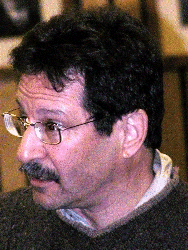
In Montreal West, according to former town commissioner Ed Manis (photo, left) who was de-elected in 2001 by the mergers, the mood was uncompromising. "There's no doubt in my mind that Montreal West unequivocally wants to return to being a separate municipality - nothing more, nothing less," he said.
August was a busy month in the demerger/decentralization debate. The first week, Côte St. Luc-Hampstead-Montreal West Borough Council passed a resolution stating that residents of the borough "should be the ones who make the ultimate decision as to the future of their respective former municipalities," and that the mega-city should provide a plan for a "true and meaningful decentralization" as an alternative.
"They're waiting to see which way the political winds blow," is how former Montreal West town commissioner Howard Barza reacted to the resolution. "They're hoping to bet on the right horse, rather than, in my mind, being courageous and taking a very firm position."
In the meantime, cracks were starting to appear in the borough council's façade. Defending the resolution as best he could, Borough Councillor Anthony Housefather acknowledged that he believed most CSL-Hampstead-Montreal West residents wanted out of the mega-city.
"I think that if there was a vote today, most residents of all three cities would choose to de-merge," he said. Two weeks later, Housefather told The Chronicle: "Right now I am not committed to the mega-city's survival at all cost."
By October, Housefather's name was among those of 23 other Montreal city and borough councillors (not including his two borough council colleagues), who'd written an open letter to Premier Jean Charest, calling on him to ensure a fair, open and democratic consultation in the issue of de-mergers. Two weeks ago, citing intolerance by the Tremblay administration for anyone not for the mega-city, he quit the ruling party.

Défusion Westmount opens storefront HQ
By Martin C. Barry
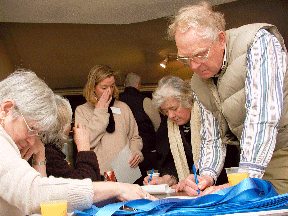
After months of work preparing for the big day, Défusion Westmount opened its demerger campaign headquarters last Monday in a renovated storefront office on Ste. Catherine Street.
The committee, which will be promoting demerger of Westmount from the mega-city, has its work cut out making sure as many Westmounters as possible get out to vote in favour of demerger on referendum day.
In a public consultation held by the City of Westmount shortly before its forced merger into the mega-city, almost 99 per cent of residents said they were opposed to being amalgamated. At least 10 per cent of the population of Westmount will have to sign a register, expected as early as May, requesting the demerger referendum.
Besides going door to door lobbying Westmounters' support for the referendum, Défusion Westmount will be compiling an electoral list of all Westmounters eligible to vote, to compare for errors with the official electoral list compiled by the province.
"There are so many people who have moved away," complained Keir Cutler, a lifelong Westmounter and one of the guests at the headquarters opening. Like others in the community, he remains concerned about possible inconsistencies in the voter list which could hinder Westmount's last chance to re-establish its independence.
Cutler estimates that in the past, as much as 20 per cent of the names recorded on electoral lists in Westmount were for persons deceased or who moved away. "If you're going to have an election based on the percentage of your electorate who vote, and you've got a list that's completely inaccurate, the whole thing becomes kind of absurd," he said.
According to Nicole Forbes, Défusion Westmount's chief coordinator, the official electoral list is supposed to be delivered by Quebec on March 8. "So we really want to see as many people in the month of February and the beginning of March as possible so we can make sure that we have our list up to date," she said. "We just want to make sure that our lists are in good order... When we get the new list, we're going to make sure that there are no discrepancies."
Addressing more than 50 supporters who braved last Monday's chilling weather to attend the opening, former Westmount mayor Peter Trent said that part of a fund set up in 2000 by the City of Westmount as a demerger "war chest" is now helping municipal groups outside Westmount seeking demerger.
"We intend to approach this whole referendum very seriously, very methodically, very professionally," he said. "We know we're in for a bit of a media battle." According to Trent, demerger supporters are currently in the process of putting together two major studies about the economic and legal aspects of municipal demerger as spelled out in Bill 9.
"We are trying to have these studies ready in time for the register signing, which we assume will take place between May 2 and about June 15," he said. Trent said the demergerists found it necessary to conduct their own research because of a possible bias in studies to be released by the government around the same time.
"We assume that the studies that the government will produce will have the same colour and tenor of the minister of municipal affairs, Mr. Fournier, who is not being seen, at least in our eyes, as someone who really is in favour of the whole idea of demerger," he said. "He seems to be much more favourable to maintaining the status-quo - that is the mega-cities."
Trent said that even though demergerists are disappointed with Bill 9, "it still does allow us to demerge. Never forget that. We will have one time when the door will be open. We've got to walk through that door. If after we demerge we're still unhappy with some of the features of the recreated city, this you can change."
Trent said that as vice chairman of the Montreal Urban Community when he was mayor, the provincial law for the MUC was changed dozens of times. "Therefore if we're unhappy with some of things that Bill 9 creates, such as the Conseil d'Agglomération," he said, referring to the controversial new council that will coordinate the post-demerger Montreal Island, "the legislator giveth and the legislator taketh away.
"Indeed we can modify this with time, as it becomes apparent that some of the things that Bill 9 creates are really not acceptable democratically."
Westmount-Ville Marie MP Robillard ready for Industry portfolio

By Martin C. Barry
Westmount-Ville Marie MP Lucienne Robillard sees herself playing a key role implementing Prime Minister Paul Martin's economic platform as Canada's new Industry Minister.
In one of her first interviews since being named to the federal portfolio by Martin two weeks ago, Robillard - who was Treasury Board President under former Prime Minister Jean Chrétien - told the Examiner that the appointment positions her front and centre in the Martin government's new economic strategy.
"It's so diverse, it's so important - it's also part of the agenda of Paul Martin," she said. "You know that Paul Martin did not fix 56 priorities for his government - he fixed three priorities. And one of them is to build the economy of the 21st century and to be competitive."
Robillard, who had not yet been fully briefed on her new duties last Friday (she also has the portfolio for economic development in Quebec), said, however, that one of the top items at Industry Canada is going to be the development of a "micro-economic" policy based on innovation-driven growth. Other issues her department will be focusing on involve telecommunications, competition, intellectual property, business law, consumerism, tourism, scientific technology and regional economic development.
"I think that what we will try to achieve is how to help our small and medium enterprises to have better productivity, to be better innovators in our economy, and to be in a situation to compete internationally," she said.
Regarding reports (which have appeared in a west end Montreal weekly newspaper several times over the past year) that Robillard wouldn't make it into the cabinet or that she is going to be eased into the Senate before the next election, she said: "I was teasing journalists on the Hill a little bit the day of my appointment, saying to them, 'Again you were wrong.'"
Robillard denied emphatically that one of the strengths that has guided her career in politics has been a survivor's instinct. Instead, she insisted her strong point is being a team player. "Paul Martin knew me," she said. "We worked very close together when he was finance minister and I was president of the treasury board, so he knew what were my skills and abilities.
"I'm really a team player at the cabinet table," she added. "So he knew that and he had to make some very difficult choices. This is the hardest work of a prime minister - to choose among his members of parliament. But I feel confident that he knew me and he knew what I can bring to the team."
Although Westmount has only 20,000 of the 94,000 residents who live in the Westmount-Ville Marie riding, from time to time some Westmounters have expressed a desire to see a local resident as their MP. Robillard lives on Montreal's South Shore.
Last June, Victor Drury of Kensington Avenue, whose family has a long history of political involvement and who has worked with Paul Martin during his campaigns, told the Examiner that, were a federal seat to become available in the riding, "I would not say no."
During her interview last Friday, Robillard said: "To everyone who would like, perhaps, to have my seat in this riding, I would like to say to everyone, stop that. I'm running in Westmount-Ville Marie again... I'm still enthusiastic about my job, so there's no reason for me to think about something else."
While Robillard's overall profile as a member of the Liberal cabinet since her first election in 1995 has increased, locally there have been concerns expressed (including an opinion piece in the Examiner earlier this year by Westmount Municipal Association president Kathleen Duncan) that she sometimes neglects local questions, while focusing on national ones in the weekly column she writes for the Examiner as the riding's MP.
"I don't agree at all with that," she replied when confronted with the issue. "The residents of Westmount care about local issues, but they care about national issues too... The most important responsibility I have is to be a member of Parliament first. If I have the privilege to be in the cabinet, it's because the people of Westmount-Ville Marie elected me. So I have always felt tied to that responsibility."
Robillard maintained that, despite her responsibilities as a cabinet minister, she manages to come to Westmount-Ville Marie every week for a riding office meeting. "I have to tell you that, perhaps, not all ministers are doing that - but I do so," she said.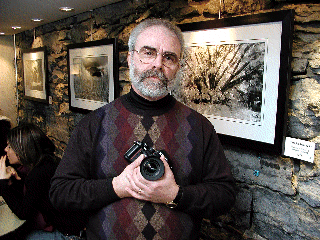
Jim LeWarne's infrared images at Java U
By Martin C. Barry
As Jim LeWarne readily admits, infrared photography can be tricky - even if the rewards make it well worth the trouble.
LeWarne, a professional photographer and graphic designer from St. Lambert who retired recently following years of service with the Royal Bank, has put together an exhibition of some his best infrared work, currently on display at Java U on Sherbrooke Street.
The ultra high contrast black and white images, shot with a relatively modest 35mm Nikon single lens reflex camera through a deep contrast red filter on Kodak high-speed Infrared film rated 100, all measure 11.75 X 21.75 inches in 20.5 X 30.5 inch frames, based on a ratio of 9:16.
This conforms to the so-called 'letterbox' format, which has become popular for viewing wide screen movies in video. The format has also gained favour among TV commercial directors because of its dramatically suggestive impact. Coincidentally, LeWarne also worked in the television industry.
Although he shot all the photos of rural scenes in Vermont with a variety of lenses, one could easily come to the conclusion that most of them were taken through a wide-angle. As LeWarne was looking through the viewfinder composing each shot, mentally he was cropping.
Infrared photography is an area most amateurs never venture into. The film is slightly more expensive than conventional stock, but requires special processing through a professional lab. However, when it's done right - as in LeWarne's case - the end result can be so visually startling that it stands out like a 3-D image.
To compensate for the unpredictable results even professionals can get when shooting infrared, LeWarne 'bracketed' his shots (he took them using a range of different settings to be on the safe side).
"With moment to moment changes in light quality, the results of artistry will differ," he wrote in a handout card, briefly describing the nature of infrared. "With applications of different filters, results will vary. In some situations, the results will be unknown, unexpected and always unusual."
LeWarne started shooting in infrared after having explored many other areas of photography. "I was looking for something that had a little bit of a difference - something that was interesting for me," he said in an interview. "I like it because it gives you a completely different view of things. Green trees, which typically would come out dark in a black and white photo, come out looking like they're covered with frost and snow. Sometimes different colours will give you different results.
"I discovered some artists who were using infrared, I explored it a little further, and I started to develop my own technique for it. Now I'm at that point where I'm comfortable with it. It takes a while to be comfortable because you're never sure what you'll get back."
LeWarne sees infrared becoming more popular as a medium - not just for advanced photographers, but for less experienced ones, as well. "It's more consumer-available," he said. "So I think it probably opens doors for a lot of people in that sense. It's certainly interesting image-wise." His work can be seen at Java U until Feb. 8.