Characteristics
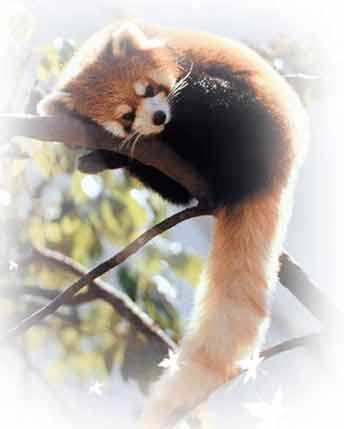
The red panda most closely resembles a raccoon, but has more of a giant panda or a bear-like body. It has a long and bushy tail, including which, can make it about 42 inches long. The red panda can weigh from 7 to 14 pounds. Its body is covered in thick and coarse dark reddish-brown fur with a soft undercoat. Its face and ears, as well as the ringlets on its tail, has light-brown and white markings. It also has a semi-pointed snout and pointed ears. The front legs have sharp, partly retractable claws, which have an angle inwards, which gives it a waddled walk.
|
 |
 |
Habitat and Behavior
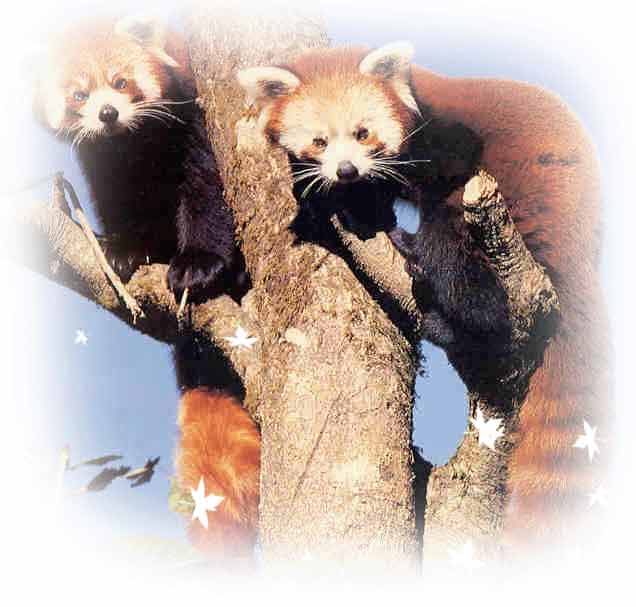
Red pandas live in southern Asia. More specifically, they live in the cool temperate forests and forested mountain slopes of China's Himalayas and Myanmar. These creatures are mostly solitary, but are often found in pairs during breeding season and in groups when the mother is still providing for her cubs. They are most active before and after day light hours; during the day, they are usually found spending time in leisure in trees. They move slow on the ground, but are very agile in the trees. |
Diet
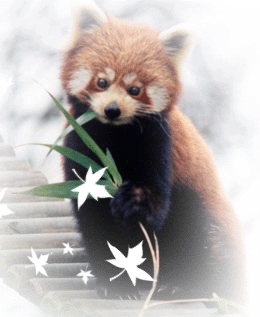
The red panda is considered to be herbivore. Its main diet consists of bamboos, berries, blossoms, acorns, roots, seeds, grains, other nuts, and leaves from various plants. They also eat insects, eggs, or small animals on occasion. They have strong jaws and broad teeth to chew bamboo and a thumb-like projection in their wrist, which is similar to that of the giant panda, to grab and hold the bamboo. It chews its food extensively while sitting, standing, or even lying back. |
 |
 |
Conservation Status
In March 1988, red pandas were declared endangered. They are threatened due to deforestation and other human interference in their habitat. The growing population of southern Asia causes the growing need for land and other natural resources. This causes increasing habitat loss that is needed for the survival of these creatures. The red pandas are now almost extinct and are protected and listed in Appendix II of the Convention on the International Trade in Threatened and Endangered Species. |
Other Interesting Facts
· Their Chinese name is hunho , which means firefox
·The red panda can live between 8 to 14 years
· Everyday the red panda eats approximately 200,000 bamboo leaves, which is about 45% of its body weight
· The word “panda” comes from the Nepalese word “nigalya ponya” which means eater of bamboo.
· Unlike bears their claws are perfectly retractable.
· Red pandas were discovered 48 years before the Giant panda.
· Because of habitat loss, there are fewer than 2,500 adult red pandas left.
|
 |
Resources
|
TOP
|