Conducting Tips, April 2000
As a conductor, you set the constant example of good musicianship: How to stand, what to feel, How to phrase the music, when to breathe, and how loud or soft to sing. Through this column, you will gradually learn how to become a competent, comfortable conductor. Each lesson can be incorporated into your current technique, so that you never have to toss everything out the window and start over.
Lesson 3: The Beat Pattern, part II
If you were to watch a dozen skilled conductors, you would see dozens of different approaches to the beat pattern. Some conductors might use very crisp, geometrical beat patterns. Others might appear to be painting shapes in the air, with no apparent pattern at all. The key to effective conducting isn't IN the beat pattern itself, but rather in the choir's ability to follow you. Skilled conductors have developed consistent, predictable ways of showing the choir where to put the beats. This lesson will focus on how to make your beat patterns consistent and predictable.
The Basics
The old "Taktell"-style metronome has a pendelum arm that swings back and forth. The click sounds at each end of the swinging motion. If you were watching, you could anticipate the click by the speed and the position of the pendelum; as it approaches the ends of the swing, it slows down and changes direction. as it moves towards the center, it speeds up, then it slows again as it approaches the other end of the swing.
A conductor's beat pattern works in a somewhat similar fashion: The conductor's hand goes up quickly, slowing as it reaches the top of the arc. There, it stops and changes direction. As it falls, it increases speed. When the hand reaches the bottom of the arc, it quickly changes direction, indicating an ictus, and the cycle begins again. The choir is able to anticipate your ictus by the speed and position of your hand.
When choosing a beat pattern, it is important that it allows for some consistency of movement, so that the choir can anticipate your ictus. The problem with the old textbook pictures of beat patterns is this: Look at page 384 in the new Hymnal, and find the illustration of the four-beat pattern. Look at the curving line between beat 1 and 2. It is a different shape and length than the line between 2 and 3. In fact, each of the four curves is absolutely different from the others, so that the choir has no basis for anticipating the ictus. The pattern is therefore ineffective.
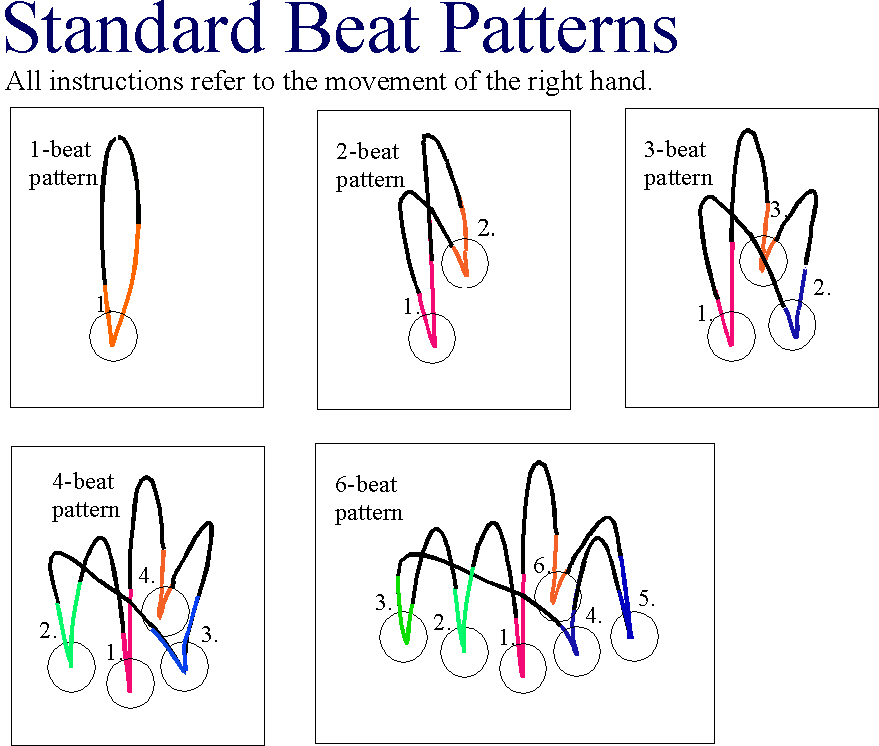
Now for an example of beat patterns that are consistent in their shape. They place the beats in the same places as the standard patterns, but the predictable movement between the beats makes the patterns effective.
Anatomy of the Beat Point
A beat point gives the choir two bits of information. First, it indicates where the ictus is. Second, it indicates where the next beat in the pattern is going to be: When a conductor is in, say, a four beat pattern, and a person gets lost, he can look at where the hand or baton is headed and discern whether the conductor is on beat 1, 2, 3, or 4. That will help him find his place again and join the rest of the choir.

The ictus will be clear if the arc made by the hand slows and speeds in a natural, organic way, like a swinging pendulum, a bouncing ball, or a person on a trampoline.
The "which beat am I on?" information is clear if the conductor uses the proper "color" for the proper beat. In the patterns illustrated above, each beat is colored so that the descending and ascending edge is clear. The downbeat (first beat of the pattern) is red in all but the 1-beat pattern. The last beat of the pattern is always orange. Beats traveling towards the center of your body are always blue, while beats traveling away from the center of your body are always green.
Emphasizing the Ascending Edge
A well-balanced beat is one where the descending edge and ascending edge of the beat receive equal emphasis. The conductor doesn't appear to be pounding the beats (emphasizing the descending edge), nor lifting the beats (emphasizing the ascending edge). The expreienced choral conductor will often intentionally lift the beats in order to achieve a lilting feel, or in order to "pull" the notes into phrases. When this is done, the tone quality tends to brighten. The experienced instrumental conductor will sometimes intentionally pound the beats to achieve strong attacks and in order to add heaviness. The choral conductor should avoid this technique, at least with amateur voices, because it usually causes singers to make vocally damaging adjustments in order to achieve the effect.
Lesson 3 will cover starting and stopping the choir: beginning on beats other than one, effective cutoffs, holds, and the like.
