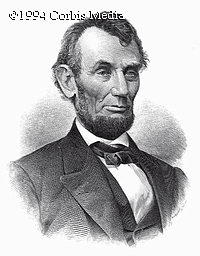
 Lincoln started to think about running for president after he had been urged constantly by his friends. He had held back for most of the time. He did start to make speeches beyond just Illinois, he delivered a speech on the need for restricting slavery that put him in the forefront of Republican leadership. All of the enthusiasm that was built up behind him because of his speech had helped him overcome his reluctance.
The Democratic Party had split its decision into factions, one nominated Douglas while the other nominated Breckinridge. This made Lincoln�s election almost a certainty. Lincoln polled 1,865,593 votes to Douglas' 1,382,713, and Breckinridge's 848,356. John Bell, candidate of the Constitutional Union party, polled 592,906. The electoral vote was Lincoln, 180; Breckinridge, 72; Bell, 39; and Douglas, 12. Lincoln left Springfield to take up his duties as president. Before him lay, as he recognized, "a task ... greater than that which rested upon Washington." The seven states of the lower South had seceded from the Union. Before Lincoln reached the national capital, Jefferson Davis was inaugurated as President of the Confederate States of America. The four states of the upper South were on the brink of secession, and divisions were visual in the border states of Maryland, Kentucky, and Missouri. Lincoln had entered the presidency of the United States under a severe handicapped starting position of having to deal with the succession of the Southern states from the Union. He had to enter the national capital very overtly due to the fact that a threat had already been made to his life. Another handicap that Lincoln faced was that nobody knew anything about him, he had run an unsuccessful senatorial campaign against Douglas and even the leaders of the Republican Party had little acquaintance with the President. Lincoln also did not have a good relationship with Congress during his Presidency, even though Congress�s majority was Republican in both houses. Lincoln decided to follow his own counsel, ignoring the opinions of Congress. In opposition to Lincoln�s negative side, there is always a counterbalancing side that shows his true strengths. He had dedicated himself solely to the preservation of the Union. Lincoln believed that he was leading a struggle to preserve "the last, best hope of earth," which he thought to be Democracy in its greatest from in the United States of America. To achieve his goal of restoring national unity he would do whatever was necessary, even disregarding the Constitution and Congress. Lincoln�s greatest asset in achieving his goal has the loyalty of the American people. Another of his assets was that he was a true political genius. He understood the value of silence and secrecy in politics and refrained from creating divisive issues or causing needless confrontations. Lincoln believed that the ultimate decision to enter into the Civil War was beyond his control, it was inevitable, no man could have stopped it. |