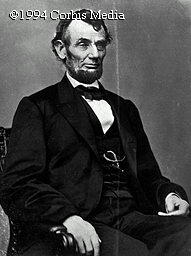
 Congress was not in session so Lincoln moved quickly to mobilize the Union. In order to restore order, Lincoln suspended the writ of habeas corpus, at first along the line between Washington and Philadelphia and later throughout most of the North, so that known secessionists and persons suspected of disloyalty could be held without trial. At the same time the President, in direct violation of the Constitution, ordered an increase in the size of the regular Army and Navy. Doubting the loyalty of certain government officials, he also entrusted public funds to private agents in New York to purchase arms and supplies. Lincoln had put himself at the head of the whole war effort. He made Congress's role clear, they were only there to appropriate money to support the war, it could initiate legislation on issues not related to the war, it could debate questions relating to the conflict. But direction of the Union war effort was to remain firmly in Lincoln's hands.
The first responsibility of the President was the successful prosecution of the war against the Confederate States. In this duty he was hampered by the lack of a strong military tradition in America and by the shortage of trained officers. Even more difficulty was finding capable general officers. Lincoln gave supreme command of the Union forces to general Winfield Scott. After the Battle of Bull Run, Lincoln started to trust general McClellan even more, but he was too cautious of a general and lost time while being on the defensive for so long. Not until the emergence of Ulysses S. Grant, hero of Vicksburg and Chattanooga, did Lincoln find a general to whom he could entrust overall direction of the war. Even then, the President kept a close eye on military operations, advising and even occasionally overruling the general, but mostly supporting and encouraging him. Lincoln being strongly opposed to slavery, he proposed the Emancipation Proclamation, he needed to do this so that foreign power could sympathize with the north, instead of the slave owning south. Because the proclamation exempted slavery in the border states and in all Confederate territory already under the control of Union armies and because Lincoln was not certain that his action would be sustained by the Supreme Court, he strongly urged Congress to adopt the 13th Amendment, forever abolishing slavery throughout the country. Congressional action on this measure was completed in January 1865. Lincoln considered the amendment "the complete consummation of his own work, the emancipation proclamation." After the war had ended, Lincoln had started up Reconstruction for the south. Three days later, the President was shot by the actor John Wilkes Booth while attending a performance at Ford's Theater in Washington. He died at 7:22 the following morning, April 15, 1865. After lying in state in the Capitol, his body was taken to Springfield, Illinois, where he was buried in Oak Ridge Cemetery. |