
�������������������� --"The Once and Future King", by T.H. White, pg. 363
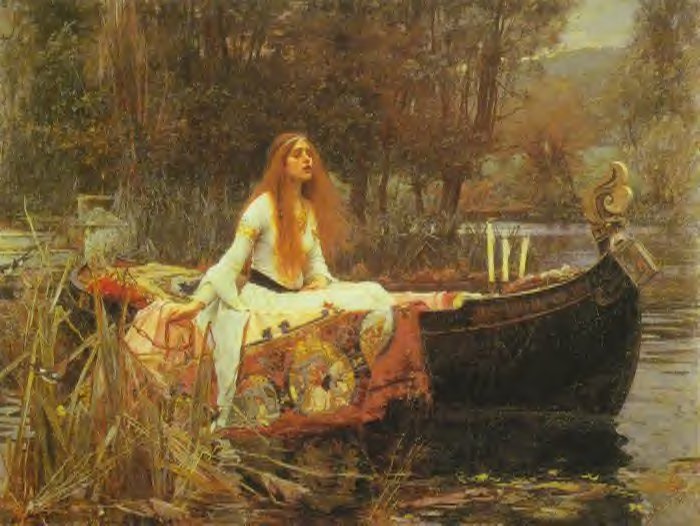
The Tragic Love Triangle of Camelot
I. Introduction:
The Love that Damned a Dream
A. Roles of the Three Participants
1.
Arthur, the king,
Guinevere, the queen, and Lancelot, the knight
a.
Metaphors:
“‘Lancelot, the flower…pearl of beauty.’” (Tennyson, L&E, 141)
b.
Lancelot largely
remains the tragic hero of the legend
B. Thesis of Research Paper
1.
“The infamous
love triangle of Camelot effectively paved the way to the kingdom’s tragic end
by violating the laws of chivalry, creating a shameful scandal, and emotionally
destroying its participants.”
II. Historical Backgrounds.
A. Background of Camelot
1. Young King
Arthur fills his court with the laws of chivalry and courtly love
2.
Chooses Guinevere of Cameliard for his
wife
3.
Lancelot soon joins the Round Table as his
greatest knight
B. History of the Love Triangle in Arthurian
Literature
1.
Chrétien de
Troyes, a French writer, introduced courtly love to the legend
a.
Did this in order
to please his aristocratic patroness, Marie de Champagne, who wrote a book on
the rules of this new social component
b.
This shifted the
main reason for Camelot’s fall from something simple, like Mordred’s scheme, to
something complex, like forbidden love
III. Origins of the Affair
A. Reasons for Affair
1.
Guinevere’s
perspective
a.
Given up by her
father without her consent to the powerful King Arthur, making her hand in
marriage a diplomatic agreement
i.
Guinevere wasn’t
consulted about marriage, therefore had no control over her future. “The marriage between her…without consulting
her.” (White, 362)
b.
Easily loved
Arthur with her mind, but not her heart, since it was difficult to love a god
i.
“‘Arthur, my
lord…the sun in heaven?’” (Tennyson, L&E,
141)
c.
Lancelot was the
earthy man she desired—Arthur gave her security, and her knight gave her
passion (White, 363)
i.
Guinevere found
“warmth and color” in Lancelot, compared to her oftentimes godly king
(Tennyson, G, 239)
ii. Guinevere gave
her heart to Lancelot and her mind to
Arthur “‘…I am yours…save by the bond.’” (Tennyson, L&E, 141)
2.
Lancelot’s
perspective
a.
Had been stolen
away by the mythical figure, the Lady of the Lake, who trained him to become
the Grail Knight
i.
This was a huge
expectation, and also a huge dedication, since he must remain pure
b.
After meeting
Guinevere, he falls deeply in love with her, an event he is unable to prevent
(Malory, 453)
3.
Mutual mitigation
a.
Guinevere and
Lancelot’s relationship made them forget their problems (Morris, DG)
b.
Could relate to
each other
i.
Guinevere was
brought to Camelot to become Arthur’s wife, Lancelot was brought to Camelot to
achieve the Grail
ii. Both had somewhat restricted lifestyles—they must both keep
up a pure or valiant image to cover what they truly felt
c.
The two young
people gravitated towards each other naturally (Morris, DG)
IV. The Violation
of Chivalry
A. Brief Definition of Chivalry
1.
Code of moral
laws that Christian, medieval knights lived by, Camelot had chivalry as one of
its main pillars
a. “According to this system…to his lady-love.”
(PH, 732)
2.
Also included
courtly love
a.
This social
component was introduced by French writers, where love was almost a kind of
religion
i.
“…the lover
should be humble…as completely as she cared to.” (Hibbert, SFKA, 22)
B. Lancelot’s Infringement of Chivalry
1.
Disloyalty to God
a.
Broke several
Commandments
i. “Thou shalt
not covet thy neighbor’s wife”—yet he coveted his best friend’s wife
ii. “Thou shall have no other Gods before me”—yet he loved
Guinevere more than he loved God (Matthews, AT, 55)
b.
By giving up his
virginity physically to Elaine, and spiritually to Guinevere, he lost his
ability to achieve miracles with God’s help (White, 383)
c.
By giving into
carnal sin, Lancelot was also denied the right to achieve the Holy Grail
(Hibbert, SFKA, 47)
2.
Disloyalty to
King
a.
Obviously,
betrayed Arthur by having a secret affair with the queen behind his back
i.
The situation was
aggravated by the fact that Arthur trusted Lancelot completely, and thus was
further devastated when the truth was revealed (Malory, 486)
ii. A further slap in the face was the fact that the affair
went on for roughly twenty-five years (White, 383)
3.
Disloyalty to
Lady
a.
Although Lancelot
was deeply in love with Guinevere, he was enchanted into sleeping with Elaine
of Corbin, whom he thought was Guinevere
i.
As a result of
the accidental event, Lancelot impregnated the Princess with Galahad, a knight
who would somehow become pure from the sin he had been conceived in
b.
Was further
unfaithful, although unintentionally, with Elaine of Astolat
i.
The young girl
fell in love with him, and he competed in a tournament for her
ii. Lancelot managed to avoid her advances, however happy a
life she promised him: “The shackles…falsely true.” (Tennyson, L&E, 158)
iii. Elaine ended up dying of her unrequited love
for him
V. The Scandal that
Ignited Camelot
A. Decades of Dangerous Trysts
1.
Adultery was a
fateful act in the Arthurian legend
a.
Morgause,
Arthur’s half-sister, was killed by her sons when they caught her in bed with a
young lover
b.
Other texts tell
of how a man who killed his wife for infidelity was hunted down by the
chivalric knights
2.
Lancelot and Guinevere’s
situation was no less hazardous
a. Their high profiles magnified the shame
that they would inevitably be subject to, Guinevere warned Lancelot about the
consequences: “…Get thee hence…break and blaze.” (Tennyson, G, 226)
a.
The two knew the
risks that they were running, Guinevere warns Elaine to keep her mouth shut:
“‘It will be his death if you do.” (White, 396)
B. A Situation Easily Preyed Upon by Evil
(Malory, 472)
1.
Power-hungry
Morgause, seduced him in his younger years in order to father his bastard
child, who would later destroy him
2.
When Morded was
old enough, his mother sent him to Camelot to stir up trouble along with his
half-brothers
a. Blame is
placed on Agravaine and Mordred : “…two knights with malice…Sir Launcelot and
Queen Gwynevere.” (Malory, 472)
3.
Mordred’s
intentions were to expose the scandal of his father’s court, and then take the
throne for himself (Tennyson, G,
227)
a.
“Lured by the
crimes…spoil the land.” (Tennyson, G,
227)
4. His plan worked beautifully, and Lancelot
and Guinevere were set up and caught on the very night that they had decided to
end the affair
C. The Legacy of Shame
1.
The Queen’s trial
a.
Arthur had no
choice but to put Guinevere on trial for her adultery (White, 579)
i.
She was found
guilty and condemned to burn at the stake, but Lancelot rescued her in the
knick of time
ii. However, this only confirmed the affair to
the public, and time started ticking for Camelot
b.
The British
population placed most of the blame on Guinevere: “‘While the wine ran…the
sinful Queen.’” (Tennyson, G,
231)
c.
Guinevere retired
to a nunnery to escape the shame, Lancelot, to a monastery
2.
Historical
infidelity
a.
Guinevere’s adultery earned her a place in history in a Welsh “Triad”:
“‘One was more faithless…any of the others.’” (Matthews, KAGQ, 31)
b.
Guinevere said it
plainly: “‘And mine will ever be a name of scorn.’” (Tennyson, G, 239)
VI. The
Self-Destruction of Camelot’s Three Pillars
A. Guinevere’s Shameful Denial
1.
Was caught
between loyalty to her husband, and passion for her lover throughout her entire
life (Tennyson, G, 239)
a.
Lancelot was more
mortal to her than sometimes godly Arthur
i.
“‘For who loves
me…touch of earth.’” (Tennyson, L&E,
141)
2.
As the years
dragged on, her fidelity was constantly questioned by troublemaking knights and
members of the court
a. Ironically,
Lancelot always ended up fighting for her in order to deny the claim
3.
Her shame haunted
her for the remainder of her life (Tennyson, G, 240)
a.
Spent the time
after Arthur’s final battle in a convent, seeking forgiveness for her vice
i.
Guinevere
contemplates suicide, but soon decides: “‘I cannot kill my sin.’” (Tennyson, G, 239)
B. Lancelot’s Emotional Erosion
1.
The sinful love
between him and Guinevere plagued his mind for years (Hibbert, 48)
a.
Did everything to
try to banish his impure thoughts, and also to be able to overcome his desires
(Matthews, AT, 54)
i.
Spent many years
away from Camelot on random quests
ii. Wore a hair shirt
b.
However, all
these efforts failed him
i.
His conscience
was a wreck: “He loved Arthur…he hated himself.” (White, 368)
c. Truly,
Lancelot’s only weakness and only sin revolved around his love for the Queen of
Camelot (Matthews, AT, 54)
2.
Was spiritually
weakened by the affair
a.
Could no longer
achieve the Holy Grail, for he was no longer a virgin, and had committed a
grievous sin (Hibbert, 47)
b.
His son, Galahad,
usurped his position as Grail Knight—in effect becoming everything that his
father could not (Matthews, KAGQ,
86)
3.
Guinevere, the
demanding lover
a.
Guinevere
exhibited violent jealousy on account of Lancelot’s unintentional affair with
Elaine of Corbin, and brief relationship with Elaine of Astolat
i.
Upon hearing of
his second accidental night with Elaine of Corbin, Guinevere flew into a rage:
“‘I curse him…die for all I care.’” (Malory, 450)
b.
As a result of
her shunning, Lancelot went mad and lived in the forest for years as a savage
before being found
4.
The greatest
knight’s sad end
a.
Was so deeply in
love with Guinevere that he was willing to risk his life to protect her after
their affair was exposed: “There hold thee….the world.” (Tennyson, G, 227)
b.
But all ended in
tragedy, and like his lover, Lancelot, too, retired to a religious house—a
monastery, where he sought God’s forgiveness
c.
After all his
expectations and struggles, Lancelot is mortal and tragic, after all (Matthews,
AT, 62)
C. Arthur’s Greatest Betrayal
1.
The sheer pain of
realization
a.
For years, Arthur
had not noticed, or had at least turned a blind eye to the affair, playing the
part of the innocent bystander finding bliss in ignorance
b.
Merlin had warned
him about Guinevere’s prophesized infidelity before their marriage, but Arthur
had ignored it
c.
His eventual
acceptance of it devastated him—his best friend and his wife, the two people he
loved most on earth, had gone and betrayed him
i.
This was made
even worse by the fact that Arthur had never shown anything but love to
Guinevere, and friendship to Lancelot
ii. Arthur was
devastated by the news: “‘Thou hast spoilt…my life.’” (Tennyson, G, 235)
2.
The challenge of
upholding the law
a.
Putting his wife
on trial was difficult for Arthur, since he still loved her after all she had
done (Tennyson, G, 236)
b.
He was challenged
to uphold his firm law, and not to bend it in this case, as a strong ruler
would do
i.
Still, his heart
disagreed with what he must do: “‘Ought I to…new law aside?’” (White, 579)
ii. Also, would he let his best friend who had betrayed him
save his queen?
3. The devastation that gave way to war
a.
The terrible
reality of his betrayal gave Arthur nothing left to live for (Tennyson, G, 235)
i.
His wife had
betrayed him
ii.
His best friend
had betrayed him
iii.
His son was
attempting to usurp his throne
iv.
All that he had
worked Camelot up to, had been for naught
b.
With so bleak a
situation, he was willing to fight an almost suicidal war against the invading,
evil forces of his son, Mordred
c.
This decision resulted
in the physical destruction of Camelot, although the moral destruction had
already been completed (Tennyson, G,
240)
i.
“From morning
until night…dead upon the field.” (Hibbert, 54)
d.
Guinevere had
broken “the cast design and purpose of the king.” (Tennyson, G, 240)
e.
Arthur’s dream
was shattered, and Camelot’s luster faded in the aftermath (Tennyson, G, 236)
VII. Conclusion
A. The Intertwining of Problems
1.
The restricted
circumstances of Guinevere and Lancelot’s life caused them to gravitate towards
one another
2.
The resulting
affair started off as a comforting thing, but grew into something bittersweet
as “seeds of hatred and fear and confusion” were added by her jealousy (White,
386)
a.
Lancelot and
Guinevere betrayed the rules of chivalry by loving each other
3.
As word got out
about the affair, a scandal developed
a.
Mordred preyed
upon the scandal, using it to his own tastes
b.
Arthur was told,
Guinevere was tried and rescued
c.
Lancelot
accidentally killed two knights—Agravaine and Gareth—and the war with Arthur
was set in motion (Malory, 475)
d.
The final battle
for Camelot raged, and the Round Table was spiritually destroyed (Malory, 478)
i.
Nearly all the
knights of the Round Table were killed, as well as Arthur (Hibbert, 54)
e.
Lancelot and
Guinevere lived with their sins for several years before dying alone and
unhappy as a result of the love that they had shared
B. Messages of de Troyes, Malory, Tennyson, and White
1.
The tragedy is
meant to show the darker side of love and the fragility of a dream
a.
Lancelot is
portrayed as a tragic hero whose love for one forbidden woman exceeds that of
his love for his God or his King (Matthews, AT, 55)
i.
This flaw is
distinctively human, and results in spiritual and emotional ruin
b.
Love can be both
an incredibly powerful creative and destructive force at the same time
c.
And a dream can
easily cave in on itself when the three pillars holding it up are destroyed
[email protected]
Term Paper Contents
Ye Olde Table of Contents

