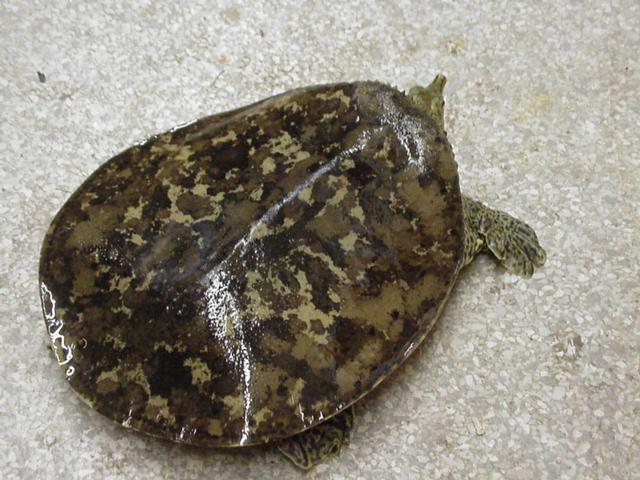
The soft-shell turtle is distinquished from other turtles by the unique structure of its shell. The peripheral bones of the carapace are reduced and the surface is covered by a leathery skin instead of scutes. The plastron is cartilaginous not bony. Their feet are highly webbed and three-toed. They have a long neck and a distinctive long and pointed nose that allows them to "snorkel" for food or a breath of air. The spiny soft-shell gets its name from cone-like projections on the cranial aspect of the carapace. Its coloring is a tan or olive background with darker or lighter spots depending on the subspecies.
In the wild their diet includes fish, snails, insects, frogs, worms, and some plants. In captivity, they will do well on pelleted turtle food supplimented with live food such as earthworms, red wigglers, minnows and crickets.
The soft-shell is an aggressive turtle and will pick on, and even kill, turtles of other species as well as their own. Because of the nature of their shells, they are very prone to shell rot and fungal infections. Even the smallest scratch can quickly escalate into a major infection. Prevention is the key. Soft-shells tend to be healthy if kept outdoors in a large well aerated pond. Indoors, they do best in a large aquarium, at least 75 to 100 gallons for a single adult, as they can grow to be as big as 20 inches. Outdoors, several specimens can be kept together as long the pond is large enough, 2000+ gallons, so that they can get away from each other.
Female soft-shells lay from 4 to 30 round, firm eggs, in sand. The incubation period varies from 53 to 96 days, depending on temperature (31 to 26 degrees Celsius, respectively.)