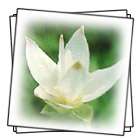
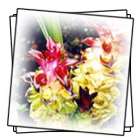
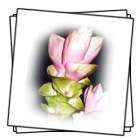
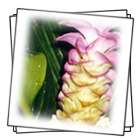
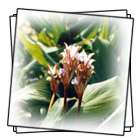
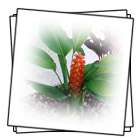
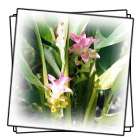
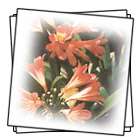
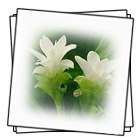
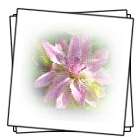
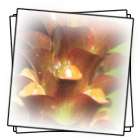
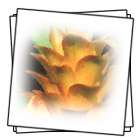
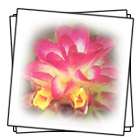
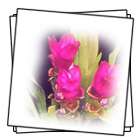
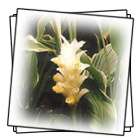
Curcumas are the unimaginable world of hidden
gingers, which get its name from some of the varieties because
they bare there flowers on short stalks amid its foliage. Foliage
is lush, broad and sometimes pleated. Curcumas love filtered light
or light shade and enjoy moist soil. Blooms appear spring, summer
or fall depending on variety. They should be fed with a good application
of fertilizer in early spring to produce an exciting and unusual
flower that can be enjoyed for weeks. All varieties listed are
very hardy, but go dormant for the winter where they will die
down to rest. Keep on the dry side while resting for the winter.
We offer the newest varieties available!
Common
Name: Hidden Lily
Division: Magnoliophyta
Class: Liliopsida
SubClass: Zingiberidae
Order: Zingiberales
SubOrder:
Family: Zingiberaceae Lindley
SubFamily:
Tribe:
SubTribe:
Country of Origin: India
Habitat:
Description: To 3 feet; leaves oblong, 12-18 inches long, acuminate;
flower spike terminating the leafy stem, 8 inches long or more,
bracts deep scarlet or orange-red, the terminal ones with flowers
in their axils, not sterile; flowers bright yellow, scarcely longer
than bracts.
These are tropical, herbaceous plants that can be grown in a warm,
humid greenhouse having a minimum winter temperature of 60 degrees.
The most important kind is C. longa, a native of India, but widely
cultivated throughout India, Ceylon, the East Indies, Fiji and
Queensland for its underground stems from which, when dried and
ground, the Turmeric of commerce is manufactured. Turmeric is
orange-yellow in color and has a very distinct aroma. It is in
demand as a condiment in Indian cookery and is the base of many
curry powders. In addition to C. longa, C. petiolata and C. Roscoeana,
both natives of Burma, are grown for their ornamental leaves and
flowers.
A source tumeric, used as a spice and dye, which is obtained
from the rhizome of the plant. Most commercial tumeric is obtained
from C. domestica.
Culture: Dies back and goes dormant in winter; water sparingly
until new growth resumes in spring.
POTTING: When grown in a hothouse, Curcuma must be potted in well-drained
soil of peat and loam mixed with small pieces of sandstone, charcoal
or soft broken brick and coarse sand. The atmosphere must be humid.