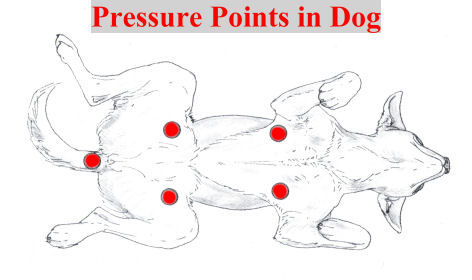
| Pressure Points: If you are having trouble controlling bleeding from a leg or tail wound, try applying pressure to the closest pressure point on the dog's underside (see above illustration). Tourniquet: Use a tourniquet only as a last resort�that is, when arterial bleeding can't be controlled otherwise and the situation is life-threatening. A tourniquet is always placed above the wound (between the wound and heart) and must be loosened every 5 to 10 minutes to prevent severe tissue damage. When it is loosened, check if the bleeding has stopped, and if it has, apply a pressure pad. Get to a vet immediately after applying a tourniquet. Sources: Dog Owner�s Home Veterinary Handbook, 3rd ed., J. Giffin, MD & L. Carlson,, DVM (Hungry Minds, 2000); and The Chihuahua Handbook, D. Caroline Coile, Ph.D. (Barron�s, 2000). |
 |
|
|
| Controlling Profuse Wound Bleeding (cont.) |
| December 2005 |
| Page 2 |
| Copyright 2005 Chihuahua Club of Savannah. All Rights Reserved. |
 |
|
 |
 |
|
| NEWS |
| Your Chi�s life could depend on your acting quickly and correctly in a heat stroke emergency. Do you know the signs of heat stroke?...How to cool your dog without making matters worse?...When to stop cooling?...What to do to prevent serious aftereffects? Signs: Early signs are rapid and loud panting, drooling, and bright red tongue, lips and gums. The dog�s rectal temperature rises above 104�F and vomiting often occurs. Subsequent signs include unsteadiness, bloody diarrhea, gray lips and gums which indicate shock, collapse, seizures, coma, and ultimately death. How to Cool Your Dog: Get your dog to a cooler place, preferably with air conditioning, at once. Then quickly and thoroughly either wet him down with cool water by hose or other means, or immerse him in a tub of cool water for up to two minutes. Do not use icy water or immerse the dog longer than two minutes at a time in order to prevent his blood vessels from constricting, which will make matters worse. Offer the dog small amounts of water to drink. When to Stop Cooling: A dog�s normal temperature ranges from 100� to 102.5�F. Stop cooling when it falls back to 103� because it will continue to fall further on its own. Additional cooling can cause hypothermia and shock, especially in small dogs like Chis that have a small body size compared with body surface area. Use a rectal thermometer (the digital type is safer and |
| Heat Stroke: Prevention & Treatment |
| quicker than the bulb type) to take a dog's temperature. It should be part of your pet first-aid kit but if one is not available, first cool your dog as described and then race him to a vet in a vehicle with the a/c turned up high. Prevent Serious Aftereffects: After cooling your dog, take him to a vet as soon as possible to treat or prevent complications that can occur minutes, hours or days after heat stroke. These include obstructed breathing due to swelling of the larynx and vocal cords, kidney failure, spontaneous bleeding, cardiac arrhythmias and seizures. Be sure to keep your dog quiet for at least three days after a heat stroke incident. Prevention is key. Dogs cannot sweat and must rely on panting to keep cool. However, when outside air becomes hot and humid, they easily become overheated because of the lack of cool air to inhale and the limited evaporation of mouth/lung moisture in high humidity. Restrict your dog�s exercise when it�s hot and humid, make sure there is shade and plenty of cool water available when he�s outside, and don�t leave him unattended in a vehicle (if you absolutely must, be verybrief, park in the shade, and leave windows partially open for air). Sources: Dog Owner�s Home Veterinary Handbook, 3rd ed., J. Giffin, MD & L. Carlson,, DVM (Hungry Minds, 2000); and The Chihuahua Handbook, D. Caroline Coile, Ph.D. (Barron�s, 2000). |
 |