 |
| World's Smallest Breed |
 |
|
|
| Copyright 2005 Chihuahua Club of Savannah. All Rights Reserved. |
| Dec 2005 |
 |
 |
|
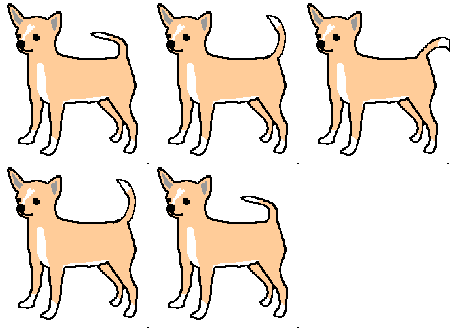 |
| Chihuahuas are recognized as the smallest breed of dogs in the world. The official American Kennel Club (AKC) standard for the breed is available at www.akc.org/breeds/chihuahua/index.cfm, and is used in judging at dog shows. The standard specifies that a Chi should weigh no more than six pounds. Of course, not all Chis meet this ideal and weigh more. A minimum weight is not specified, but there is general agreement that Chis should not be bred to be extremely small. Overly small dogs are usually the runts of the litter or the offspring of poor specimens, and as such, can be prone to numerous physical defects and health problems. Reputable breeders therefore don't claim to sell "teacup" Chis and advise the public to avoid purchasing a dog from anyone who does. As everyone who has a Chi for a pet knows, the size of their dog doesn�t much matter. More important is that the world�s smallest dog, no matter what s/he may weigh, has the world�s largest heart. |
| Chihuahuas are known as clannish dogs. They are unique in that they instinctively recognize and prefer fellow Chis over other types of dogs. They also are unlikely to greet a human stranger in a welcoming manner, tending instead to react with reserve, caution and sometimes hostility. However, Chis are very loving and affectionate with their own people and usually get along well with non-Chi pets in their household. Because of this innate clannishness, it is important to socialize your Chi with other dogs and people beginning at an early age. Take your dog for walks and car rides, introduce him or her to people who visit your home and who you meet outside, and consider enrolling in a puppy training class. Make these situations fun, and encourage your Chi with praise or a treat. The repeated exposure to outside sights, sounds and people will produce a confident, well-socialized dog. The popularity of Chis as a breed, combined with their need for socialization and preference for other Chis, have fueled the growth of Chihuahua-focused groups worldwide. These groups offer members a venue in which to exchange information about their dogs and socialize them with other Chis. Sources: Living with a Chihuahua, M. Greening, ed. (Barron�s, 2003); & Chihuahuas for Dummies, J. O�Neil (Hungry Minds, 2001). |
| A Clannish Dog |
| UNIQUE CHARACTERISTICS OF CHIHUAHUAS |
| NEWS |
| Chis are commonly born with a �soft spot�on the top of the head where the skull bones have not completely fused. In human infants, this is called a fontanel, while in dogs it is referred to as a molera (a misspelling of the Spanish word �mollera� meaning fontanel). Other types of dogs are occasionally born with a molera that almost always closes within a few weeks. In contrast, a Chi's molera often never fully closes, although it does gradually becomes smaller. The molera is so closely associated with the breed that once it was thought all true Chis had one. Although that is not correct, it is estimated that about 85% of Chis still have an open molera by age one and a half. By age 3 years, estimates of Chis with an open molera range from 50% to 80%, although its size usually has decreased to that of a dime or nickel. |
| The Molera |
| The molera appears as a slight depression at the top of the skull where there is a covering of membrane rather than bone. Dogs with a molera are therefore more susceptible to brain injury or death from a blow to the head. It is important, especially in young Chis who generally have a large molera, to be vigilant in avoiding falls and rough play. Also, use caution in areas with low furniture, such as coffee tables or chair rungs, where a small dog might strike its head. |
 |
| Sources: The Chihuahua Handbook, D. Caroline Coile, Ph.D. (Barron�s, 2000); & Chihuahuas for Dummies, J. O�Neil (Hungry Minds, 2001). |