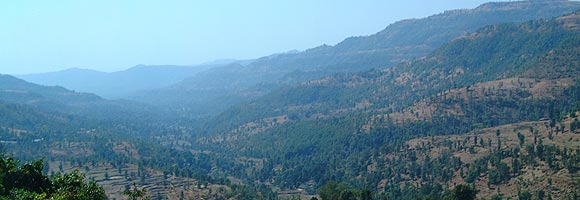
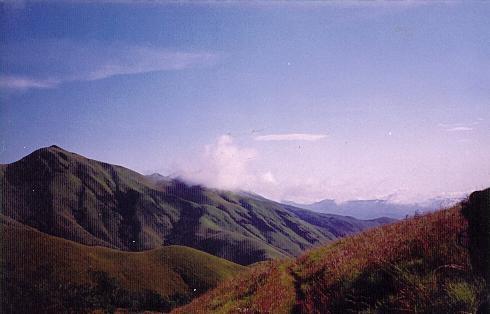
The
Western Ghats comprise the mountain range that runs along the western coast of
India, from the Vindhya-Satpura ranges in the north to the southern tip. The
ecosystems of the Western Ghats are located mainly in the following regions: the
tropical wet evergreen forests in Amboli to land of Radhanagari; the
Montane evergreen forests in Mahabaleshwar and Bhimashanker; moist deciduous
forests in Mulsi and the scrub forest in Mundunthurai. A great variety of
vegetation all along the Ghats: scrub jungles, grassland along the lower
altitudes, dry and moist deciduous forests, and semi-evergreen and evergreen
forests. There are two main centres of diversity, the Agashyamalai hills and the
Silent Valley. The complex topography and the heavy rainfall have made certain
areas inaccessible and have helped the region retain its diversity. Almost
one-third of all the flowering plant species in India are found in this region.
Of the 450-odd plants found in this region, 40% are endemic (these are species
that have adapted to this particular area and the conditions existing in it.)
There is an equal diversity of animal and bird life. There is only one
biodiversity reserve in the Western Ghats, the Nilgiri biodiversity
reserve,which helps in conserving endemic and endangered species. A few of the
indigenous and exotic tree and plant species in the Western Ghats are the teak,
jamun, cashew, hog plum, coral tree, jasmine, and crossandra.
Some
of the national parks situated in this region are the Borivali national park in
Maharahshtra near Mumbai, which is home to a large variety of birds and the
Nagarhole national park which borders the Bandipur national park, famous for its
tiger leopard, sloth bear, barking deer and mouse deer. More than 250 species of
birds are found in this park.. There is the Anamalai wildlife sanctuary in Tamil
Nadu, which has evergreen forests and tall high-altitude temperate grasslands.
The Nilgiri languar, the rare lion-tailed macaque, spotted deer, and the giant
squirrel are some of the animals found here. Racket tailed drongos, hornbills,
fairy bluebirds are some of the birds seen here. The famous Periyar national
park in Kerala, is home to a large number of elephants, gaur, sambhar, and
lion-tailed macaque and a variety of birds.
Indian Biodiversity
Gap Analysis of the conservation effort
During
the past 40 to 50 years the plant and animal life has as a whole suffered due to
so-called development and urbanization, which has led to the extinction of many
species and more are in the are in danger of becoming extinct.
Western Ghats is the name given to the narrow
stretch of land that borders the western coast of south peninsular India.
At points the Ghats are hardly 5-6 km away from the coast. Myth logically the
Ghats were created when Parashurama the sage had thrown his battle axe at the Arabian
ocean. Whatever may be the facts but one thing is for sure that the western Ghats
are relatively younger to the other mountain regions of India.
Threatened Indian species
For years these Ghats were a natural border
between the coastal towns and other centers of populace. The only routes being
infested by wild beasts in the accompanying thick evergreen forests of the
western Ghats. The Ghats stretches from modern day Maharashtra to Kanyakumari or
Cape Comorin the last bit of land of the Indian subcontinent.
My Favorite trekking spot
Read about western ghats
Western
Ghats Forestry
Webmaster