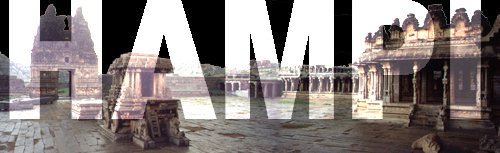
Out of the hundreds of ruins and a few preserved historical locations of India none is as grand and as beautiful as Hampi, the former capital of the ancient Vijaynagar Empire one of the greatest and most prosperous empires to be built by man and sadly sacked plundered and destroyed by man.
"Vijayanagara is such that the pupil of the eye has never seen a place like it ..." so eulogized Abdul Razaq, a Muslim envoy, who visited Hampi. 343 km from Bangalore and 74 km from Bellary, Hampi - a world heritage center - is the most beautiful and evocative of all the ruins in Karnataka. The Tungabhadra river flows through Hampi, on the banks of which, it is said, the Goddess Hampi (Parvati) attained Lord Shiva. This city was praised by historians like, Nuniz and Paes, as being greater than Rome, its palaces plated with jewel-encrusted gold, simply the 'bets provided city in the world'.
The erstwhile capital of the Vijayanagar kingdom, Hampi is full of delightful surprises. In the 13th century, the markets here overflowed with luxuriant silks, brilliant diamonds, rubies and emeralds. Today, the Market Place with its ancient, roofless stalls is a riot of colour on festive nights, when the Virupaksha Temple is all ablaze with lamps.
Vijayanagar, meaning (meaning "City of Victory" in Sanskrit), now Hampi, was once the capital of the last of the great southern (and perhaps the largest ever) Hindu empires. Founded in 1336 by five princes, Vijayanagar united the Deccan, restored Hinduism to its early glory as the primary religious force, and remained a force until the early 17th century. At its height, it may have had a population of 500,000 people over and above a million-man mercenary army. Today, the site of the city, on the banks of the Tungabhadra River, is an arid, 33-square-mile spread of majestic ruins, also partly occupied by the scrappy modern village of Hampi towered over by its ornate 15th-century Virupaksha Temple.
Vijayanagar financial and political strength stemmed from its control of spice and cotton production and trade. Great international markets existed within its frontiers and intellectual exchange was encouraged. As a result, literature and the arts flourished, and peace and prosperity spread throughout the realm as it never had before. Contact even with the northern Muslims was common and expected, bringing with it new thought and creative productivity. Despite this stability, petty squabbles and shifting alliances led to a fatal battle in 1565 at which the forces of Vijayanagar were defeated by an alliance of lesser kingdoms. Vijayanagar was destroyed and despite moving the capital to another city, by 1614 the empire had collapsed.
LOCATION
Hampi
is located in the central part of the state of Karnataka, in the southern part
of India. It is 353 km from Bangalore, and 13 km from Hospet. It is located on
top of a rugged terrain and is 467 m above sea level. Tungabhadra River flows
through Hampi. It has a tropical climate with hot summers (April–June), and
cool winters (October–February). It experiences the southwestern monsoon rains
from June to August.
VISITING
TIME
The best time to visit Hampi is from
October to March.
