I had warned most of you that my home pages consists of many a thing that may irk a lot of you. If so please leave before my ideas corrupt you to the core. To be serious i have included the stuff about the explosives so that even a layman could know about the same in case he comes across some stuff and thus alert the authorities. The way things are going about in today's world , anything is possible.
General
Few military bombs (other than those dropped by aircraft) are currently manufactured on the scale and with the diversity encountered in the Second World War. The exception to this generalization is the mine - both the anti-personnel and anti-tank mine. Mines can be adapted without too much difficulty with average combat-engineer experience. Some 300 different types of mines are buried under the soil, killing tens of thousands every year.
Most bombs assembled by terrorists are improvised. The raw material required for explosives is stolen or misappropriated from military or commercial blasting supplies, or made from fertilizer and other readily available household ingredients. Such assembled bombs are known as Improvised Explosive Devices (IEDs).
Components
IEDs have a main charge, which is attached to a fuse. The fuse is attached to a trigger. In some types of IEDs, these three components are almost integrated into a single whole. The trigger is the part which activates the fuse. The fuse ignites the charge, causing the explosion. The explosion consists of a violent pulse of blast and shock waves. The effects of the IED are sometimes worsened by the addition of material, such as scrap iron or ball-bearings. Sometimes the trigger is not the only component that activates the fuse; there is also an anti-handling device that triggers the fuse when the IED is handled or moved. The purpose of most IEDs is to kill or maim. Some IEDs, known as incendiaries, are intended to cause damage or destruction by fire. The format of the charge in some IEDs (some of which have no casing to contain the components of the IED) can be shaped or directional, rendering a measure of control over the explosion. Anti-personnel mines and other types of mines have been adapted by terrorists to suit their purposes.
Favoured Explosive Charges
Methods / Triggers used to detonate an IED
Examples of IEDs
Pipe Bomb
This is the most common type of terrorist bomb and usually consists of
low-velocity explosives inside a tightly capped piece of pipe. Pipe bombs
are very easily made using gunpowder, iron, steel, aluminium or copper
pipes. They are sometimes wrapped with nails to cause even more harm.
Molotov Cocktail
This improvised weapon - first used by the Russian resistance against German
tanks in the Second World War - is used by terrorists world-wide. Molotov
cocktails are extremely simple to make and can cause considerable damage.
They are usually made from materials like gasoline, diesel fuel, kerosene,
ethyl or methyl alcohol, lighter fluid and turpentine, all of which are
easily obtained. The explosive material is placed in a glass bottle, which
breaks upon impact. A piece of cotton serves as a fuse, which is ignited
before the bottle is thrown at the target.
Fertilizer Truck Bomb
Fertilizer truck bombs consist of ammonium nitrate. Hundreds of kilograms
may be required to cause major damage. The Irish Republican Army, Tamil
Tigers and some Middle Eastern groups use the ammonium nitrate bomb.
Barometric Bomb
One of the more advanced weapons in the terrorist's arsenal. The detonator
of the bomb is linked to an altitude meter, causing the explosion to occur
in mid-air.
| CLASSIFICATION | EXPLOSIVE | COLOR | USES | RATE OF DETONATION | REMARKS |
|
Low Explosives |
Black Powder | Black, gray or cocoa brown | Safety fuse, Muzzle loaders | 1,312 feet per second | very sensitive to friction heat and shock |
| Smokeless Powder | Light brown to black | Small arms, mortars, rockets | Rapid burning | very sensitive to friction heat and shock | |
|
Primary Explosives |
Lead Azide | White to buff gray | Detonators, priming compositions | 13,400 to 17,000 feet per second | very sensitive to friction heat and shock |
| Lead Styphnate | White to buff gray | Priming compositions | 17,100 Feet per second | very sensitive to friction heat and shock | |
| Mercury Fulminate | Light orange to reddish brown | Detonators, priming compositions | 11,500 to 21,100 feet per second | very sensitive to friction heat and shock | |
| Tetracene | Pale yellow | Detonators, priming compositions | Less than 13,100 feet per second | sensitive to shock and heat. Used in combination with other explosives | |
|
Secondary Explosives |
Amatol | Buff to yellow to dark brown | Main charge for bombs, projectiles | 14,800 to 21,100 feet per second | Developed during WWII to conserve TNT |
| Ammonal | Gray | Projectile filler | 17,700 feet per second | water soluable | |
| Ammonium Nitrate | White but may be dyed other colors | Ingredient of many explosive mixtures | 3,300 to 8,200 feet per second | Must be kept cool | |
| Ammonium Picrate | yellow to orange to red | Armor piercing projectiles and bombs | 22,500 feet per second | Relatively insensitive to shock and friction | |
| Astrolite | White pellets | Demolition | 2,600 to 26, 200 feet per second | Inert until mixed. Do not use with Tetryl | |
| C-4 | White to light brown | Plastic demolition explosive | 26,400 feet per second | Insensitive to impact and friction | |
| Cyclotol | Buff to yellow to brown | Fragmentation bombs, projectiles | 25,900 to 26,400 feet per second | Excellent for blast effects | |
| Flex-x | any color--Usually olive drab or red | Cutting charges | 22,300 feet per second | Flexible, waterproof, insensitve to shock | |
|
Secondary Explosives |
HBX (Torpex) | Gray | Main charge filler for underwater bombs and torpedoes | 22,700 to 23,700 feet per second | Excellent for blast effects |
| HMX | White | Mixed with TNT in high blast warheads | 29,900 feet per second | By product of RDX manufacture | |
| Kinepak | Powder is white, the liquid is usually pink | Construction | 20,100 feet per second | Inert until mixed | |
| Minol | gray | Filler for bombs and depth charges | 19,100 to 19,700 feet per second | Comparable to TNT in sensitivity to initiation | |
| Nitro-Cellulose | White | Blasting, smokeless powder | 21,900 feet per second | Used in flashless powder | |
| Nitro-glycerin | Clear to amber. Red fumes mean "Beware" | Demolition, ingredient in dynamite | 4,900 to 25,400 feet per second | Can be absorbed through skin causing headache | |
|
Secondary Explosives |
Nitro-guanidine | White to yellow | Propellant and bursting charge ingredient | 25,100 feet per second | One of the least sensitive military explosives |
| Nitro-starch | white | Mortar shells, grenades | 16,00 feet per second | Another form of Nitro-cellulose | |
| Octol | Buff | Projectile and bomb filler | 27,500 to 28,300 feet per second | Excellent for blast effects | |
| Pentolite | White to yellow to gray | Shape charges, boosters | 24,500 feet per second | Presence of grit increases impact sensitivity | |
| PETN | white unless dyed | Det cord, blasting caps, primer | 27,200 feet per second | Presence of grit increases impact sensitivity | |
| Picratol | Yellow to brownish yellow | Armor piercing projectiles and bombs | 22,900 feet per second | Insensitive to initiation | |
|
Secondary Explosives |
Picric acid | Cream to yellow to red | Alternative filler | 19,00 feet per second | Dangerous when it deteriorates |
| RDX | White but may be dyed | Det cord, blasting caps, used to make C-4 | 26,800 feet per second | Not used much until WWII | |
| Tetryl | Clear to yellow to gray | Booster, blasting caps | 25,800 feet per second | Colors skin reddish brown and causes rash | |
| Tetrytol | Light yellow to buff | Bursters, demolition blocks | 24,000 to 24,200 feet per second | Similar to TNT and Tetryl | |
| TNT | Light yellow to brown to light gray | Bombs, projectiles, demolition | 21,800 to 22,400 feet per second | Standard with which all other explosives are measured | |
| Torpex | Gray | Depth charges, mines | 24,600 feet per second | Excellent for blast effects | |
| Tritonal | Silvergray | Bombs | 21,200 to 22,000 feet per second | More powerful and more sensitive to shock than TNT | |
|
|
Dynamite | There are hundreds of formulas for dynamite and there is no set standard for detonation speed, color, or size. Dynamite with nitroglycerin as an ingredient is becoming rare. Nitroglycerin dynamite will crystalize after a long period of storage. A sudden temperature difference of 3 degrees can cause these crystals to detonate without warning | |||
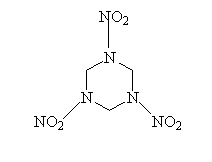
The Grand Dad of them all and a boon to the wretched terrorists ( RDX)
Properties
Appearance White solid Molecular weight 222.1
Melting Temperature 204° C, high but lowers when mixed with TNT
Thermal ignition temp 260° C
Stability High chemical stability, especially compared to TNT
Solubility Difficult to dissolve in organic liquids
Sensitivity Easily initiated by impact of friction, often coated with oil or wax
History
1899 RDX first prepared by a German named Henning for use in medicine.
1920 RDX first recognised as a possible explosive.
1940 A continuous method for the preparation of RDX was developed.
RDX was used with TNT to fill bombs and shells during the Second World War by both sides in order to create more powerful weapons.
Structure
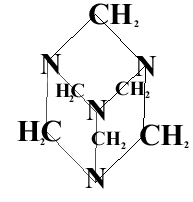
Synthesis
The best way to make RDX is to use the compound pictured above and react it with ammonium nitrate and concentrated nitric acid. The mixture is warmed and when cold water is added, RDX is precipitated. The mechanism for this reaction is very complicated.
Decomposition Products
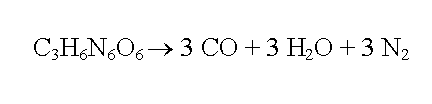
RDX, like TNT, does not have enough oxygen in its molecular formula to completely oxidize everything during an explosion. It is only after contact with the atmospheric oxygen that can allow complete combustion to occur. Below is the decomposition reaction of RDX.