
The City of Vijayanagar in the late 13th century
Nicolo,
on reaching India, visited first the city of Cambaya in Gujarat. After twenty
days' sojourn there he passed down the coast to "Pacamuria," probably
Barkur, and "Helly," which is the "Mount d'Ely" or "Cabo
d'Eli" of later writers. Thence he travelled inland and reached the Raya's
capital, Vijayanagar, which he calls "Bizenegalia" He begins his
description thus: --
"The
great city of Bizenegalia is situated near very steep mountains. The
circumference of the city is sixty miles; its walls are carried up to the
mountains and enclose the valleys at their foot, so that its extent is thereby
increased. In this city there are estimated to be ninety thousand men fit to
bear arms."
I
must here interpose a correction. There were no "mountains" properly
so called at Vijayanagar; only a confused and tumbled mass of rocky hills, some
rising to considerable altitude. The extent of its lines of defences was
extraordinary. Lofty and massive stone walls everywhere crossed the valleys, and
led up to and mounted over the hillsides. The outer lines stretched unbroken
across the level country for several miles. The hollows and valleys between the
boulder-covered heights were filled with habitations, poor and squalid
doubtless, in most instances, but interspersed with the stone-built dwellings of
the nobles, merchants, and upper classes of the vast community; except where the
elaborately constructed water-channels of the Rayas enabled the land to be
irrigated; and in these parts rich gardens and woods, and luxurious crops of
rice and sugar-cane, abounded. Here and there were wonderfully carved temples
and fanes to Hindu deities, with Brahmanical colleges and schools attached to
the more important amongst their number.
As to the appearance of the scenery, I cannot do better than quote the description given in 1845 by a distinguished South-Indian geologist, Lieutenant Newbold:
"The
whole of the extensive site occupied by the ruins of Bijanugger on the south
bank of the Tumbuddra, and of its suburb Annegundi on the northern bank, is
occupied by great bare piles and bosses of granite and granitoidal gneiss,
separated by rocky defiles and narrow rugged valleys encumbered by precipitated
masses of rock. Some of the larger flat-bottomed valleys are irrigated by
aqueducts from the river.... The peaks, tors, and logging-stones of Bijanugger
and Annegundi indent the horizon in picturesque confusion, and are scarcely to
be distinguished from the more artificial ruins of the ancient metropolis of the
Deccan, which are usually constructed with blocks quarried from their sides, and
vie in grotesqueness of outline and massiveness of character with the alternate
airiness and solidity exhibited by nature in the nicely-poised logging stones
and columnar piles, and in the walls of prodigious cuboidal blocks of granite which often crest and top her massive domes and ridges in natural cyclopean
masonry."
The
remains of palaces, temples, walls, and gateways are still to be seen, and these
abound not only on the site of Vijayanagar proper, but also on the north side of
the swiftly rushing river, where stood the stately citadel of Anegundi, the
mother of the empire-city. The population of this double city was immense, and
the area occupied by it very extensive. From the last fortification to the
south, beyond the present town of Hospett, to the extreme point of the defences
of Anegundi on the north, the distance is about twelve miles. From the extreme
western line of walls in the plain to the last of the eastern works amongst the
hills lying in the direction of Daroji and Kampli the interval measures about
ten miles. Within this area we find the remains of the structures of which I
have spoken. The hovels have disappeared, and the debris lies many feet thick
over the old ground-level. But the channels are still in working order, and
wherever they exist will be found rich crops, tall and stately trees, and a
tangle of luxuriant vegetation. On the rocks above are the ruins of buildings
and temples and walls, and in many places small shrines stand out, built on the
jutting edges of great boulders or on the pinnacles of lofty crags, in places
that would seem inaccessible to anything but monkeys and birds.
In
the central enclosure are the remains of great structures that must once have
been remarkable for their grandeur and dignity. These immediately surrounded the
king's palace; but in 1565 the Muhammadans worked their savage will upon them
with such effect that only the crumbling ruins of the more massive edifices
amongst them still stand. The site of the palace itself is marked by a large
area of ground covered with heaps of broken blocks, crushed masonry, and
fragments of sculpture, not one stone being left upon another in its original
position.
To
return to Nicolo. He continues: --
"The
inhabitants of this region marry as many wives as they please, who are burnt
with their dead husbands. Their king is more powerful than all the other kings
of India. He takes to himself 12,000 wives, of whom 4000 follow him on foot
wherever he may go, and are employed solely in the service of the kitchen. A
like number, more handsomely equipped, ride on horseback. The remainder are
carried by men in litters, of whom 2000 or 3000 are selected as his wives on
condition that at his death they should voluntarily burn themselves with him,
which is considered to be a great honour for them....
"At
a certain time of the year their idol is carried through the city, placed
between two chariots, in which are young women richly adorned, who sing hymns to
the god, and accompanied by a great concourse of people. Many, carried away by
the fervour of their faith, cast themselves on the ground before the wheels, in
order that they may be crushed to death -- a mode of death which they say is
very acceptable to their god. Others, making an incision in their side, and
inserting a rope thus through their body, hang themselves to the chariot by Nay
of ornament, and thus suspended and half-dead accompany their idol. This kind of
sacrifice they consider the best and most acceptable of all.
"Thrice
in the year they keep festivals of especial solemnity. On one of these occasions
the males and females of all ages, having bathed in the rivers or the sea,
clothe themselves in new garments, and spend three entire days in singing,
dancing, and feasting. On another of these festivals they fix up within their
temples, and on the outside on the roofs, an innumerable number of lamps of oil
of SUSIMANNI, which are kept burning day and night. On the third, which lasts
nine days, they set up in all the highways large beams, like the masts of small
ships, to the upper part of which are attached pieces of very beautiful cloth of
various kinds, interwoven with gold. On the summit of each of these beams is
each day placed a man of pious aspect, dedicated to religion, capable of
enduring all things with equanimity, who is to pray for the favour of God. These
men are assailed by the people, who pelt them with oranges, lemons, and other
odoriferous fruits, all which they bear most patiently. There are also three
other festival days, during which they sprinkle all passers-by, even the king
and queen themselves, with saffron water, placed for that purpose by the
wayside. This is received by all with much laughter."
The
first of these festivals may be the Kanarese New Year's Day, which Domingo Paes
in his chronicle asserts to have fallen, during his visit to Vijayanagar, on
October 12 -- "FESTAS EM QUE TODOS VESTEM PANOS NOVOS E RICOS E GALANTES, E
CADA HUU COMO O TEM, E DAO TODOS OS CAPITAEES PANOS A TODA SUA GNETE DE MUYTAS
CORES E GALANTES."[127] The second should be the Dipavali festival, which
occurs about the month of October, when lamps are lighted by all the
householders, and the temples are illuminated. The description of the third
answers to the nine-days' festival, called the MAHANAVAMI, at Vijayanagar,
which, during the visit of Paes, took place on September 12. The other feast of
three days' duration answers to the HOLI festival.
Conti
next describes the finding of diamonds on a mountain which he called "Albenigaras"
and places fifteen days' journey beyond Vijayanagar "towards the
north." He repeats the story which we know as that of "Sinbad the
Sailor," saying that the diamonds lie in inaccessible valleys, into which
lumps of flesh being thrown, to which the precious stones adhere, these are
carried up TO the summits by eagles, which are then driven off and the stones
secured. The direction given, though it should rather be east than north, points
to the mines on the Krishna river being those alluded to -- mines which are
often styled the "mines of Golkonda" by travellers. Marco Polo told
the same tale of the same mines in the year 1296. Conti continues: --
"They
divide the year into twelve months, which they name after the signs of the
zodiac. The era is computed variously...."
After
having given a short account of the different coinages and currencies, which is
interesting, but of which the various localities are left to the imagination, he
writes: --
"The
natives of Central India make use of the ballistae,[128] and those machines
which we call bombardas, also other warlike implements adapted for besieging
cities.
"They
call us Franks and say, 'While they call other nations blind, that they
themselves have two eyes, and that we have but one, because they consider that
they excel all others in prudence.'[129]
"The
inhabitants of Cambay alone use paper; all other Indians write on the leaves of
trees. They have a vast number of slaves, and, the debtor who is insolvent is
everywhere adjudged to be the property of his creditor. The numbers of these
people and nations exceeds belief. Their armies consist of a million men and
upwards."
Abdur
Razzak also visited, the city during the reign of Deva Raya II., but about
twenty years later than Conti. He was entrusted with an embassy from Persia, and
set out on his mission on January 13, A.D. 1442. At the beginning of November
that year he arrived at Calicut, where he resided till the beginning of April
1443. Being there he was summoned to Vijayanagar, travelled thither, and was in
the great city from the end of April till the 5th December of the same year. The
following passage explains why he left Calicut.
"On
a sudden a man arrived who brought me the intelligence that the king of
Bidjanagar, who holds a powerful empire and a mighty dominion under his sway,
had sent him to the Sameri as delegate, charged with a letter in which he
desired that he would send on to him the ambassador of His Majesty, the happy
Khakhan (I.E. the king of Persia). Although the Sameri is not subject to the
laws of the king of Bidjanagar, he nevertheless pays him respect and stands
extremely in fear of him, since, if what is said is true, this latter prince has
in his dominions three hundred ports, each of which is equal to Calicut, and on
TERRA FIRMA his territories comprise a space of three months' journey."
In
obedience to this request, Abdur Razzak left Calicut by sea and went to
Mangalore, "which forms the frontier of the kingdom of Bidjanagar." He
stayed there two or three days and then journeyed inland, passing many towns,
and amongst them a place where he saw a small but wonderful temple made of
bronze.
"At
length I came to a mountain whose summit reached the skies. Having left this
mountain and this forest behind me, I reached a town called Belour, the
houses of which were like palaces."
Here
he saw a temple with exquisite sculpture.
"At
the end of the month of Zoul'hidjah we arrived at the city of Bidjanagar.
The king sent a numerous cortege to meet us, and appointed us a very handsome
house for our residence. His dominion extends from the frontier of Serendib to
the extremities of the country of Kalbergah (I.E. from the Krishna River to Cape
Comorin). One sees there more than a thousand elephants, in their size
resembling mountains and in their form resembling devils. The troops amount in
number to eleven LAK (1,100,000). One might seek in vain throughout the whole of
Hindustan to find a more absolute Rai; for the monarchs of this country bear the
title of Rai.
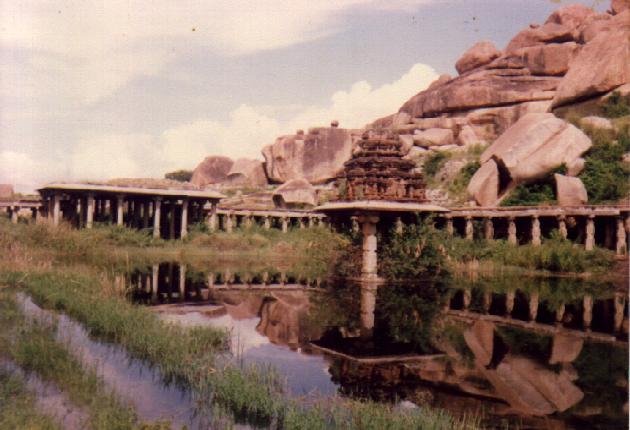

1) The Lake Bazaar where shopping and pleasure must have overlapped.
2) Decorative murals as these bedecked very temple wall.


3) Resting point for weary travelers all along the road to the capital were built (All roads led to Hampi!!!!)
4) The fabulous stone chariot at Virupakasha temple complex carved out of a single stone.
5) Even ordinary folk had comfortable stone dwellings though the nobles in a class of themselves.
6) The kings were sensitive to the needs of the citizens too , there were a large number of lakes and pools dug. Irrigational canals miles long were constructed to ferry water from the mighty Tungabhadra to the fields. Krishnadevaraya employed the services of Portuguese Engineer for civil building its recorded.
7) Elephants stables which have survived the ravages of both the Moslem onslaught as well as that of time are intact. One can only imagine if the royal animals were given this kid of treatment how the royals themselves must have lived.
"The
city of Bidjanagar is such that the pupil of the eye has never seen a place like
it, and the ear of intelligence has never been informed that there existed
anything to equal it in the world. It is built in such a manner that seven
citadels and the same number of walls enclose each other. Around the first
citadel are stones of the height of a man, one half of which is sunk in the
ground while the other half rises above it. These are fixed one beside the other
in such a manner that no horse or foot soldier could boldly or with ease
approach the citadel."
The position of these seven walls and gates have long been a puzzle to me, but I hazard the following explanation. The traveller approached from the southwest, and the first line of wall that he saw must have been that on the neck between the two hills south-west of Hospett. Paes also describes this outer defence-work as that seen by all travellers on their first arrival from the coast.
After being received at this entrance-gate Razzak must have passed down the slope through "cultivated fields, houses, and gardens" to the entrance of Hospett, where the second line of fortification barred the way; and since that town was not then thickly populated, the same features would meet his eye till he passed a third line of wall on the north side of that town. From this point the houses became thicker, probably forming a long street, with shops on either side of the road, leading thence to the capital. The fourth line of wall, with a strong gateway, is to be seen on the south of the present village of Malpanagudi, where several remains of old buildings exist; and notably a handsome stone well, once probably belonging to the country-house of some noble or chief officer. The fifth line is on the north of Malpanagudi, and here the great gateway still stands, though the wall is much damaged and destroyed.
The sixth line is passed
just to the south of the Kamalapur tank. The seventh or inner line is the great
wall still to be seen in fairly good repair north of that village. This last
surrounded the palace and the government buildings, the space enclosed measuring
roughly a mile from north to south, and two miles and a quarter from east to
west. The remains of the upright stones alluded to by Razzak were seen by
Domingo Paes in A.D. 1520.I believe that they have now disappeared.

Razzak
describes the outer citadel as a "fortress of round shape, built on the
summit of a mountain, and constructed of stones and lime. It has very solid
gates, the guards of which are constantly at their post, and examine everything
with severe inspection." This passage must refer to the outer line of wall,
since Razzak's "seventh fortress" is the innermost of all. The guards
at the gates were doubtless the officers entrusted with the collection of the
octroi duties. Sir Henry Elliot's translation (iv. 104) adds to the passage as
quoted the words, -- "they collect the JIZYAT or taxes." This system
of collecting octroi dues at the gates of principal towns lasted till recent
days, having only been abolished by the British Government.


