Rules of the Opening
The opening is the beginning phase of the game. The object of the opening is to array your army in the position if maximum readiness. This process is called development. Development involves getting your pieces out from their starting positions to more aggressive posts with the objective to control the centre of the board. There are ten main rules for you to bear in mind in the opening. These rules can be broken because chess is a dynamic game and mastering it requires real thinking in each position.
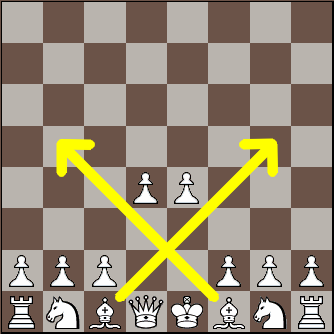
1. Start with the centre pawns (the e or d pawn) - moving these pawns doesn't just stake a claim in the centre, but also enables other pieces to mobilize productively. In the diagram below we can see that after both the e and d pawn had moved and control the centre, the bishops can be deployed effectively. With the bishops out of the way, the King is one step closer to castling, if you wish to. In the diagram below, we can see the options for the bishops after both of the central pawns move.
2. Try to develop your pieces so that they threaten something or make it difficult for your opponent to develop.
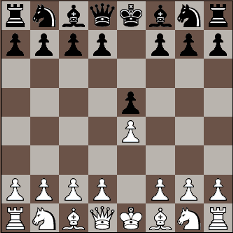
White is to move in the above diagram. 1. Nf3 is an example of a good move that threatens the black e pawn and giving the opponent something to take into account. Whereas the move 1. c3 does not threaten the opponent and may give Black more time to plan his or her own threat.
3. Develop knights before bishops. This is because the Knights don't have a lot of choices from their initial position and by developing them to squares like c3 and f3, they become more poised. The Bishops on the other hand have to wait until the central pawns move and after that happens the Bishops have a lot of squares to go. So, it is sensible for the Bishops to wait for the best square to post on.
4. Try to move each piece only once in the opening. The main objective of the opening is to deploy your pieces to the position where they achieve maximum readiness in the shortest time. This is called development. Usually, who develops first will have the best opportunity to control the game. So by moving the same piece twice, the opponent is presented with extra time to develop his/her pieces.
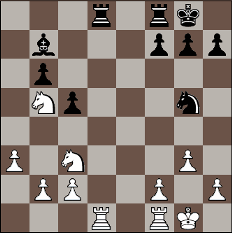
5. Make only one or two pawn moves. The initial position of the pawns is where the defense of your fortress is at its strongest because the pawns support each other and create a barrier that is difficult to penetrate. Each pawn move leaves holes in the defence and this is like a door for your opponent to enter your fortress and attack your King. The diagram below illustrates the space left behind (the g2 square) because of pawn movements. So, think before you move your pawns because pawn moves are irreversible.
6. Don't bring your Queen out too early. Try to save the queen for later. Early queen play often leads to a loss of time. Since the queen is the most valuable unit, it has to be move to safety practically every time it's attacked.
7. Castle as soon as possible to bring your King to safety. A King remaining in the centre could then be subject to attack, so one reason for castling is to remove the King from potential danger and shelter it behind a wall of pawns. Castling also activates a rook. Then the castled rook can take advantage of the open lines in the middle.
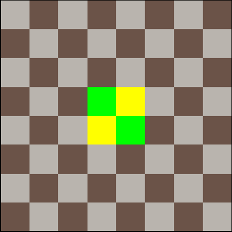
8. Play to get control of the centre of the chessboard. Let every Piece have some bearing on the centre. As a general rule, whoever controls the greater share of the centre has the greater mobility. In the centre, Queens, Bishops and Knights have greater mobility than elsewhere and can move rapidly to either wing as occasion demands. The centre consists of the squares d4, d5,e4 and e5. The important central squares are the yellow and green coloured squares in the chessboard below.
9. Try to keep at least one pawn in the centre of the chessboard. Being the least valued piece on the chessboard the pawn is powerful at guarding posts especially in the centre if supported by a friendly unit. By occupying the central squares, the pawn can direct traffic and prevent enemy arsenal from penetrating base camp.
10. Do not pawn-grab. Your opponent may intentionally hang his/her pieces (especially pawns) so that he/she could take advantage of the extra tempo (time) and develop while you capture their unimportant pieces.
|home||articles||puzzles||downloads||links||guestbook||about|