
 |
Go it's
your turn. Whoops I forgot that I'm writing a website. Let me introduce you to the world of chess. |
Chess is a one of the most famous board games ever invented. It is a mind game (abstract strategy game)for intellectual players that requires a lot of practice. |
|
Here are some chess websites that I recommend for beginners and higher.http://www.chess.com/ and http://www.sparkchess.com/ just control click or click to visit these websites. But you do need to make a register to play against other people. Here is a brief history about chess. The history of chess spans some 1500 years. The earliest predecessor of the game probably originated in India, before the 6th century AD. From India, the game spread to Persia. When the Arabs conquered Persia, chess was taken up by the Muslim world and subsequently spread to Southern Europe. In Europe, chess evolved into roughly its current form in the 15th century. In the second half of the 19th century, modern chess tournament play began, and the first World Chess Championship was held in 1886. The 20th century saw great leaps forward in chess theory and the establishment of the World Chess Federation (FIDE). Developments in the 21st century include use of computers for analysis, which originated in the 1970s with the first programmed chess games on the market. Online gaming appeared in the mid-1990s. The precursors of chess originated in India during the Gupta Empire, where its early form in the 6th century was known as chaturaṅga, which translates as "four divisions (of the military)": infantry, cavalry, elephantry, and chariotry, represented by the pieces that would evolve into the modern pawn, knight, bishop, and rook, respectively. According to chess historians Gerhard Josten and Isaak Linder, "the early beginnings" of chess can be traced back to the Kushan Empire in Ancient Afghanistan. Chess was introduced to Persia from India and became a part of the princely or courtly education of Persian nobility. In Sassanid Persia around 600 the name became chatrang, which subsequently evolved to shatranj, due to Arab Muslims' lack of ch and ng native sounds, and the rules were developed further. Players started calling "Shāh!" (Persian for "King!") when attacking the opponent's king, and "Shāh Māt!" (Persian for "the king is helpless" – see checkmate) when the king was attacked and could not escape from attack. These exclamations persisted in chess as it traveled to other lands. The game was taken up by the Muslim world after the Islamic conquest of Persia, with the pieces largely keeping their Persian names. The Moors of North Africa rendered Persian "shatranj" as shaṭerej, which gave rise to the Spanish acedrex, axedrez and ajedrez; in Portuguese it became xadrez, and in Greek zatrikion, but in the rest of Europe it was replaced by versions of the Persian shāh ("king"). Thus, the game came to be called ludus scacchorum or scacc(h)i in Latin, scacchi in Italian, escacs in Catalan, échecs in French (Old French eschecs); schaken in Dutch, Schach in German, szachy in Polish, šahs in Latvian, skak in Danish, sjakk in Norwegian, schack in Swedish, šakki in Finnish, šah in South Slavic languages, sakk in Hungarian and şah in Romanian; there are two theories about why this change happened:
The Mongols call the game shatar, and in Ethiopia it is called senterej, both evidently derived from shatranj. Chess spread directly from the Middle East to Russia, where chess became known as шахматы (shakhmaty, literally "checkmates", a plurale tantum). The game reached Western Europe and Russia by at least three routes, the earliest being in the 9th century. By the year 1000 it had spread throughout Europe. Introduced into the Iberian Peninsula by the Moors in the 10th century, it was described in a famous 13th-century manuscript covering shatranj, backgammon and dice named the Libro de los juegos. Chess spread throughout the world and many variants of the game soon began taking shape. Buddhist pilgrims, Silk Road traders and others carried it to the Far East where it was transformed and assimilated into a game often played on the intersection of the lines of the board rather than within the squares. Chaturanga reached Europe through Persia, the Byzantine empire and the expanding Arabian empire. Muslims carried chess to North Africa, Sicily, and Iberia by the 10th century. The game was developed extensively in Europe, and by the late 15th century, it had survived a series of prohibitions and Christian Church sanctions to almost take the shape of the modern game. Modern history saw reliable reference works, competitive chess tournaments and exciting new variants which added to the game's popularity,further bolstered by reliable timing mechanisms (first introduced in 1861), effective rules and charismatic players. |
Here are some facts about Indian chess Grandmaster Viswanathan Anand.
Viswanathan Anand (born 11 December 1969) is an Indian chess Grandmaster and the current World Chess Champion. Anand has won the World Chess Championship five times[2] (2000, 2007, 2008, 2010, 2012), and has been the undisputed World Champion since 2007. Anand was the FIDE World Rapid Chess Champion in 2003, and is widely considered the strongest rapid player of his generation. Anand became India's first grandmaster in 1988. He was also the first recipient of the Rajiv Gandhi Khel Ratna Award in 1991–92, India's highest sporting honour. In 2007, he was awarded India's second highest civilian award, the Padma Vibhushan, making him the first sportsperson to receive the award in Indian history. Anand has won the Chess Oscar six times (1997, 1998, 2003, 2004, 2007, 2008). He held the FIDE World Chess Championship from 2000 to 2002, at a time when the world title was split. He became the undisputed World Champion in 2007 and defended his title against Vladimir Kramnik in 2008. He then successfully defended his title in the World Chess Championship 2010 against Veselin Topalov and in the World Chess Championship 2012 against Boris Gelfand. As the reigning champion, he will face Magnus Carlsen, the winner of the Candidates Tournament for the World Chess Championship 2013. Anand is one of six players in history to break the 2800 mark on the FIDE rating list, and in April 2007 at the age of 37, he became the world number one for the first time. He was at the top of the world rankings five out of six times, from April 2007 to July 2008, holding the number-one ranking for a total of 15 months. In October 2008, he dropped out of the world top three ranking for the first time since July 1996. Anand regained the world number one ranking on the November 2010 list, but had to concede the top spot back to Carlsen in July 2011.
|
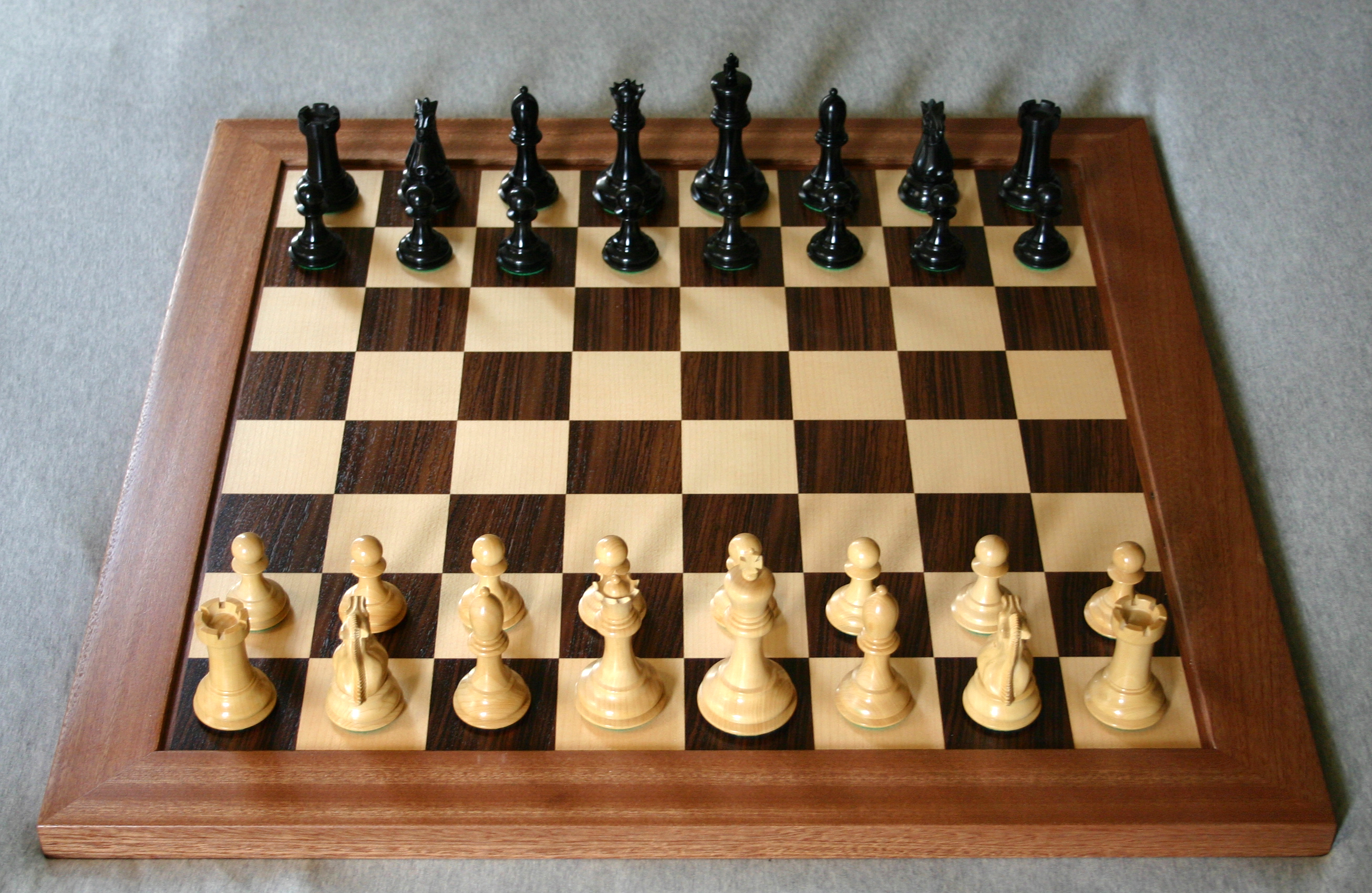
Here are some facts about chess. Chess is a two-player strategy board game played on a chessboard, a checkered gameboard with 64 squares arranged in an eight-by-eight grid. It is one of the world's most popular games, played by millions of people worldwide at home, in clubs, online, by correspondence, and in tournaments. Each player begins the game with 16 pieces: one king, one queen, two rooks, two knights, two bishops, and eight pawns. Each of the six piece types moves differently. Pieces are used to attack and capture the opponent's pieces, with the objective to 'checkmate' the opponent's king by placing it under an inescapable threat of capture. In addition to checkmate, the game can be won by the voluntary resignation of the opponent, which typically occurs when too much material is lost, or if checkmate appears unavoidable. A game may also result in a draw in several ways, where neither player wins. The course of the game is divided into three phases: opening, middlegame, and endgame. The first official World Chess Champion, Wilhelm Steinitz, claimed his title in 1886; the current World Champion is Indian chess Grandmaster Viswanathan Anand. In addition to the World Championship, there are the Women's World Championship, the Junior World Championship, the World Senior Championship, the Correspondence Chess World Championship, the World Computer Chess Championship, and Blitz and Rapid World Championships. The Chess Olympiad is a popular competition among teams from different nations. Online chess has opened amateur and professional competition to a wide and varied group of players. Chess is a recognized sport of the International Olympic Committee and international chess competition is sanctioned by the World Chess Federation (FIDE), which adopted the now-standard Staunton chess set in 1924 for use in all official games. There are also many chess variants, with different rules, different pieces, and different boards. Since the second half of the 20th century, computers have been programmed to play chess with increasing success, to the point where home computers can play chess at a very high level. In the past two decades computer analysis has contributed significantly to chess theory, particularly in the endgame. The computer Deep Blue was the first machine to overcome a reigning World Chess Champion in a match, when it defeated Garry Kasparov in 1997. |