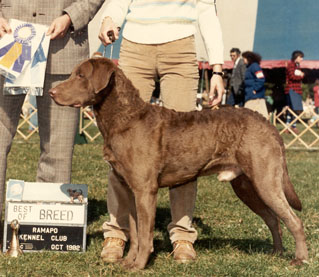
| AKC Chesapeake Bay Retriever Breed Standard The Chesapeake originated in the United States and is a member of the Sporting Group, it was first recognized by the AKC in 1878. The Chesapeake has a cherry disposition but a seriousness of purpose toward his work. He faces the winter harshness with courage and an eagerness to perform his retrieving duties. The breed is known for its prowess in rough, icy water and to bring in downed ducks and geese. The Chesapeake Bay Retriever has a thick short wavy coat that sheds in the spring and requires daily brushing. The Chesapeake Bay Retriever can be brown, sedge or deadgrass in color. He is a bold, strong, active dog, so needs plenty of exercise every day. He especially likes swimmimg, so retrieving games are ideal throughout the summer and fall. |
 |
| Chesapeake Bay Retriever Breed Standard |
| General Appearence |
| Equally proficiant on land and in the water, the Chesapeake Bay Retriever was developed along the Chesapeake Bay to hunt waterfowl under the most adverse weather and water conditions, often having to break ice during the course of many strenuous multiple |
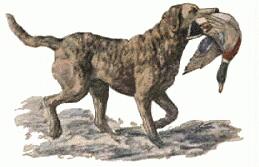
| retrieves. Frequently the Chesapeake must face wind, tide and long cold swims in it's work. The breed's characteristics are specifically suited to enable the Chesapeake to function with ease, efficiency and endurance. In head, the Chesapeake's skull is broad and round with a medium stop. The jaws should be of sufficient length and strength to carry large game birds with a easy, tender hold. The double coat consists of a short, harsh, wavy outer coat and a dense, fine, wooly undercoat containing an abundance of natural oil and is ideally suited for the icy rugged conditions of weather the Chesapeake often works in. In body, the Chesapeake is strong, well-balanced, powerfully built animal of moderate size and medium length in body and leg, deep and wide in chest, ther shoulders built with full liberty of movement, and with no tendency to weeknessin any feature, particulary the rear. The power though, should not be at the expense of agility or stanima. Size and substance should not be excessive as this is a working retriever of an active nature. Distintive features include eyes that are very clear, of yellowish or amber hue, hindquarters as high or trifle higher than the shoulders, and a double coat which tends to wave on the shoulders, neck, back and loins only. Th Chesapeake is valued for it's bright and happy disposition, intelligence, quiet good sense, and affectionate protective nature. Extreme shyness or extreme aggressive tendencies are not desirable in the breed either as a gun dog or companion. Disqualifications: Specimens that are lacking in breed characteristics should be disqualified. Size, Proportion, Substance Height--Males should measure 23 to 26 inches; females should measure 21 to 24 inches. oversized or undersized animals are to be severely penalized. Proportion--Height from the top of the shoulder blades to the ground should be slightly less then the body length from the breast bone to the point of buttocks. Depth of the body should be equal. weight--Males should weigh 65 to 80 pounds; females should weigh 55 to 70 pounds. Head The Chesapeake Bay Retriever should have an intelligent expression. Eyes are to be medium large, very clear, of yellowish or amber color and wide apart. Ears are to be small, set well up on the head, hanging loosly, and of medium leather. Skull is broad and round with medium stop. Nose is medium short. Muzzle is approximately the same length as the skull, tapered, pointed but not sharp. lips are thin, not pendulous. Bite--Scissors is preferred, but a level bite is acceptable.Disqualifications: Either undershot or over shot bites are to be disqualified. Neck, Topline, Body Neck should be of medium length with a strong muscular appearance, tapering to the shoulders. Toopline should show the hindquarters to be as high as or a trifle higher than the shoulders. Back should be short, well coupled and powerful. chest should be strong, deep and wide. Rib cage barrel round and deep. Body is of medium length, neither cobby nor roached, but rather approching hollowness from underneath as the flanks should be tucked up. Tail of medium length; medium base. The tail should be straight or slightly curved and should not curl over back or side kink. Forequarters There should be no tendency to weakness in the forequarters. Shoulders should be sloping with full liberty of action, plenty of power and without any restrictions of movement. Legs should be medium in length and straigt, showing good bone and muscle. Pasterns slightly bent and of medium length. The front legs should appear straight when viewed from the front or rear. Dewclaws on the forelegs may be removed. Well webbed hare feet should be of good size with toes wellrounded and close. Hindquarters Good hindquarters are essential. They should show fully as much power as the forequarters. There should be no tendency to weakness in the hindquarters. Hindquarters should be especially powerful to supply the driving power for swimming. Legs should be medium lengthand straight, showing good bone and muscle. Stifles should be well angulated. The distance from hock to ground should be of medium length. The hind legs should look straight when viewed from the front or rear. Dewclaws, if any, must be removed from the hind legs. Disqualification: Dewclaws on hind legs Coat Coat should be thick and short, nowhere over 11/2 inches long, with a dense fine wooly undercoat. Hair on the legs and face should be very short and straight with a tendency to wave on the shoulders, neck,back and loins only. Moderate feathering on rear of hindquarters and tail is permissible. The texture of the Chesapeake Bay Retriever's coat is very important, as the Chesapeake Bay Retriever is used for hunting under all sorts of conditions, often working in ice and snow. The oil in the harsh outer coat and wooly undercoat is of extreme value in preventing the cold water from reaching the Chesapeake Bay Retriever's skin and aids in quick drying. A chesapeake Bay Retriever's coat should resist the water in the same way that a duck feathers do. When the Chesapeake Bay Retriever leaves the water and shakes, the coat should not hold water at all, being merely moist. Disqualifications: A coat that is curly or has a tendency to curl all over the body must be disqualified. Feathering on the tail or legs over 13/4 inches long. Color The color of the Chesapeake Bay Retriever must be of nearly that of it's surroundings as possible. Any color of brown, sedge or deadgrass is acceptable, self-colored Chesapeake Bay Retriever's being preferred. One color is not preferred over another. A white spot on the breast , belly, toes or back of feet (immediately above the large pad) is permissible, but the smaller the spot the better, solid colored preferred. The color of the coat and it's texture must be given every consideration when judging on the bench or in the ring. Honorable scars are not penalized. Disqualification: Black colored; white on any partof the body except breast, belly, toes or back of feet. Gait The gait should be smooth, free and effortless, giving the impression of great power and strength. When viewed from the side, there should be good reach with no restrictions of movement in the front and plenty of drive in the rear, with good flexion of the stifle and hock joints. Coming at you, there should be no signs of elbows being out. When the Chesapeake Bay Retriever is moving away from you, there should be no signs of cowhockedness from the rear. As speed increases, the feet tend to converge toward a center line of gravity. Temperament The Chesapeake Bay Retriever should show a bright and happy disposition with a n intelligent expression. Courge, willingness to work, alertness, nose, intelligence, love of water, general quality and, most all, disposition should be given primary consideration in the selection and breeding of the Chesapeake Bay Retriever. |
 |
 |
| Sam and Patti Cooper 17254 Cool Spring Rd. Marydel, Maryland 21649 410-482-7376 |

|