Suqwamish and Duwamish (1786-1866)
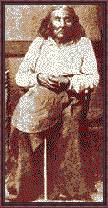
Seattle, also known as Sealth, was very young when George Vancouver
came to Puget Sound to map the region. Before that time,
the Duwamish and Suquamish (his mother and father's respective tribes)
had had very little contact with the whites.
Seattle's brief experience with Vancouver impressed him greatly,
which was perhaps why, in later life, he tried to advocate a peaceful
coexistence with the settlers. When he was a young man Seattle
inherited his father's position as chief, after first having proved
his leadership in warfare against other tribes in the area.
Seattle was so impressed by the French Catholic missionaries
that in the 1830's he converted to Christianity, taking the
baptismal name "Noah".
By the 1850's the settlement had begun to grow and prosper
and the name was changed from Alki Point to Seattle.
More and more settlers began to move into the area,
and in 1855 the governor of Washington Territory called
together the tribes to propose a new treaty.
This treaty would send the tribes to a reservation
and their lands would be controlled by the government.
Although Seattle continued to council for peace,
the conflict lasted many years. Finally Seattle moved onto a
small patch of land on the western side of Puget Sound where
he spent the remainder of his life.
Speach by Chief Seattle 1851
This is a speech made in 1851 by Seattle, chief of the Suquamish,
in response to a treaty proposal under which the Indians would
sell two million acres of land for $150,000.
Buckminster Fuller calls it "one of the most beautiful
and profound environmental statements ever made".
From people that have done research, these were not
his actual words but the gist of what he said.
It make them none the less profound.How Can
You Buy or Sell the Sky?
How can you buy or sell the sky, the warmth of the land?
The idea is strange to us. If we do not own the freshness
of the air and the sparkle of the water, how can you buy them?
Every part of this earth is sacred to my people.
Every shining pine needle, every sandy shore,
every mist in the dark woods, every clearing and humming
insect is holy in the memory and experience of my people.
The sap which courses through the trees carries the
memories of the red man.
The white man's dead forget the country of their birth
when they go to walk among the stars. Our dead never
forget this beautiful earth, for it is the mother of the red man.
We are part of the earth and it is part of us.
The perfumed flowers are our sisters; the deer, the horse,
the great eagle, these are our brothers. The rocky crests,
the juices in the meadows, the body heat of the pony,
and man--all belong to the same family.
So, when the Great Chief in Washington sends word that he
wishes to buy our land, he asks much of us.
The Great Chief sends word he will reserve us a place so
that we can live comfortably to ourselves.
He will be our father and we will be his children.
So we will consider your offer to buy our land.
But it will not be easy. For this land is sacred to us.
This shining water that moves in the streams and rivers is
not just water but the blood of our ancestors.
If we sell you land, you must remember that it is sacred,
and you must teach your children that it is sacred and
that each ghostly reflection in the clear water of the
lakes tells of events and memories in the life of my people.
The water's murmur is the voice of my father's father.
The rivers are our brothers; they quench our thirst.
The rivers carry our canoes, and feed our children.
If we sell you our land, you must remember,
and teach your children, that the rivers are our
brothers and yours, and you must henceforth give the
rivers the kindness you would give any brother.
We know that the white man does not understand our ways.
One portion of land is the same to him as the next,
for he is a stranger who comes in the night and takes
from the land whatever he needs. The earth is not his
brother, but his enemy, and when he has conquered it,
he moves on.
He leaves his father's grave behind, and he does not care.
His father's grave and his children's birthright are forgotten.
He treats his mother, the earth, and his brother, the sky,
as things to be bought, plundered, sold like sheep or bright beads.
His appetite will devour the earth and leave behind only a desert.
You do not know. Our ways are different from your ways.
The sight of your cities pains the eyes of the red man.
There is no quiet place in the white man's cities.
No place to hear the unfurling of leaves in spring or
the rustle of the insect's wings. The clatter only seems
to insult the ears. And what is there to life if a man cannot
hear the lonely cry of the whippoorwill or the arguments
of the frogs around the pond at night? I am a red man and
do not understand. The Indian prefers the soft sound of the
wind itself, cleansed by a midday rain, or scented with pinon pine.
The air is precious to the red man for all things share
the same breath. The white man does not seem to notice the
air he breathes. Like a man dying for many days he is numb
to the stench. But if we sell you our land, you must remember
that the air is precious to us, that the air shares its spirit
with all the life it supports.
The wind that gave our grandfather his first breath also
receives his last sigh. And if we sell you our land,
you must keep it apart and sacred as a place where even
the white man can go to taste the wind that is sweetened
by the meadow's flowers.
You must teach your children that the ground beneath their
feet is the ashes of our grandfathers. So that they will
respect the land, tell your children that the earth is rich
with the lives of our kin. Teach your children that we have
taught our children that the earth is our mother.
Whatever befalls the earth befalls the sons of the earth.
If men spit upon the ground, they spit upon themselves.
This we know: the earth does not belong to man;
man belongs to the earth. All things are connected.
We may be brothers after all. We shall see.
One thing we know which the white man may one day discover:
Our God is the same God.
You may think now that you own Him as you wish to own our land;
but you cannot. He is the God of man, and His compassion is
equal for the red man and the white. This earth is precious to Him;
and to harm the earth is to heap contempt on its creator.
The whites too shall pass; perhaps sooner than all other tribes.
Contaminate your bed and you will one night suffocate in
your own waste.
But in your perishing you will shine brightly fired by
the strength of the God who brought you to this land and
for some special purpose gave you dominion over this land
and over the red man.
That destiny is a mystery to us, for we do not understand
when the buffalo are all slaughtered, the wild horses are tame,
the secret corners of the forest heavy with scent of many men
and the view of the ripe hills blotted by talking wires.
Where is the thicket? Gone. Where is the eagle? Gone.
The end of living and the beginning of survival.