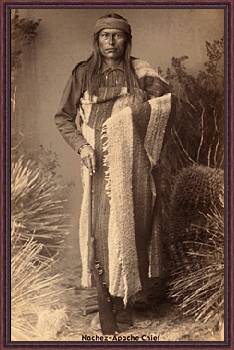
Chiricahua - Apache Chief
Not a lot is known about Cochise's descendants except to say that he was the descendent of a long line of chiefs and was rasied to follow in their footsteps. Although Apache leaders did not inherit their positions, but rather earned them by demonstrating their abilities and influencing others, the son of a great chief was treated specially and had a good chance to become a leader himself. Ceremonies and rituals accompanied every stage of an Apache's life - from birth to death. When Cochise was about 4 days old (a magic number to the Apaches), a shaman, or Medicine Man, would have constructed a special cradle for him known as a "tosch" and attached a bag of pollen or the claw of a hummingbird to protect him from evil forces. When he learned to walk, another ceremony would celebrate his first pair of moccasins, and the following spring a ritual would have been made of his first haircut. Each of these events and hundreds of others were social occasions as they were part of the Apache religion, with feasting, dancing and much singing.
Cochise was taught Apache religious beliefs as soon as he was able
to understand them. Through stories told by his parents,
he came to know the Apache God, Usen, The White Painted Woman,
Child of the Water, The Mountain Spirits, and the force called
Power that raged before the universe was contained in all things.
Power was in everything, but it was also possible for
Usen to award a gift of Power to an individual, giving
him special skills and foresight. Cochise received many
gifts of Power, and the Apaches believed that it was these
gifts that allowed him to be a successful warrior and leader.
The Apaches believed in many kinds of Power - some good and some bad -
and felt that these forces were in constant conflict.
This idea explained the enemies in their life and the
need to struggle to survive in a region that although
very beautiful, presented constant challenges.
Kind beings known as Mountain Spirits were thought to have
lived in the caves on Cochise's homeland. The Apaches
believed that these spirits were very special protectors
and could help with important ceremonies. Any undertaking
would be much less prosperous without their assistance.
Thus, the Apaches felt a strong connection to their home mountains.
To leave them meant to be without the Mountian Spirits.
Although the Apaches stayed near the Mountain Spirits,
they moved around quiet often within their home territory.
The women packed their belongings and each time they stopped,
they built a wickiup - a small dome shaped hut covered with
brush or animal hides. Apache women were responsible for
most of the daily chores. Although Cochise would not be expected
to cook or clean as an adult, working with his mother during
his childhood taught him a valuable lesson. He learned never
to take a woman's contribution to the family for granted.
Cochise no doubt was taught the importance of strict mental
and physical discipline, as were the other Apache children
as their lives often depended on it. In time,
Cochise memorized every rock, tree, and hole in Chiricahua territory.
He developed patience and self-control by stalking deer,
the skin of which was of great value to the Apaches, but which
was a most difficult animal to hunt. Sometimes when a heard of
deer would be grazing in the open, a warrior would be forced
to spend hours crawling on the ground behind weeds to get
close enough to it. Although this kind of hunting could be
frustrating, it helped Cochise develop stealth, which would
come in handy on raids.
When he was 17 or 18, he became a "dikohe" or apprentice warrior,
and was given a different name. He was called Goci, later spelled
Cochise. The Apaches were taught that "counting coup" or stealing
stealthily, was a better way to let your enemies know that you had
the upper hand, rather than killing which would no doubt lead to
retaliation and more bloodshed. Over the course of his dealings
with both the Mexicans and the Americans, he would steal horses
from under the noses of his enemies, adding to his reputation as
a man of much power. It was only after his family and his nation
had suffered many casualties, that his raids turned to revenge,
and even then, Cochise was known to return many horses stolen by
renegade Apaches when he had not approved of their actions.
Throughout his life his incredible skills as a warrior inspired
respect from his people and terror in his enemies, but friends
and Indians alike believed him to be an honest man.
In the end, Cochise's skill as a diplomat helped his people
retain the lands they so cherished. Many have said that he was
the most powerful Apache leader in history. At his death,
it was reported that his people wailed loudly for more than a day.
After his death, the Government broke the historic treaty made
with Cochise and moved the Chiricahua from the ancient mountain
homeland to the hot, flat, dry, Arizona desert. Many refused to go,
and after their defeat, were sent to prison in Florida or died in
Oklahoma of tuberculosis or other diseases. For most of
the Chiricahua, the day they left the reservation was the
last time they saw their homeland. For more information:
Cochise by Howard White, Professor of History, Pepperdine University