
Four regions are the primary sources of Chinese cooking styles: Beijing (Peking) in the north, the southern provinces of Guangdong (Canton), the eastern area of Nanjing (Shanghai) and Szechuan to the west. Each has its distinct style:
From the north come homey noodle dishes and steamed buns, as well as the justly famous Peking duck. In general, northern-style cooking is considered bland but satisfyingly filling.
Cantonese cooking is probably the most familiar of Chinese regional cuisines. it's the style that familiarized us as children with such exotic dishes as wonton soup and barbecued spare ribs�different, but easy on the palate. This region is home to the stir-fry specialties that rely on fresh, not preserved, ingredients prepared quickly in little oil. Cantonese cooking is not spicy.
From the east come Shanghai's renowned fresh fish and seafood dishes paired with an abundance of fresh vegetables�in fact, vegetarians delight in the many meatless listings on Shanghai-style menus. Poultry, too, is a specialty from this area. Shanghai cooking tends to be slightly oilier than that of other regions.
Go west to the Szechuan region and you'll find fiery, spicy cusine featuring hot chilies, peppercorns and aromatic garlic and ginger. Pork, poultry and soybeans are common elements of Szechuan cooking.
Know Your Menu
Typical dishes you'll see on Chinese menus include lo mein, chow mein, chow fun, mai fun or lai fun. These dishes are all noodle-based, and also incorporate shrimp or other seafood, pork, chicken or beef. Opt for the saut�ed or stir-fried proteins without the noodles. Egg rolls, an all-time favorite appetizer, are encased in dough wrappers, then deep fried. Peking duck is a fine choice�just leave the pancakes that come with it on the side. The same applies to moo shu pork�help yourself to the filling, but pass on the pancakes. Be aware that the cubes of meat in sweet-and-sour pork are dipped in batter before deep-frying, then they're slathered in sticky, sweetened sauce. In addition to avoiding rice- and noodle-based dishes, other high-carb ingredients you should be on the lookout for on Chinese menus are peas, onions, black beans, soybeans, oranges and corn.
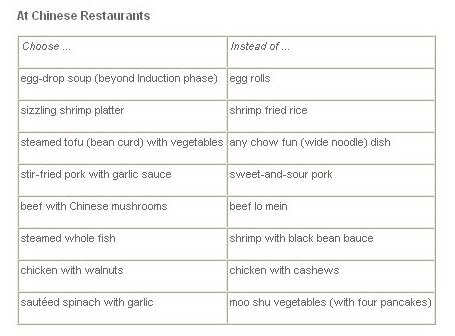
If you�re in the Induction phase of Atkins, stick to dishes that are stir-fried, steamed or broiled, and ask for sauces to be served on the side. Because so many Chinese sauces are prepared with cornstarch or sugar, it is best to avoid sauced dishes when you are doing the stricter phases of the Atkins Nutritonal Approach�. Certain restaurants will prepare dishes without cornstarch and sugar upon request.
If you�ve moved on to the Ongoing Weight Loss phase, you can probably order one sauced dish and one simply prepared dish. Even better, order the sauced dish with the sauce on the side so that you can regulate how much of it you eat.
By the time you are in the Pre-Maintenance phase�and if your metabolism allows it�you may be able to enjoy a half-cup serving of brown rice with your meal.