PETROCHEMICALS FROM


 is the main product of hydrocarbon steam cracking. It is generally used immediately to produce other products within the petrochemical complex. Globally 50% of ethylene is used to prepare polyethylene (PE). The primary use of polyethylene is in film applications for packaging, supermarket bags and trash liners. The next major use of ethylene is the preparation of monomers like vinyl chloride, styrene, etc.
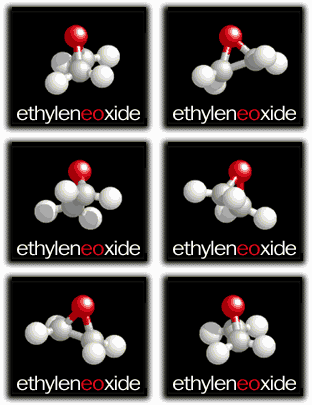 |
 (EO) is produced by direct oxidation of ethylene with air or oxygen. EO is a highly reactive and flammable gas at room temperature. It is generally converted to ethylene glycol. EO is also a key raw material in the processing of surfactants, ethanolamines, and polyethylene glycols.
 (EG) (HOCH2CH2OH) is produced by the direct hydration of ethylene oxide. EG itself can react with EO to give Diethylene glycol (DEG) and
triethylene glycol (TEG).
(EG) (HOCH2CH2OH) is produced by the direct hydration of ethylene oxide. EG itself can react with EO to give Diethylene glycol (DEG) and
triethylene glycol (TEG).
The three ethylene glycols offer a range of viscosity, hygroscopicity and boiling point. Glycols have high boiling points, hygroscopicity, non-corrosiveness, freeze point depression, lubricating and plasticizing properties. So they are useful as heat transfer liquids, plasticizers, humectants, cosmetics, ointments, pharmaceutical preparations, brake fluids, chemicals for textile finishing and natural gas purification, extractants for mercaptans from natural gas and refinery gas.
EG is commercially available in three grades: fibergrade, industrial grade and antifreeze grade. They are used as coolants in automobile antifreeze and its excellent humectant (hygroscopicity) properties also make it ideal for treating textile fibers, tobacco, paper, adhesives, printing inks.
EG is also used in the manufacture of polyester fibers and polyethylene terephthalate (PET).
The main uses for TEG (HOCH2CH2OCH2CH2OCH2CH2OH) depend upon its hygroscopic properties. TEG is employed as a liquid desiccant for the dehydration of natural gas, dehumidifiers for air conditioning systems, and humectant for tobacco. It is also used as a vinyl plasticizer, in the preparation of polyester resins and polyols in the preparation of polyurethanes.
Ethylene glycol ethers are extremely good solvents having an alcohol functional group that can form hydrogen bonding and an ether functional group that is electronegative. So it is miscibility with both polar and non-polar substances and are often used as coupling agents in surface coatings, printing inks, cleaners, cosmetics and agrochemical formulations. They are also used as extractants, and as coalescing agents and flow improvers in water-based paints. Shell produces ethylene glycol monobutyl ether (Butyl OXITOL) and diethylene glycol monobutyl ether (Butyl DIOXITOL).
 is obtained as a by-product of the refinery catalytic cracking process used to make gasoline or as a by-product of the steam cracking process used to make ethylene. There are also a number of technologies for making propylene directly from other feedstocks. The most common of these on-purpose process routes is the dehydrogenation of propane to propylene. Propylene is used mainly to prepare polypropylene, the material for endless household items. Plastic buckets, food containers, plastic raffia strings, heavy-duty grocery bags and trash bags. In the industry it is used to make plastic containers for motor oils, road barricades, carpets, artificial turf for soccer and hockey, etc.
Propylene is also used to prepare other monomers like acrylonitrile, which is the starting material for acrylic fibres and coatings. Propylene oxide is the raw material for polyurethane resins and isopropyl alcohol is a very popular solvent. So propylene is a key component of countless end use products including automobile headlights, taillights, disk brake pads and bumpers; CDs and optical disks; clear film food wrap; eyeglasses; flexible foams used in bedding and furniture; rigid foam insulation; impact-resistant and bullet-proof windows; nitrile rubber hoses, seals and gaskets; paints and protective coatings; and wood products such as plywood, oriented strandboard and laminates.
 is produced commercially via three different routes.
Propylene oxide is a chemical building block for a series of products.
- Propylene glycol (PG) is used for airplane de-icers, fibre glass-reinforced unsaturated polyester resins (UPR), and hydraulic fluids
- Polyether polyols (poly-alcohols) is a component for the preparation of a class of polymers known as polyurethanes. The material ranged for rigid and flexible foams, to coatings, adhesives, sealants & and elastomer. Polyether polyols is also used in non-Urethane applications such as surfactants and oil demulsifiers.
- Propylene glycol ethers (GE).
- Polyalkylene glycol fuel additives and lubricants.
- Modified starches and allyl alcohols.
Monopropylene glycol (MPG), dipropylene glycol (DPG) and tripropylene glycol (TPG) is collectively known as propylene glycols (PG). They are prepared by reacting PO with water. The first stage of the reaction gives a mixture of MPG and DPG, which are separated by distillation.
MPG (C3H8O2) is the largest volume propylene glycol. Its most important use is in the production of unsaturated polyester resins. Other applications are in paints and coatings; airplane de-icers / anti-icers; antifreeze and industrial coolants; detergents; hydraulic fluids; tobacco humectant; and cosmetics. It is a viscous odourless liquid; highly hygroscopic and miscible in all ratios with water, alcohols, esters, ketones and amines. It has limited miscibility with halogenated hydrocarbons and is not miscible with aliphatic hydrocarbons.
DPG (C6H14O3) is also used to prepare unsaturated polyester resins, alkyd resins and urethane polyols. Being a hygroscopic liquid and miscible with water in any ratio, and also highly soluble in most organic solvents it is used as a plasticizers and in cosmetics.
1,3-Propanediol cost more to produce. Its most successful application to date has been in the preparation of polytrimethylene terephthalate (CORTERRA Polymers) used in the manufacture of carpet and textile fibres.
Propylene glycol ethers are extremely good solvents with a bifunctional nature (ether-alcohol) which allows it to mix with both polar and non-polar substances. So they are often used as coupling agents in water-based paints. Propylene glycol ether acetates are clear liquids with a pleasant, fruity odour and are mainly used in surface coatings, printing inks, cleaners, cosmetics and agrochemical formulations. They are also used as extractants, and as coalescing agents and flow improvers in water-based paints. The Shell range of propylene glycol ethers and acetates is sold under the trade name PROXITOL*. The monomethyl ether of propylene glycol is known as Methyl PROXITOL and the dipropylene glycol as Methyl DIPROXITOL. Methyl PROXITOL acetate is widely used in the surface coatings industry as a solvent and to regulate flow and coalescence.
 is manufactured by Shell using in two ways. In the first, benzene and propylene are used to produce cumene which is then converted to phenol and its co-product, acetone. The second process from isopropyl alcohol (IPA) gives a high-grade acetone. Acetone can be reacted with phenol to give Bisphenol A (BPA), which is used to prepare polycarbonate and epoxy resins. Acetone is also used to prepare acrylic monomers. These two applications accounted for two thirds of total acetone use.
Acetone, sometimes known as 2-propanone or dimethyl ketone (DMK), is also one of the most widely used solvents in the world as it offers high solvency with a high rate of evaporation, and also it is listed as a non-volatile organic compound (VOC) in the US. It is used in many everyday products, including paints, cleaning fluids, fingernail polish remover, and adhesives. It is also used extensively as an intermediate in pharmaceuticals.
1-Butene is produced either by separation from crude C4 refinery streams or from the reaction of ethylene. It is converted to butylene oxide and secondary butyl alcohol (SBA) and methyl ethyl ketone (MEK).
Butyl rubber, made from isobutene with a small amount of isoprene, using aluminum chloride initiator, has outstanding impermeability to gases and is used, for example, in inner tubes. Styrene-isoprene-rubber is a copolymer that is used in pressure sensitive adhesives.
 , as 1,3-butadiene is commonly known in industry, is a by-product from the cracking of ethane and propane. Other products of the C4 stream include isobutylene, methyl tertiary butyl ether (MTBE) and 1-butene. Most of butadiene is used in the production of styrene-butadiene rubber (SBR). SBR is often referred to as synthetic rubber because it is mainly used to manufacture automobile tyres. Styrene-butadiene latex is used for carpet backings and adhesives. Styrene-butadiene block copolymers found uses ranging from asphalt modifiers (road and roofing construction applications), to adhesives, footwear and toys.
Butadiene is also used to prepare polybutadiene. Polybutadiene is used in the manufacture of tyres. But its importance is as an intermediate for the preparation of acrylonitrile-butadiene-styrene (ABS). Because of its ability to withstand high impact and its poor oil absorption properties ABS has became the material of choice for personal items like telephones, computer casings, refrigerator casings and trays and other household appliances.
Nitrile rubber is used in hoses, fuel lines, gasket seals, gloves and footwear.
Butadiene is also converted to adiponitrile and chloroprene, the monomers for the preparation of nylon and neoprene.
 , also called 2-methyl-1,3-butadiene, is produced by using an extractive distillation process to remove the lighter fractions from the crude C5 stream from the ethylene cracker. Isoprene is polymerised, using Ziegler catalysts, to yield polyisoprene, which resembles natural rubber in chemical structure. Polyisoprene is used in a wide variety of rubber applications including medical equipment, baby bottle teats/nipples, toys, shoe soles, tyres, and elastic films and threads for golf balls or textiles. It is also used in adhesives and in paints and coatings.
 is mainly derived from 'reformate', which is a major component of high octane gasoline, or from 'pygas' (pyrolysis gasoline), a co-product of ethylene manufacture. Benzene is the starting material for many chemicals and polymers. It is used to prepare styrene, from which polystyrene is then made; for cumene, from which phenol and bisphenol A, the precursors of epoxy resins and polycarbonates, are made; and for cyclohexane, the precursor of caprolactam and adipic acid, which are the used to prepare nylon polymers. These polymers are used to manufacture everyday items ranging from clothing, packaging, paints, adhesives, unbreakable windows, plywood, computer casings, compact discs, etc, etc.
 has high octane and low vapour pressure and so is a very desirable blending component in motor gasoline. Toluene is also converted to
- benzene by the hydro-dealkylation process;
- xylenes by a disproportionation reaction to give benzene and xylene.
- to phenol and isocyanates. Isocyanates react with polyols to give polyurethanes. Polyurethanes are a class of polymers used in a wide variety of goods such as foams for furniture and bedding, coatings for floors and furniture, artificial sports tracks, ski suits and waterproof leisure wear.
 are extracted or distilled from 'reformate', which is a major component of high octane gasoline. They are three isomers, but Shell only supply mixed xylenes, not the individual isomers. Mixed xylenes are desirable gasoline components, but are blended less often than toluene because their value is usually higher in chemical applications. Mixed xylenes are also used as solvents. Commercially the most important isomer is para-xylene, which is used in both polyester fibres and polyethylene terephthalate (PET) resins. Ortho-xylene is used in plasticisers, medicines and dyes.
 is produced by the alkylation of benzene with ethylene followed by dehydrogenation. Another process, the 'SMPO' process, oxidises propylene with ethylbenzene hydroperoxide to give styrene monomer and propylene oxide. The major use of styrene is in the production of polystyrene and expandable polystyrene. They are also used to prepare other polymers like acrylonitrile butadiene styrene, styrene-acrylonitrile, styrene butadiene rubber, unsaturated polyester resins, and styrene butadiene latices.
 Benzene and propylene are used to produce cumene, which then gives phenol and its co-product, acetone. Phenol solidifies at 41�C but as it is very hydroscopic, it is often seen as a solid/liquid form. The largest single use for phenol is in the production of Bisphenol A (BPA), prepared from phenol and acetone. BPA is used prepare polycarbonate and epoxy resins. Polycarbonate and epoxy resins are used in countless items we encountered everyday; CDs, circuit boards and fibre glass boats. When reacted with bromine, BPA forms the fire-retardant tetrabromobisphenol A. BPA is also used to manufacture engineering thermoplastics such as polysulfones and polyarylates.
Phenol is also used to produce phenolic resins, which are used in the moulding of heat-resistant components for household appliances, counter-top and flooring laminates, foundry castings, and as phenolic adhesives in wood products such as plywood and oriented strandboard. It is also a valuable intermediate in the manufacture of detergents, agricultural chemicals, medicines, plasticisers, and dyes.
 Hydrocarbon solvents is a mixture of hydrocarbons derived mainly from petroleum fractions. They are sold on a performance basis (boiling range, flash point etc.) rather and not as chemical solvents which are sold on a specification basis (purity, boiling point).
White spirits and mineral spirits blends are hydrocarbon distillates from selected crude oil (and then desulphurised). They are clear colourless mixtures of paraffins, cycloparaffins and aromatic hydrocarbons with boiling points ranging between 150�C and 220�C. The liquids are chemically stable, non-corrosive and possess a mild odour. Examples of the Shell range are LAWS (Low Aromatic White Spirit), Mineral Spirits 135 and SHELLSOL H. White spirits and mineral spirits blends are used as solvents or diluents in thinners for paints and varnishes, paint driers, colour printing of fabrics, metal cleaning and degreasing, preparation of furniture, shoe and floor polishes, dry cleaning formulations and in the rubber industry.
Other hydrocarbon solvent types require more processing steps such as hydrogenation and fractionation. Shell produces normal- and iso-pentane. The pentanes, produced after distillation and hydrotreating, are used in aerosols, as blowing agents in foams (eg expandable polystyrene). Others like the isoparaffinic are chemically synthesised. Shell produces isoparaffinic solvents ranging from volatile iso-C8 up to slow evaporating C14+. They are sold as SHELLSOL TD, SHELLSOL T, SHELLSOL OMS and Isoparaffin 2025. High boiling isoparaffins are synthesised by means of a so-called alkylation process. Isoparaffins are virtually odourless making them particularly suitable for use in odour-free paints, printing inks, dry cleaning, wallpaper manufacture, photocopying, household sprays, fragrant polishes and hand cleaners. Their inertness and low solvency make isoparaffins the ideal carrier for catalysts in polymerisation processes. Shell does not produce chlorinated hydrocarbon solvents.
Aliphatic mineral spirits are mixtures of normal-, iso- and cycloparaffins. They are made from selected distillation fractions that are subsequently hydrogenated, to reduce the aromatics content. Their flash points are in the range of 25�C up to 120�C. Shell produces SHELLSOL* D (de-aromatised) grades, the hydrotreated VM&P (Varnish Makers' and Painters') Naphtha, and hydrotreated Mineral Spirits. The number behind the D-grade indicates the minimum flash point in degrees centigrade (eg SHELLSOL D40). They are used in low odour paints, wood treatment products, printing inks, adhesives, metal cleaning and degreasing, dry cleaning, aerosol formulations, household specialty products, lamp oil, lighter fluids, hand cleaning compounds, metal rolling oils and drilling solvents.
Aromatic solvents. Shell produces a range of other aromatic solvents sold as SHELLSOL. They found used in the manufacture of paints and agricultural formulations. Other grades have many other uses where high solvent power is required such as printing inks, cleaners and wood preservatives.
Alcohols and glycols are versatile solvents with a pleasant odour. Lower alcohols up to C4 are water soluble and dissolve polar components; this ability decreases with increasing size. The Shell range of alcohols include Isopropyl Alcohol (IPA), butanols, diacetone alcohol, 2-ethylhexanol and methyl isobutyl carbinol. Alcohols and glycols are used in surface coatings, thinners, printing inks, adhesives, cosmetics, toiletries and cleaners. These products are also used in pharmaceuticals, disinfectants, medical applications, for the extraction of vitamins, as wetting agents in lithographic printing.
Ketones are prepared from propylene and butylene. They are chemically very stable liquids with a characteristic odour. Due to the carbonyl group, ketones are hydrogen acceptors and so have outstanding solvency. They are used in surface coatings, adhesives, thinners, printing inks and cleaning agents. Other industrial use is in pharmaceuticals, extraction, and dewaxing. Shell produces Methyl Ethyl Ketone (MEK), Methyl IsoBbutyl Ketone (MIBK) and DiIsoButyl Ketone (DIBK).