


BERYLLIUM METAL
The metal is hard and brittle, and greyish in colour. It is comparative light with a density of 1.86 cm‾�, and so is useful as windows in X-ray machines as it allows high penetration of the ray. The most important beryllium mineral is beryl, Be3Al2(SiO3)6.
BONDING
Beryllium has two protons and two electrons. Both the electrons are in the 2s-orbital. So compare with lithium they are held more firmly to the nucleus. This is shown by a smaller atomic radius of 0.89� as compared with 1.22� for lithium.
The stronger attraction also increases the ionisation potential; 9.32 eV for the first electron and 18.21 eV for the second electron. So for the beryllium to give away two electrons to become a beryllium (+2) cation would require 27.53 eV. Much too high for most reactions. So it usual form molecules via covalent bond.
Beryllium's problem.
The classical covalent bonding allows both participating atoms to acquire the electron configuration of the inert gases. Obviously this is not possible for beryllium. It requires eight valence electrons to reach the configuration of neon and it has only two electrons to trade with. Let us see how beryllium solves this problem.
First it undergoes atomic hybridisation to give the electron configuration of;
So for beryllium chloride the molecule is linear; Cl-Be-Cl
This linear molecule would give beryllium an outer valence shell of four electrons, so it needed another four electrons, like the "lone pair of electrons" in the chloride atoms. Lone electron pairs are found in valence orbitals of atoms with a pair of electron. s-orbitals are too spaced out to provide a concentrated area of electrons. The most effective lone
 Cl−Be−Cl Cl−Be−Cl  Cl−Be−Cl Cl−Be−Cl Cl−Be−Cl Cl−Be−Cl |
electron pairs are those in directional orbitals; orbitals pointed out like the p-orbital, d-orbital, or sp-orbitals.
The molecule formed will be as shown. The chloride are said to be coordinated into the beryllium. Coordination bonds are very weak and give only temporary stability to the beryllium chloride. And they are most important in the solid state.
In water beryllium found achieve greater stability by coordinating to the sp� lone electron pair of oxygen to give BeCl2{H2O}4. This is actually the compound you would get if you isolate beryllium chloride from an aqueous solution by recrystallisation. The water cannot be easily removed.
REACTIONS
Beryllium and its compounds should be considered as extremely toxic. Take precaution against inhalation when handling these compounds.BERYLLIUM OXIDE
Beryllium is oxidized to BeO. It exists in a tetrahedral form with the beryllium surrounded by four oxygen atoms (BeO4). It is an extremely hard material. When heated above 800�C it changes its crystalline structure. The oxide produced is resistant to attack by acids or bases. So beryllium is often added to copper for this purpose.
BERYLLIUM HYDROXIDE
Beryllium hydroxide is not easily prepared. When beryllium reacts with strong bases, it does not give the hydroxide but a complex product, best represented empirically as BeO2+�, a beryllate. Empirically in science means better than nothing. We accept it until we know the whole truth.
It is possible that the hydroxide is formed and reacted further to produce the beryllate.
BERYLLIUM SALTS
Here the term salt is used very loosely. Normally only ionic compounds can be referred to as salts. It is used here to differentiate it from the "truly, truly" covalent compounds.
Beryllium reacts with the common acids; H2SO4, HCl, HNO3 to give the corresponding compounds. Like all reactions of beryllium in water the final products would have water molecules coordinated in them. The compounds isolated would be;
The chlorides and nitrates are not stable to heating. At 125�C the nitrate decomposes;
Do not worry over this reaction; all you need to know is that nitrates are generally not thermally stable. When heated it will decompose to give brown nitrogen dioxide gas. So in analytical chemistry, heat the compound in a hard test-tube. If brown fume is given off suspect that a nitrate is present. Remember to do this in a fumehood.
To prepare the anhydrous chlorides and nitrates other methods have to be used. For example, to prepare BeCl2 carbon tetrachloride is passed over beryllium oxide at 800�C.
           |
Beryllium salts are acidic. That is when dissolved in water they give the hydronium ion.
Empirically the beryllium hydroxide is visualised as a trimer (three units linked together), as show on the right.
Of course beryllium can coordinate with nitrogen or oxygen. However between oxygen and nitrogen it bond better with oxygen. For example;
Tutorial 1
- What is the compound obtained when BeCl2 reacts with a hydrochloric acid solution? Present its molecular formula.
- What is the compound obtained when BeCl2 dissolves in water? Present its molecular formula.
- When beryllium hydroxide is placed in hydrochloric acid what is the reaction? Present the equation.
- When beryllium hydroxide is placed in sodium hydroxide what is the reaction? Present the equation. Answer
CHELATE COMPOUNDS
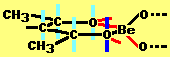
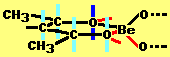
The combination of covalent and coordination bonding allow beryllium to form a special type of compounds when other appropriate factors are present. Example, beryllium acetylacetonate, Be(-O-C(CH3)=CH-C(CH3)=O)2
 |
◄`► |  |
||
 p−orbitals with two electrons p−orbitals with two electrons p−orbitals with one electron which overlaps with the adjacent p−orbital to from a π−bond p−orbitals with one electron which overlaps with the adjacent p−orbital to from a π−bond sp�−orbital with two electrons sp�−orbital with two electrons sp�−orbital forming a σ−bond sp�−orbital forming a σ−bond | ||||
Note: The compound has a tetrahedral structure. The illustration shows only one of the acetylacetonate groups, the other group is similar and is represented partially by two attached oxygens.
Quantum Mechanics provided us with the orbitals and hybrid-orbitals. It does not restrict the electrons in the molecule to confine itself to a particular centre. The electron can move throughout the molecule on condition that they do not demand a change in the structure of the molecule.
Experiment results showed that it is not possible to differentiate between covalent and coordination bonds by the two oxygens of the acetylacetonate groups, to beryllium. For example, the covalent bond should be stronger and the coordination bond weaker. So the bond distance between the oxygen and the beryllium for a covalent bond should be shorter than that of the coordination bond. Experiments showed that both bonds have the same length.
The explanation put forward was the electrons from the p-orbitals circulate non-stop throughout the flat structure provided by the acetylacetonate-beryllium arrangement. In chemistry such movement of electrons impart an added stability to the bond. This is referred to as resonance stabilisation of the bond.
The resulting compound of such a covalent-coordination system of bonds is then referred to as a chelated compound. For beryllium to form chelated compounds the structure of the coordination must be correct and there must be a system of p-orbitals to allow the movement of electrons around the system, passing through the covalent and coordination bonds. More
