Molecular formula mass is the mass of one molecule in a.u.m. or in relative units. Formula mass is the molecular mass calculated by molecular formula for substances, which do not consist of molecules.
M(Aa Bb) = a x Am(A) + b x Am(B).
M is molecular mass, Am is atomic mass, A and B are elements, a and b are number of elements in the molecule.
1mole is number of particle equal to 6.02 x 10²³.
NA=6.02 x 10²³ 1/mole. NA is Avogadro’s number.
If you know number of moles and Avogadro’s number (which is constant), you can find number of particles.
N = n x NA.
N is number of particles, n is number of moles.
Mass of one mole of substance is called molar mass. It is equal by value to molecular mass and expressed in g/mole.
M(H2O)=18, M(H2O)=18 g/mole. M is molar mass.
If you know mass of a sample and molar mass, you can find number of moles for this sample.
n = m/M.
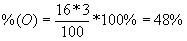
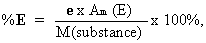
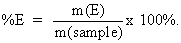
To find mass percentage of an element in a substance you should use following formulas
where E is an element and e is its subscript in the molecule;
Example: Find percentage of oxygen in calcium carbonate.
Calcium carbonate has the following molecular formula: CaCO3.
M(CaCO3)=40+12+16*3=100;