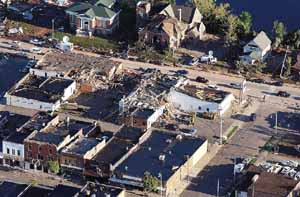
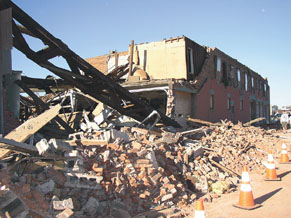
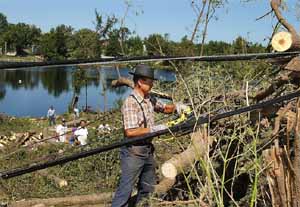
| In times of chaos. . . Ladysmith is usually a quiet, peaceful little town nestled in the woods by the river. A returning visitor would not recognize the town as it is today, as he would first come upon the roaring of chain saws and the aro- matic smell of pine that seemed to invade the entire town. It would not be the noises or smells that would shock the visitor, but the horrendous sights he would witness. Around four PM on Labor Day, 2002, a raging torrent of fury ripped through the small town's lazy afternoon and uprooted not only massive trees, but also the lives of many people. The tornado left many injured and even more homeless, but thankfully everyone escaped with their lives. Its path wound around and destroyed 3 by 14 block chunk of downtown Ladysmith, leaving devastation and confusion in its wake. "No doubt, I thought, this is it! I'm gonna die now!" Said a little old and now homeless lady named Gloria Volkmann. This silver-haired lady was at home when the tornado struck her house, walking into her living room. "There was glass flying," she stated. Her bedroom window had been blown out, and the magnificent winds ripped the clothing out of her closet and tossed them around her bedroom. "There was the worst howling sound," she recalled. She remembered how black it was outside, and realized that the black was now stained on her walls. Her house, like so many others, is literally unlivable. The garage was demolished beyon recognition, strewn across her yard and the street. She is camping in a trailer in Chippewa Falls now as she waits for her life to calm down. I met an old acquaintance, Dor, sitting on the curb resting her tired feet. She was a volunteer, one among many hundreds who came to help out however they could. Volunteers streamed to Ladysmith from all over Wisconsin, some even from Minnesota. They ranged from Superior and Washburn, to Rice Lake, Eau Claire and Minneapolis, and many other places. "This place was a disaster," she stated blatantly. "There were ladders in trees and cars upside down on their hoods." Volunteers from Bruce's Red Cross were hosting over 30 elderly and a few families with small children in the High School Gym- people left completely homeless because of the storm. As she told me this, a veteran perched on a near-by weather-worn stoop began to forlornly play Taps. I walked down the debris-stricken trees amongst piles of broken and useless rubble that was once people's belongings. I thought to myself, "I couldn't even begin to imagine what these people are going through," and I snapped another picture. A man wearing yellow Carharts and driving a red Polaris 4-wheeler drove up to us and offered some water. His name is Mel Vanwy from Hayward, a long-time graduate of Cornell High School. He was yet another volunteer working through the affliction. He was a witness, driving on Hwy 27 when he saw tornado rip through the town. "I hit the skids," he remembered, "hoping that it wouldn't come my way." He had actually been paged to go to Ladysmith because the threat of a tornado "seemed eminent". Being only three minutes away, he narrowly missed the twister. "People really bonded together in this time of crisis," he reflected. "It's really amazing. Too bad it can't always be that way." I couldn't disagree with him. Before he left, he remarked, "Insurance companies are going to have a field day." Further along on my journey, I noticed an old man looking solemnly at the remains of what had been his home across from the now-destroyed feed mill (1940) for the past 61 years. We walked up to him and his son-in-law, Ken Brown, a member of Ladysmith's City Council. Joe Brucek, 86, and his wife Lois, 83, were at Cornell's Brunet Park when the storm was busy ravaging their home. They returned home to find their yard in shambles and their roof entirely ripped off. The house was crooked, as if someone had stuck a giant corkscrew inside of it and twisted it a few times, and the once-lovely and welcoming blue siding was now unrecognizable with the encrusted dirt permanently ground into it. He told of how overwhelmed they were at the clutter in their yard, and then the relief they felt as twenty or thirty volunteers came down the road and started cleaning up. "Isn't that something," commented Ken as a busload of volunteers heading home passed by their house. The bus read Eau Claire Transportation. When asked what he was going to do now, Joe smiled solemnly and answered, "That's a good question." His eyes shifted back to his yard and house. Ken commented, "We are just thankful that nobody was here. It looks like a war zone." They are planning on re-building. First, there was the sound of an out-of-control freight train, and then the sirens began to wail. By the time the sirens had sounded the tornado already over. It lasted no longer than a minute, but left massacres to last a lifetime. The firehouse was so damaged that the fire trucks could not be accessed. "They still have not found them," remarked Ken. "And the tornado never showed up on National Radar." I found myself standing underneath 2 down power lines as I interviewed Mary Morgan. Her house, also, was totally destroyed. There were five or six children running around the ruins. "We were at the IGA shopping when it hit," Mary said. "There was a big roar and the power went out." They returned home to find that they didn't have a home. "We had to tell the kids what happened. We'll survive. There's not much else you can do." Bill and Mary Morgan plan to rebuild. Uncountable houses were destroyed in this tumult of nature. Many other buildings were destroyed as well. It is this author's opinion that God saved the lives of the people of this disaster. Many businesses were destroyed-completely wiped out-but the buildings stood empty due to the holiday. The Davis Motel, a historical landmark, no longer has a roof. The Subway restaurant is damaged and out of commission for quite some time. The City Hall, newly finished of remodeling, was also damaged and has no windows. A church is destroyed forever, and the old Free-Library, now a bead and breakfast owned by the mayor, was hit as well. There were gas stations ripped apart-even the roof to the Gilman High School was tore off. We walked up to a police officer from Superior, Officer Champaign. He was one of twelve officers from Superior there that day, and he foretold of more officers to come. Each police officer worked a twelve-hour shift, and was paid minimal wages for their heroic supervision of the town in this time of urgency. "I didn't make it to the siren," Champaign said, "But I made it here." |
 |
 |
 |
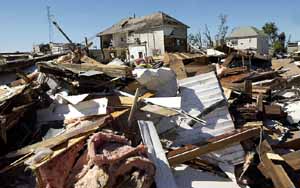 |
| Ladysmith, Wisconsin, September 2nd, 2002 |